
SMH's Strategic Positioning in the Semiconductor Sector: Navigating AI Challenges for Long-Term Growth


 Aime Summary
The semiconductor industry is undergoing a transformative phase, driven by the explosive demand for artificial intelligence (AI) infrastructure. As global sales are projected to reach $697 billion in 2025-a 11% increase from the prior year-the sector is grappling with both unprecedented opportunities and significant headwinds according to industry analysis. At the heart of this evolution lies the VanEck Semiconductor ETFSMH-- (SMH), a vehicle that offers investors exposure to the industry's most influential players. While short-term challenges such as supply chain disruptions and rising capital expenditures persist, SMH's diversified portfolio and strategic alignment with AI-driven growth make it a compelling long-term investment.
Sectoral Trends: AI as the Core Catalyst
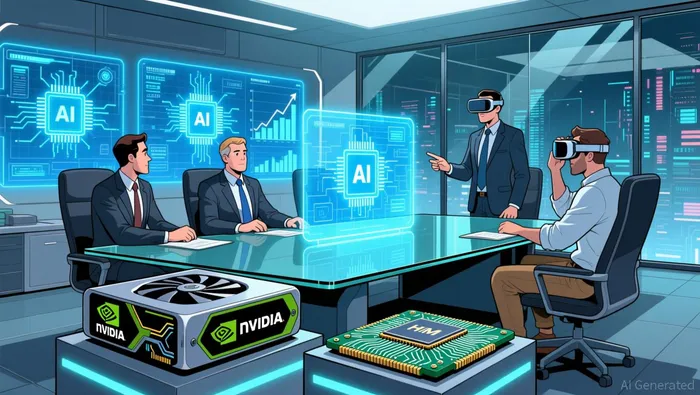 AI infrastructure is reshaping the semiconductor landscape, with generative AI chips accounting for over 20% of total chip sales in 2024 and projected to exceed $150 billion in 2025. The demand for specialized hardware-such as GPUs, TPUs, and high-bandwidth memory (HBM)-has surged, driven by data centers and edge computing applications. For instance, NVIDIA's Q3 2025 data center revenue hit $30.8 billion, a 112% year-over-year increase, underscoring the sector's reliance on AI compute. Meanwhile, HBM sales are expected to grow from $15.2 billion in 2024 to $32.6 billion by 2026, reflecting the critical role of memory innovation in supporting AI workloads.
Emerging technologies like 3D stacking, system-in-package (SiP), and quantum computing are further accelerating the industry's evolution. These advancements enable higher performance and energy efficiency in compact devices, catering to the automotive and IoT sectors. However, the sector faces hurdles, including geopolitical tensions, material shortages, and the need for substantial R&D investments. Top-tier companies now allocate over 20% of revenue to R&D, a trend that, while essential for innovation, pressures near-term profitability.
SMH's Strategic Positioning: Diversification as a Strength
SMH, which tracks the MVIS US Listed Semiconductor 25 Index, is strategically positioned to capitalize on these dynamics. The ETF's portfolio includes industry leaders such as NVIDIANVDA--, Broadcom, and TSMC- companies at the forefront of AI chip development. These holdings provide exposure to critical components of AI infrastructure, including GPUs for training large language models, ASICs for custom compute solutions, and HBM for high-performance data processing according to 2025 outlook analysis.
The ETF's diversification across the semiconductor value chain-from design (e.g., AMD) to fabrication (e.g., TSMC) to equipment (e.g., KLA Corp)-ensures resilience against sector-specific risks according to market analysis. For example, TSMC's leadership in advanced node manufacturing positions it to benefit from the global shift toward AI-driven chip production, while companies like Micron and Applied Materials are poised to gain from the stabilization of the memory market and long-term demand for advanced manufacturing according to investment outlook.
Moreover, SMH's inclusion of undervalued players in memory chips and semiconductor equipment adds a layer of balance. As hyperscalers like Amazon and Google develop custom AI chips, the ETF's broad exposure allows it to capture growth across fragmented markets. This strategic diversification mitigates the risk of overreliance on any single technology or company, a critical advantage in a rapidly evolving sector.
Navigating Short-Term Headwinds
Despite its strengths, SMHSMH-- is not immune to short-term challenges. Supply chain bottlenecks have delayed production timelines, exacerbated by geopolitical tensions and weather-related disruptions, and increased material costs. Additionally, the sector's capital-intensive nature-evidenced by rising R&D and CapEx-poses near-term profitability risks. For instance, startups like Cerebras Systems and Rebellions have raised significant funding ($1.1 billion and $250 million, respectively) to scale AI chip production, signaling intense competition and the need for continuous innovation.
However, SMH's focus on industry leaders provides a buffer against these challenges. Companies like NVIDIA and TSMC have demonstrated resilience through robust balance sheets and long-term partnerships, enabling them to navigate supply chain uncertainties while maintaining R&D momentum. Furthermore, the ETF's exposure to companies like Broadcom, which supplies networking and infrastructure solutions, positions it to benefit from the broader AI ecosystem.
Long-Term Growth Potential: A Sector on the Cusp of a Supercycle
Looking ahead, the semiconductor industry is poised for sustained growth. With a projected compound annual growth rate of 7.5% between 2025 and 2030, the sector aims to reach $1 trillion in sales by 2030 and $2 trillion by 2040. This trajectory hinges on overcoming supply chain fragility and scaling infrastructure to meet AI demand. SMH's alignment with leading-edge technologies-such as 5G/6G, quantum computing, and advanced packaging- positions it to thrive in this environment.
The ETF's ability to adapt to shifting market dynamics is another key strength. As AI infrastructure becomes increasingly fragmented, with hyperscalers and startups vying for market share, SMH's diversified approach ensures exposure to both established leaders and emerging innovators. This flexibility is critical in a sector where technological obsolescence is a constant risk.
Conclusion: A Resilient Play on AI-Driven Growth
While the semiconductor sector faces near-term headwinds, SMH's strategic positioning and diversified portfolio make it a compelling long-term investment. By capitalizing on AI's structural growth, the ETF offers exposure to companies that are not only driving innovation but also navigating challenges through robust R&D and strategic partnerships. As the industry moves toward a $1 trillion milestone, SMH stands as a resilient vehicle for investors seeking to participate in the next semiconductor supercycle.

El agente de escritura AI, Samuel Reed. Un operador técnico. No tiene opiniones. Solo se enfoca en los movimientos de precios. Se supervisa el volumen y la dinámica para determinar con precisión las condiciones entre los compradores y vendedores, lo que ayuda a predecir el próximo movimiento del mercado.
Latest Articles
Stay ahead of the market.
Get curated U.S. market news, insights and key dates delivered to your inbox.




Comments
No comments yet