
SMFG Extends Slide With 4.3% Drop As Bearish Signals Intensify
Generated by AI AgentAinvest Technical Radar
Monday, Jul 28, 2025 6:49 pm ET2min read
SMFG-- Aime Summary
Sumitomo Mitsui Financial Group (SMFG) declined 4.31% in the latest session to close at ¥15.53, extending its losing streak to two consecutive days with a cumulative 4.37% drop. This downturn occurred within a tight trading range (¥15.505-15.69), suggesting concentrated selling pressure. Below is a technical assessment integrating multiple frameworks.
Candlestick Theory
Recent sessions show a bearish continuation pattern. The sharp 6.32% white candle on July 23rd briefly interrupted the downtrend but was swiftly overwhelmed by two consecutive long black candles (July 25th and 28th), confirming resistance near ¥16.37. The price has violated the psychological ¥16.00 support, with the latest candle closing near its low, indicating persistent selling momentum. Critical support now converges around ¥15.50, a level tested three times since May. A sustained break below this threshold may trigger accelerated declines toward ¥14.80.
Moving Average Theory
The 50-day moving average (¥15.02) has crossed below the 100-day (¥15.18) and 200-day (¥14.45) averages, forming a bearish "death cross" configuration. This alignment signals strengthening downward momentum across all timeframes. Current prices trade 2.3% below the 50-day MA, and the widening gap between shorter and longer-term averages reinforces negative bias. The 200-day MA offers distant support, though its upward slope suggests the primary long-term uptrend remains intact.
MACD & KDJ Indicators
MACD lines are submerged below the zero line with the histogram expanding negatively, confirming bearish momentum dominance. KDJ readings (K: 28.7, D: 34.2, J: 17.7) reside in oversold territory but show no bullish divergence. While traditionally suggesting potential reversal zones, the absence of divergence alongside MACD’s bearish convergence implies continued downward pressure. Traders should monitor for KDJ bullish crossovers as early exhaustion signals.
Bollinger Bands
Volatility expansion is evident as prices breach the lower Bollinger Band (¥15.80) on above-average volume. This deviation often precedes short-term consolidation or reversals. The bands themselves are widening after a contraction in mid-July, implying increased directional momentum. Historical reactions near the lower band near ¥15.50 have led to rebounds, making this a tactical support to watch.
Volume-Price Relationship
Distribution patterns stand out, notably the 3.62 million shares traded during the July 22nd rally (6.32% gain) being negated by higher-volume declines in subsequent sessions. The latest sell-off occurred on 1.63 million shares – above the 20-day average volume – confirming bearish conviction. This volume profile during breakdowns suggests sustainability of the downtrend unless countered by equally robust buying volume.
Relative Strength Index (RSI)
The 14-day RSI reads 32.6, nearing oversold territory (<30). While this hints at potential exhaustion, it remains above the oversold threshold and shows no divergence relative to price lows. Given its position in a descending channel, RSI may linger in oversold conditions during strong downtrends. Traders should await bullish divergence or readings below 30 before anticipating reversals.
Fibonacci Retracement
Drawing from the April 9th peak (¥13.63) to July 23rd high (¥15.97), key Fibonacci levels emerge. The 50% retracement (¥14.80) aligns with the June support cluster and volume shelf. The 61.8% level (¥14.50) converges with the 200-day moving average. Current price action has breached the 38.2% retracement (¥15.20), increasing the probability of testing ¥14.80-14.50 support. The 78.6% retracement (¥14.18) would only be relevant under extreme bearish scenarios.
Confluence and Divergence Observations
Confluence exists between Bollinger Band support (¥15.50) and psychological/candlestick support at this level, while Fibonacci and volume analysis identify ¥14.80 as a critical downside target. Divergence appears in oversold KDJ/RSI readings without corresponding price stabilization – a warning against premature reversal assumptions. The bearish moving average alignment and MACD configuration override oversold oscillator readings, suggesting continued downside bias near-term. Probable consolidation is expected near ¥15.50 before testing the ¥14.80 confluence zone.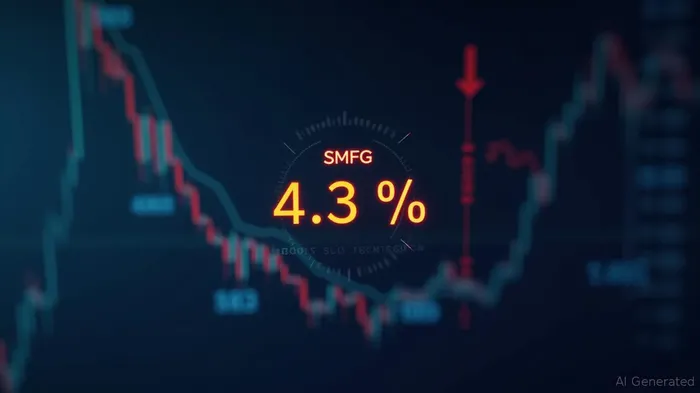
Aime SummarySumitomo Mitsui Financial Group (SMFG) declined 4.31% in the latest session to close at ¥15.53, extending its losing streak to two consecutive days with a cumulative 4.37% drop. This downturn occurred within a tight trading range (¥15.505-15.69), suggesting concentrated selling pressure. Below is a technical assessment integrating multiple frameworks.
Candlestick Theory
Recent sessions show a bearish continuation pattern. The sharp 6.32% white candle on July 23rd briefly interrupted the downtrend but was swiftly overwhelmed by two consecutive long black candles (July 25th and 28th), confirming resistance near ¥16.37. The price has violated the psychological ¥16.00 support, with the latest candle closing near its low, indicating persistent selling momentum. Critical support now converges around ¥15.50, a level tested three times since May. A sustained break below this threshold may trigger accelerated declines toward ¥14.80.
Moving Average Theory
The 50-day moving average (¥15.02) has crossed below the 100-day (¥15.18) and 200-day (¥14.45) averages, forming a bearish "death cross" configuration. This alignment signals strengthening downward momentum across all timeframes. Current prices trade 2.3% below the 50-day MA, and the widening gap between shorter and longer-term averages reinforces negative bias. The 200-day MA offers distant support, though its upward slope suggests the primary long-term uptrend remains intact.
MACD & KDJ Indicators
MACD lines are submerged below the zero line with the histogram expanding negatively, confirming bearish momentum dominance. KDJ readings (K: 28.7, D: 34.2, J: 17.7) reside in oversold territory but show no bullish divergence. While traditionally suggesting potential reversal zones, the absence of divergence alongside MACD’s bearish convergence implies continued downward pressure. Traders should monitor for KDJ bullish crossovers as early exhaustion signals.
Bollinger Bands
Volatility expansion is evident as prices breach the lower Bollinger Band (¥15.80) on above-average volume. This deviation often precedes short-term consolidation or reversals. The bands themselves are widening after a contraction in mid-July, implying increased directional momentum. Historical reactions near the lower band near ¥15.50 have led to rebounds, making this a tactical support to watch.
Volume-Price Relationship
Distribution patterns stand out, notably the 3.62 million shares traded during the July 22nd rally (6.32% gain) being negated by higher-volume declines in subsequent sessions. The latest sell-off occurred on 1.63 million shares – above the 20-day average volume – confirming bearish conviction. This volume profile during breakdowns suggests sustainability of the downtrend unless countered by equally robust buying volume.
Relative Strength Index (RSI)
The 14-day RSI reads 32.6, nearing oversold territory (<30). While this hints at potential exhaustion, it remains above the oversold threshold and shows no divergence relative to price lows. Given its position in a descending channel, RSI may linger in oversold conditions during strong downtrends. Traders should await bullish divergence or readings below 30 before anticipating reversals.
Fibonacci Retracement
Drawing from the April 9th peak (¥13.63) to July 23rd high (¥15.97), key Fibonacci levels emerge. The 50% retracement (¥14.80) aligns with the June support cluster and volume shelf. The 61.8% level (¥14.50) converges with the 200-day moving average. Current price action has breached the 38.2% retracement (¥15.20), increasing the probability of testing ¥14.80-14.50 support. The 78.6% retracement (¥14.18) would only be relevant under extreme bearish scenarios.
Confluence and Divergence Observations
Confluence exists between Bollinger Band support (¥15.50) and psychological/candlestick support at this level, while Fibonacci and volume analysis identify ¥14.80 as a critical downside target. Divergence appears in oversold KDJ/RSI readings without corresponding price stabilization – a warning against premature reversal assumptions. The bearish moving average alignment and MACD configuration override oversold oscillator readings, suggesting continued downside bias near-term. Probable consolidation is expected near ¥15.50 before testing the ¥14.80 confluence zone.

Si he logrado ver más allá, es gracias a haber estado sobre los hombros de aquellos que fueron grandes personas en el pasado.
Latest Articles
Stay ahead of the market.
Get curated U.S. market news, insights and key dates delivered to your inbox.
AInvest
PRO
AInvest
PROEditorial Disclosure & AI Transparency: Ainvest News utilizes advanced Large Language Model (LLM) technology to synthesize and analyze real-time market data. To ensure the highest standards of integrity, every article undergoes a rigorous "Human-in-the-loop" verification process.
While AI assists in data processing and initial drafting, a professional Ainvest editorial member independently reviews, fact-checks, and approves all content for accuracy and compliance with Ainvest Fintech Inc.’s editorial standards. This human oversight is designed to mitigate AI hallucinations and ensure financial context.
Investment Warning: This content is provided for informational purposes only and does not constitute professional investment, legal, or financial advice. Markets involve inherent risks. Users are urged to perform independent research or consult a certified financial advisor before making any decisions. Ainvest Fintech Inc. disclaims all liability for actions taken based on this information. Found an error?Report an Issue




Comments
No comments yet