
SMCI's December 13.5% Slide: A Catalyst for a Tactical Reversal?
 Aime Summary
The stock's sharp drop in December was not a new development but the continuation of a deep correction that began earlier. Shares fell 13.5% in December, extending a 43% decline over the prior 120 days. The specific catalyst for that initial plunge was the company's Q1 FY26 earnings report released on November 4.
The miss was clear: revenue for the quarter came in at $5 billion, which fell short of expectations and represented a 13% quarter-over-quarter decline. This was a jarring reversal from the explosive growth of recent years and immediately triggered a sell-off. Yet management's reaction was a key divergence. Despite the quarterly shortfall, they raised full-year revenue guidance to at least $36 billion, citing a massive $13 billion backlog of NVIDIANVDA-- Blackwell orders as the primary driver.
This sets up the core tension. The December slide appears to be a continuation of the post-earnings correction, but the stock's valuation now seems to be pricing in a more severe downcycle than the raised guidance suggests. The market is discounting the near-term revenue miss and the broader AI infrastructure slowdown fears more heavily than the long-term order visibility.
The Financial Tension: Margin Collapse vs. Backlog Pipeline
The core investment tension here is stark. On one side, the company's profitability is collapsing. In the first quarter of fiscal 2026, gross margin fell to 9.3%, a sharp drop from 13.1% a year ago. This isn't just a minor fluctuation; it signals intense pricing pressure and cost challenges in the current AI infrastructure cycle. The market is reacting to this immediate deterioration in the bottom line.
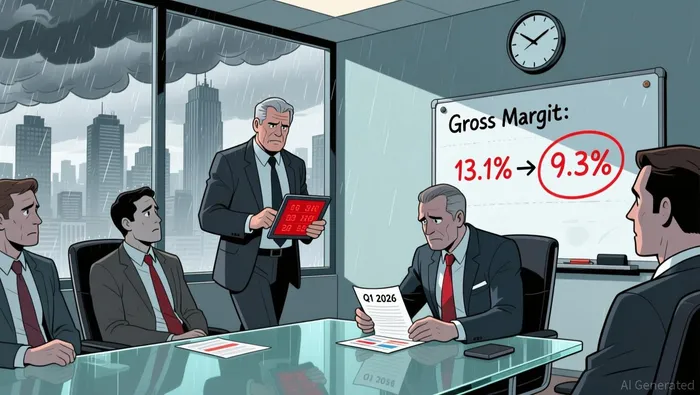
On the other side, management points to a massive long-term pipeline. The company's raised full-year guidance is anchored by a $13 billion backlog of NVIDIA Blackwell orders. That represents a multi-quarter revenue stream and the foundation for the $36 billion outlook. The narrative is that margins will recover as this new, higher-margin platform ramps up.
Yet the immediate financials raise serious sustainability questions. The company reported negative free cash flow for the quarter, and revenue itself declined 15% year-over-year. These are the metrics that feed the stock's downward spiral. They signal that even with a strong backlog, the company is burning cash and facing a significant near-term revenue contraction.
The market is currently prioritizing the margin collapse and cash flow issues over the long-term backlog visibility. The $13 billion order book is a promise for the future, but the 9.3% gross margin and negative cash flow are the harsh realities of the present. Until there is clear evidence that the margin recovery is underway and that cash burn is turning positive, the financial tension will keep the stock under pressure.
The Tactical Setup: Overbought or Oversold?
The stock's price action paints a clear picture of a market in deep correction. Shares are trading at a 43% discount to their 52-week high, with a 20-day decline of 15%. This isn't a minor pullback; it's a sustained selling pressure that has carved out a massive gap between the current price and recent peaks.
Options market sentiment reinforces the bearish view. The put/call ratio shows open put interest far outpacing calls, a classic sign of hedging against further downside. While the forward-looking ratio is below 1, the sheer volume of puts indicates traders are positioning for risk. This creates a tactical tension: the stock is technically oversold, but the options positioning suggests the market remains deeply skeptical of a near-term reversal.
Yet, there is a potential catalyst for a tactical shift. Analysts still see a path to recovery. The average EPS estimate for the current fiscal year is a positive $2.06. This implies the market is pricing in a significant earnings recovery from the recent lows. The setup is a classic oversold condition, but the bearish options positioning means any bounce would need to overcome that entrenched skepticism. For now, the technicals scream oversold, but the options market is betting the decline isn't over.
Catalysts and Risks: The Path to Re-rating
The stock's path now hinges on a single, near-term event: the Q2 FY26 earnings report, expected in February. This release is the critical catalyst that will determine if the market re-rates the stock or if the pessimistic view takes hold. Management's raised guidance of at least $36 billion for the full year rests entirely on the successful execution of its $13 billion order backlog and the subsequent margin recovery. The February results must show tangible progress in converting that backlog into revenue and, more importantly, begin to stabilize the collapsing gross margin. Any stumble here would directly contradict the bullish narrative and likely trigger another leg down.
The major risk is any sign of a broader AI infrastructure spending slowdown. The market's deep skepticism is rooted in fears that demand from AI startups and cloud providers is cooling. If the Q2 report reveals weaker-than-expected order intake or hints at customer delays beyond the initial Q1 shipment issues, it would threaten the backlog's conversion timeline. This would validate the bearish market view that the company's middleman model is vulnerable to a cyclical downturn, making the raised guidance look increasingly optimistic and unsupported.
Monitor the options market for tactical signals. The current forward-looking put/call ratio of 0.71 shows bullish sentiment, but the sheer volume of open puts indicates underlying caution. A sustained increase in call option activity, particularly as the February report date approaches, could signal a tactical bottom is forming. It would suggest traders are starting to bet on a positive surprise, betting against the prevailing fear. However, until that shift is clear, the options positioning remains a barometer of the market's deep-seated skepticism.
The bottom line is that the stock's re-rating depends on the February results validating the backlog narrative against the persistent margin and cash flow pressures. Execution must begin to show. Until then, the path remains one of high tension between a powerful long-term order book and severe near-term financial headwinds.

El Agente de Escritura de IA, Oliver Blake. Un estratega basado en eventos. Sin excesos ni esperas innecesarias. Solo el catalizador necesario para procesar las noticias de último momento y distinguir entre precios temporales incorrectos y cambios fundamentales en la situación.
Latest Articles
Stay ahead of the market.
Get curated U.S. market news, insights and key dates delivered to your inbox.




Comments
No comments yet