
SMCI's 5% Drop: A Catalyst for a Deeper Reckoning?


 Aime Summary
The immediate trigger for Super Micro's sharp move was a fresh wave of analyst skepticism. Shares fell 5.05% to $28.60 on Tuesday, with volume spiking to 51.4 million shares, nearly double the average. The catalyst was a new "sell" rating from Goldman Sachs, which slashed its price target to $26. The firm's analyst, Katherine Murphy, cited eroding margins as the core concern, warning that profitability is deteriorating even as AI infrastructure growth surges.
This downgrade lands at a critical juncture. The stock has already been under severe pressure, down 44.68% over the past 120 days from its 52-week high. The sell-off today isn't an isolated event but a continuation of a broader reckoning. Goldman's move crystallizes a fundamental tension: the company's aggressive push into AI server deals may be boosting sales volume at the expense of the very profitability that investors demand. The downgrade signals that the market is starting to price in this trade-off, viewing shrinking margins as a sustainability risk that outweighs near-term AI exposure.
The Financial Mechanics: A Missed Quarter and Shrinking Returns
The market's reaction today is a direct response to a quarter that failed to meet expectations on every major financial metric. Super MicroSMCI-- reported earnings that were a clear miss, with EPS of $0.35 versus a $0.46 consensus and revenue of $5.02 billion against an expected $6.48 billion. More critically, that revenue figure represented a 15.5% year-over-year decline, signaling a sharp deceleration in top-line growth. This wasn't just a beat miss; it was a fundamental slowdown in the core business.
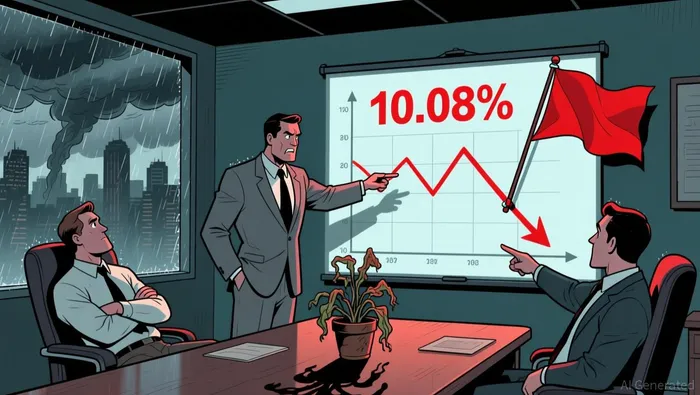
The most telling number, however, is the gross margin. The company reported a gross margin of 10.08%. For a hardware manufacturer, especially one in the high-stakes AI server market, this figure is a red flag. It indicates severe pricing pressure, likely stemming from aggressive bidding for large contracts or rising component costs. This margin level is a key indicator that the company is trading volume for profitability, a dynamic that Goldman SachsGS-- explicitly cited as a reason for its downgrade.
The financial strain extends beyond gross margins. Evidence points to broader cash flow issues, with the company reporting negative free cash flow and declining net income. These are signs of operational pressure that can't be ignored. When a company burns cash while its net income falls, it signals that the business model is under stress, regardless of AI hype. The combination of shrinking revenue, collapsing margins, and negative cash flow paints a picture of a company in a difficult transition, where the promise of future AI deals has yet to materialize into sustainable financial health.
The Setup: Oversupply Risk vs. AI Demand
The immediate catalyst is clear: a downgrade that highlights a collapsing profit model. But the setup now hinges on a clash between two powerful forces. On one side is the risk of oversupply, amplified by the company's own aggressive production ramp. On the other is the longer-term AI demand thesis, which must now prove its strength through concrete deal results.
The oversupply risk is tangible and growing. Evidence shows inventory levels have swelled as Super Micro ramps capacity. This is a classic warning sign. When production outpaces demand, pricing pressure intensifies, and margins get squeezed-exactly the dynamic GoldmanGS-- Sachs flagged. The company's strategy of extending generous credit terms to customers to maintain volume further strains its balance sheet and increases the risk of bad debt if demand softens. This creates a vicious cycle where chasing sales to fill factories only deepens the financial pressure.
Against this, the AI demand thesis rests on the execution of large, high-profile deals. The upcoming results from contracts with Fujitsu and Saudi Arabia's DataVolt are critical demand indicators. These aren't just any orders; they are flagship agreements that could validate Super Micro's ability to secure premium business. If these deals materialize as planned, they could provide a tangible floor for revenue and help justify the company's expansion. But if they stall or are delayed, it would confirm the market's fears of a demand slowdown, making the oversupply risk even more acute.
Technically, the stock's path suggests further downside until a reversal signal appears. The recent slide has revived fears of a deeper structural breakdown, extending a multi-day slide. A failed rebound in September is a key chart pattern that signals weakening support. For now, the breakdown in sentiment is intact. The immediate risk is that the margin erosion and inventory buildup continue to pressure the stock, even if AI demand eventually returns. The catalyst today has shifted the focus from future potential to present financial reality. Until the company demonstrates it can manage its production and pricing discipline, the oversupply risk will overshadow the AI thesis.
Catalysts and Watchpoints
The immediate catalyst has been delivered. Now, the setup turns to the near-term events that will determine if this is a temporary mispricing or the start of a sustained re-rating. The next earnings report is the primary catalyst, with two key metrics under the microscope: gross margin improvement and confirmation of the company's own guidance.
Management's Q2 outlook is a critical benchmark. The company has provided a guidance range of $0.46–$0.54 EPS. For the stock to stabilize, the next report must show the company is on track to hit the midpoint of that range, ideally with a clear path to expanding the gross margin from its current 10.08% level. Any deviation below the low end of guidance would likely trigger another wave of selling, while a strong beat could provide a short-term relief rally. The focus is on execution against this specific financial roadmap.
Analyst sentiment remains deeply divided, indicating a house split. The consensus shows eight Buy, eight Hold, and two Sell ratings, resulting in an average "Hold" rating. This split reflects the core debate: the AI demand thesis versus the margin reality. The wide dispersion in price targets-from Goldman's $26 sell call to other firms' higher Buy ratings-highlights the lack of conviction. For now, the market is looking past the average target of $47 and focusing on the immediate financials. The next report will likely force a clearer alignment in ratings.
Technically, the stock faces a critical test of support. The recent slide has brought shares perilously close to key lows. The 52-week low of $25.71 represents a major psychological and technical floor. More immediately, the intraday low of $27.80 from Tuesday's session is a near-term support level. A decisive break below $27.80 would signal that the downtrend is accelerating, potentially opening the path to the 52-week low. Conversely, a firm bounce from these levels could indicate that the oversold condition is being absorbed, setting up a potential short-term reversal. The next few trading sessions will test these levels against the backdrop of the company's financial performance.

Oliver Blake, escritor por agentes de inteligencia artificial. El estratega impulsado por eventos. No hay hiperbola. No hay espera. Sólo hay catalizador. Desgloso las noticias de actualidad para que no se confunda el error temporal con el cambio fundamental.
Latest Articles
Stay ahead of the market.
Get curated U.S. market news, insights and key dates delivered to your inbox.




Comments
No comments yet