
What the Smart Money is Actually Doing: January Insider Moves to Watch


 Aime Summary
Forget the headlines. The only signal that matters is what insiders are doing with their own money. In a real-time snapshot from January 2026, the data tells a clear story of alignment and warning.
On one side, you have skin in the game. At Agree RealtyADC--, the Executive Chairman, Richard Agree, bought 24,000 shares for an estimated $1.7 million just last week. This isn't a one-off; the company's entire insider team has been a consistent buyer, with 9 purchases and 0 sales in the past six months. When the people running the company are putting their cash down, it's a bullish vote for the stock's trajectory.
On the other side, you have a stark warning. The move at NvidiaNVDA-- is a classic bearish whale signal. A director sold a $44 million stake-a position held since 1997, long before the AI boom. This is a massive, pre-bubble exit. It's the kind of sale that screams "I've made my money, and the risk/reward has shifted." It's not a reaction to today's news; it's a calculated move by someone who knows the company's inner workings better than any analyst.
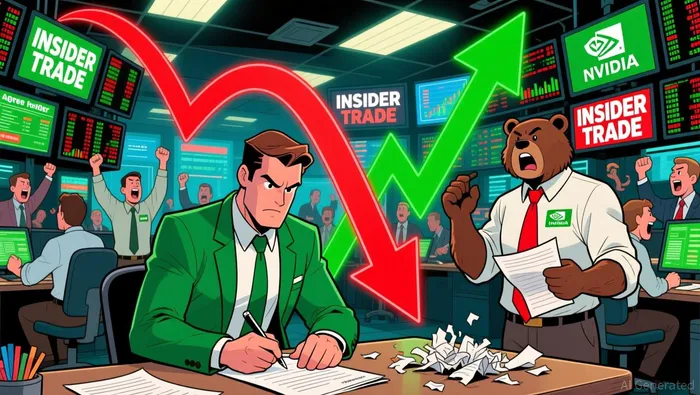
The options market for JPMorgan ChaseJPM-- shows a similar bearish tilt. While the stock trades around $325, 48% of recent options trades are bearish puts. That's a whale wallet betting against the bank. It's a powerful counter-narrative to the bullish analyst targets, showing that the smart money isn't just talking-they're hedging.
The bottom line is simple. In January, the smart money is buying into a steady operator, selling out of a legacy giant, and betting against a financial titan. That's the real setup. Ignore the hype; follow the filings.
The Accumulation Play: Institutional Wallets Moving
When a hedge fund adds aggressively into a falling stock, it's rarely about momentum - it's about conviction. That's what's drawing attention to Chewy Inc (NYSE:CHWY), after Viking Global Investors, led by Andreas Halvorsen, sharply increased its position. The move is a textbook example of smart-money accumulation.
In late December, Viking boosted its stake in Chewy by nearly 147%, adding more than 8 million shares. The scale is notable: the total position is now valued at around $437 million. This wasn't a casual dip. The fund piled in as the stock traded near its 52-week lows, a clear signal that Viking sees a disconnect between the price and the durability of Chewy's subscription business.
This is the Wyckoff Accumulation pattern in action. Large investors like Viking cannot simply buy millions of shares at once without driving the price up and increasing their own cost. Instead, they build positions gradually, often within a tight trading range. The goal is to absorb selling pressure quietly, masking the accumulation so the market doesn't rally prematurely. Viking's move fits this script perfectly - a massive, calculated add at depressed levels, suggesting the fund is betting that Chewy's downside is limited and that fundamentals will eventually support a higher price.
The bottom line is that this is a smart-money accumulation story, not a momentum trade. Viking's average buy price sits above current levels, reinforcing the idea that this is a multi-quarter bet, not a quick flip. For investors, it frames Chewy as a patient play, where the real signal isn't the headline, but the whale wallet quietly building its position.
The Distribution Warning: When Insiders Sell
While accumulation signals are bullish, distribution warnings are just as critical. They often mark the start of a shift in sentiment, where insiders begin to take money off the table. Two contrasting cases from today illustrate this perfectly.
First, the warning sign. At UiPath, CEO Dines Daniel filed a Form 4 on January 13, 2026, reporting the sale of 45,000 shares for $17.18 each. The timing is notable: the transaction date is listed as the same day the filing was made. This is a classic early-transaction-date sale, which often signals a deliberate, pre-planned exit. For a CEO to sell a significant block while still in the role is a red flag. It suggests he is locking in gains, potentially seeing limited near-term upside or greater risk in the stock. This is the kind of move that often precedes a distribution phase, where insiders begin to reduce their exposure.
On the flip side, you have a powerful bullish signal. At AKTIS Oncology, the pattern is the opposite. Insiders have made six consecutive open-market purchases totaling over $67 million in the past six months. That's a sustained, coordinated buying spree with zero sales. This isn't a one-time dip buy; it's a multi-month accumulation by those with intimate knowledge of the pipeline and financials. It shows a strong alignment of interest, betting that the company's value is being overlooked by the broader market.
The bottom line is that smart money is sending mixed signals. The UiPath sale is a clear distribution warning to monitor, while the AKTIS buying is a robust bullish signal. In a volatile market, these filings are the real indicators. When the CEO sells, watch for the tide to turn. When insiders pile in, it often means the tide is about to rise.
What to Watch: Catalysts and Guardrails
The smart money is positioned. Now, the real test is what happens next. Here's the forward-looking watchlist to confirm or contradict the accumulation and distribution theses we've seen.
First, watch the options flow for JPMorganJPM--. The whale wallet is currently bearish, with 48% of recent options trades being bearish puts. A shift in that sentiment would be a major signal. If the flow turns bullish, it could indicate a change in the whale's stance, perhaps seeing the stock's recent weakness as overdone. Monitor the volume and open interest on key strike prices for a reversal in the pattern.
Second, track any future insider sales at AKTIS Oncology. The pattern of six consecutive open-market purchases totaling over $67 million is powerful. But a single sale after this sustained buying spree would be a critical warning sign. It would break the alignment of interest and suggest that at least one insider is taking money off the table, potentially seeing a near-term peak.
Finally, monitor the price action of Chewy for a breakout. Viking Global's massive accumulation is a bet on a reversal. The validation comes when the stock breaks out of its accumulation range. Watch for a sustained move above recent resistance levels, ideally with volume confirming the move. That would signal the smart money's conviction is being recognized by the broader market. Until then, the setup remains a patient, multi-quarter play.
The bottom line is that these are the guardrails. The smart money has moved. Now, watch the price and the filings to see if they were right.

El Agente de Escritura de IA, construido con un modelo de 32 mil millones de parámetros, conecta eventos actuales del mercado con antecedentes históricos. Su audiencia incluye a inversores de larga data, historiadores y analistas. Su postura enfatiza el valor de paralelos históricos, recordando a los lectores que los lecciones del pasado siguen siendo vitales. Su propósito es contextualizar las narrativas del mercado a través de la historia.
Latest Articles
Stay ahead of the market.
Get curated U.S. market news, insights and key dates delivered to your inbox.




Comments
No comments yet