
Smart Contract Hacks: CrossCurve Bridge Exploit Drains $3M in Liquidity
 Aime Summary
A vulnerability in CrossCurve’s smart contract allowed attackers to bypass message validation and unlock funds across multiple networks according to reports.
- The attack exploited a flaw in the ReceiverAxelar contract, enabling spoofed cross-chain messages to trigger unauthorized token withdrawals as detailed.
- The breach resulted in a total loss estimated at $3 million, with liquidity drained across EthereumETH--, ArbitrumARB--, and other chains according to analysis.
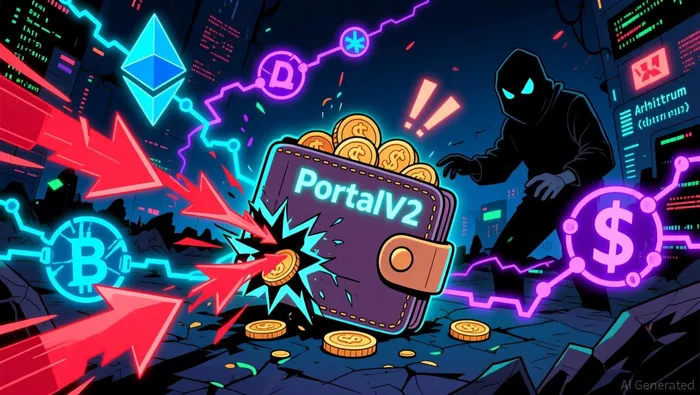
CrossCurve, a cross-chain liquidity protocol, announced on January 31 that its bridge infrastructure was exploited, leading to a $3 million loss. The attack leveraged a vulnerability in a smart contract that allowed spoofed cross-chain messages to bypass authentication and unlock tokens from the PortalV2 contract according to reports. The breach was discovered through blockchain analytics and has since triggered immediate action from the protocol’s team.
The vulnerability was traced back to the expressExecute function in the ReceiverAxelar contract, which failed to verify the legitimacy of cross-chain messages. This enabled attackers to simulate valid communication between chains and withdraw funds without depositing corresponding assets on the source chain according to technical analysis. The impact was swift, with the PortalV2 contract’s balance dropping from approximately $3 million to nearly zero as reported.
CrossCurve has identified ten Ethereum wallet addresses involved in the exploit and has issued a 72-hour bounty offer for the return of funds. The protocol has also warned of potential criminal and civil action if the funds are not recovered according to statements. The incident bears striking similarities to the 2022 Nomad Bridge hack, where a similar failure in message validation led to a $190 million loss as documented.
What Vulnerability Led to the $3M Loss?
The vulnerability in CrossCurve’s ReceiverAxelar contract allowed attackers to bypass message validation by simulating valid cross-chain communication. This flaw enabled them to unlock tokens from the PortalV2 contract without proper verification according to reports.
The issue lay in the absence of robust validation checks in the expressExecute function. This enabled attackers to exploit the contract by spoofing messages and triggering token withdrawals across multiple chains .
What Actions Has CrossCurve Taken in Response to the Exploit?
CrossCurve has suspended all platform interactions and is urging users to halt activity with the protocol until the issue is patched . The protocol has also identified ten Ethereum addresses linked to the exploit and has issued a 72-hour bounty offer for the return of funds .
In addition to the bounty program, CrossCurve has warned of potential legal action if the funds are not recovered. The protocol is collaborating with blockchain analytics firms and exchanges to track the flow of assets and recover the stolen liquidity .
What Broader Implications Does This Have for Cross-Chain Systems?
The exploit highlights the ongoing risks in cross-chain infrastructure, particularly in custom receiver contracts. These contracts require robust validation mechanisms to prevent unauthorized fund releases .
The incident echoes the 2022 Nomad Bridge hack, where a similar failure in message validation led to a $190 million loss . This reinforces the need for secure smart contract templates, audits, and secure software development lifecycles to prevent such incidents .
Security experts have pointed to the importance of multi-layered validation stacks in cross-chain systems to mitigate single points of failure. CrossCurve’s own architecture, which includes integrations with networks like AxelarAXL-- and LayerZeroZRO--, was marketed as a safeguard against such vulnerabilities .
The breach underscores the importance of continuous monitoring and rapid response in the event of a security incident. CrossCurve’s immediate shutdown of the protocol and engagement with blockchain analytics firms demonstrate an attempt to contain the damage .
The incident serves as a reminder to investors and protocol developers of the inherent risks in cross-chain systems. While these systems offer scalability and interoperability, they also introduce complex validation challenges that can be exploited if not properly secured .

Blending traditional trading wisdom with cutting-edge cryptocurrency insights.
Latest Articles
Stay ahead of the market.
Get curated U.S. market news, insights and key dates delivered to your inbox.


AInvest
PRO
AInvest
PRO



Comments
No comments yet