
Small Manufacturers and Tariff Vulnerability: The Case of Heritage Steel
 Aime Summary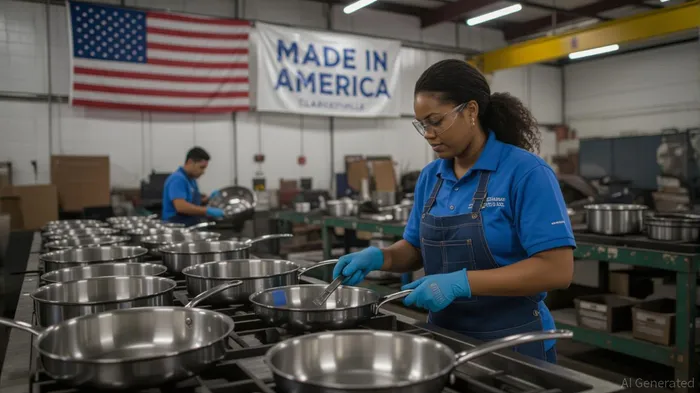
In the heart of Clarksville, Tennessee, Heritage Steel has long symbolized the resilience of American manufacturing. Yet, beneath its gleaming cookware and patriotic branding lies a stark reality: the company's survival hinges on a precarious balance between domestic production and global supply chain dependencies. As U.S. steel tariffs escalate—reaching 25% on steel and 50% on derivative products—the family-owned firm faces a 65% surge in input costs for its critical five-ply cladded steel, sourced from South Korea. This case study of Heritage Steel illuminates a broader crisis for small manufacturers, whose vulnerability to geopolitical risk exposure in domestic supply chains is reshaping the economic landscape.
The Tariff Squeeze: A Double-Edged Sword
The Trump-era tariffs, now entrenched in 2025 policy, have created a paradox for U.S. manufacturers. While they shield domestic steel producers like U.S. Steel (X) and AlcoaAA-- (AA) from foreign competition, they simultaneously inflate costs for downstream industries. Heritage Steel, for example, has raised prices by 15% to offset a 50% cost increase in raw materials. Its vice president, Danny Henn, admits the company is “absorbing most of the pain,” a strategy that risks eroding margins in an already competitive market.
The ripple effects extend beyond cookware. Small manufacturers in automotive, construction, and electronics face similar dilemmas. J.P. Morgan estimates that light vehicle prices could rise by 11.4% if automakers pass on steel tariff costs, while machinery and equipment producers grapple with 25–30% tariff burdens. For firms operating on thin margins, these pressures are existential.
Geopolitical Risk and the Fragility of Domestic Supply Chains
The tariffs have exposed a critical flaw in U.S. manufacturing: the illusion of self-sufficiency. Heritage Steel's quest to source cladded steel domestically has hit a wall—no U.S. supplier currently meets its technical specifications. This mirrors broader industry struggles, as companies like AppleAAPL-- face threats of 25% tariffs for failing to reshore production. The result is a fragmented supply chain, where small manufacturers must navigate both protectionist policies and retaliatory measures from trading partners like China and the EU.
The First Quarter 2025 CFO Survey underscores the gravity of the situation: over 50% of manufacturing executives cite tariffs as their top business risk. For Heritage Steel, the challenge is twofold—securing alternative materials while maintaining price competitiveness in a market where imports account for 80% of U.S. cookware sales.
Investment Risks: Sector-Specific Vulnerabilities
The economic implications of these tariffs are profound. Small manufacturers in import-dependent sectors face a trifecta of risks:
1. Margin Compression: With limited pricing power, firms must absorb cost increases or retreat from markets.
2. Supply Chain Disruptions: Tariffs on intermediate goods (e.g., 20% on Chinese imports) force costly reshoring or nearshoring.
3. Retaliatory Measures: $330 billion in U.S. exports now face retaliatory tariffs, further straining cash flows.
Historical data from the Trump era reveals a 1.0% GDP contraction in 2025, with households absorbing an average $1,219 in additional costs. For investors, this volatility demands a reevaluation of portfolio allocations.
Strategic Hedges: Navigating Tariff Uncertainty
For investors seeking to mitigate exposure, several strategies emerge:
- Defensive Sector Rotation: Shift capital to industries insulated from global trade shocks. Utilities, healthcare, and consumer staples—represented by ETFs like the iShares MSCIMSCI-- USA Min Vol Factor ETF (USMV)—have shown resilience.
- Commodity Hedging: Allocate to inflation-protected assets like gold (SPDR Gold Shares, GLD) and copper (iShares Copper ETF, COPX), which benefit from energy transition trends and U.S. dollar weakness.
- Geographic Diversification: Invest in nearshoring hubs such as Vietnam (iShares MSCI Vietnam ETF, VNM) while pairing with defensive ETFs to balance growth and stability.
- Liquidity Buffers: Maintain 12–18 months of cash reserves to weather supply chain disruptions. Short-term U.S. Treasury bills offer a safe haven during periods of uncertainty.
The Path Forward: Resilience Over Efficiency
Heritage Steel's story is a microcosm of the broader struggle for U.S. manufacturers. While the company's U.S.-based labor model offers advantages, its reliance on imported materials underscores the fragility of domestic supply chains in a protectionist era. For investors, the key lies in balancing growth and stability—favoring firms with localized supply chains, pricing power, and diversified revenue streams.
As tariffs continue to reshape global trade, the lesson is clear: resilience, not efficiency, will define the next decade of manufacturing. For small manufacturers like Heritage Steel, the challenge is not just to survive, but to adapt in an increasingly volatile world.

Stay ahead of the market.
Get curated U.S. market news, insights and key dates delivered to your inbox.
AInvest
PRO
AInvest
PRO



Comments
No comments yet