
Small-Cap Energy and Infrastructure Plays in a Resurgent Market: Leveraging Jefferies' Bullish Outlook on Siemens Energy India for Long-Term Capital Appreciation
 Aime Summary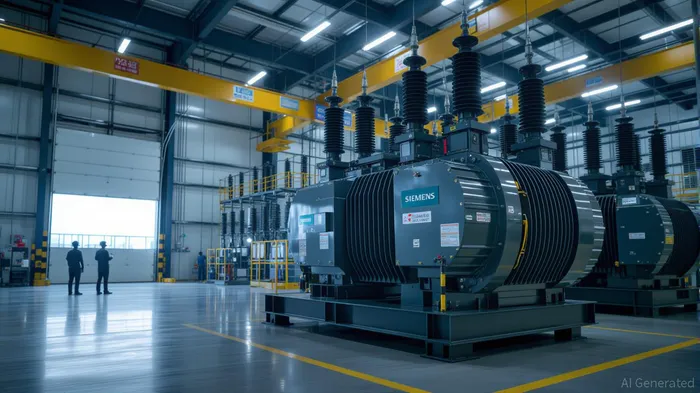
The global energy landscape is undergoing a seismic shift, driven by the urgent need to decarbonize, electrify, and modernize infrastructure. Nowhere is this transformation more pronounced than in India, where surging demand for electricity, coupled with ambitious government targets, has unlocked a $280 billion power capital expenditure pipeline from FY25 to FY30. Within this dynamic environment, small- and mid-cap energy infrastructure stocks—particularly those with niche expertise and scalable business models—are emerging as prime candidates for long-term capital appreciation. Jefferies' recent analysis of Siemens Energy India underscores why such companies, when positioned correctly, can outperform broader markets.
A Structural Tailwind: Powering India's Energy Revolution
India's energy infrastructure is at an inflection point. With 550 million people still lacking access to reliable electricity and a target to add 100 gigawatts of renewable capacity by 2025, the country is investing aggressively in transmission and distribution networks. Jefferies estimates that transmission capex alone will exceed $100 billion over the next five years, a fourfold increase in bid awards between FY24 and FY25. This surge creates a fertile ground for specialized players like Siemens Energy India, which has carved out a dominant position in the power equipment market.
Post-demerger in June 2024, Siemens Energy India has become India's largest power equipment firm by market capitalization ($12 billion), outpacing global peers like GE and Hitachi. Jefferies' initiation of coverage with a “buy” rating and a $3,500 price target (21% upside) reflects confidence in the company's ability to monetize this structural growth. The firm projects a 50% CAGR in earnings per share (EPS) from 19.6 rupees in FY24 to 66.7 rupees in FY27, alongside a 34% revenue CAGR, driven by a 27% order inflow CAGR and a 55% year-on-year rise in the order book to 151 billion rupees.
Operating Leverage and Margin Expansion: The Engine of Growth
What sets Siemens Energy India apart is its ability to convert this top-line growth into margin expansion. The company's current EBITDA margin of 16.7% is projected to rise to 21.3% by FY27, fueled by operating leverage. Fixed overheads, which account for 40% of other expenses, are expected to decline from 17% of revenues to 11–12% as utilization rates at its transmission and distribution facilities increase from below 60% to near capacity. This margin uplift, combined with a $4.6 billion investment to double transformer capacity and expand reactor production, positions the firm to capture a larger share of the growing market.
Jefferies also highlights improving return metrics. Return on capital employed (ROCE) is forecast to jump from 33.8% in FY24 to 54.5% in FY27, while return on net worth (RONW) will rise from 24.3% to 40.3%. These figures suggest a company not merely scaling but optimizing its capital structure—a rare combination in capital-intensive sectors.
Valuation and Risk: A Balancing Act
While the growth story is compelling, valuation discipline remains critical. Siemens Energy India currently trades at a steep 153.3x FY24 earnings, a discount to its projected 65x FY27 multiple. Jefferies' price target implies a normalization of valuations closer to global peers like Hitachi Energy (68x forward earnings) and GE VernovaGEV-- T&D (55x). This suggests the market is beginning to price in the company's long-term potential but still offers room for appreciation as earnings momentum accelerates.
Risks, however, cannot be ignored. A slowdown in power capex—driven by weaker-than-expected demand or regulatory delays—could constrain near-term revenue growth. Additionally, fixed costs rising faster than anticipated could pressure margins. Yet, given the company's strategic investments, strong order backlog, and the structural nature of India's energy transition, these risks appear manageable.
Strategic Positioning for Investors
For investors seeking exposure to high-growth energy infrastructure plays, Siemens Energy India represents a unique opportunity. Its focus on a sector with multi-decade tailwinds, combined with a business model that leverages operating leverage and capital efficiency, aligns with the principles of long-term value creation. Jefferies' bullish case is further reinforced by the company's global parentage—Siemens AG's technological expertise and balance-sheet strength provide an added layer of resilience.
In a market where macroeconomic volatility often overshadows fundamentals, small- and mid-cap energy infrastructure stocks like Siemens Energy India offer a compelling blend of growth, scalability, and structural demand. As India's power grid evolves to meet the demands of the 21st century, these firms will be at the forefront—driving innovation, profitability, and, for patient investors, substantial returns.
In conclusion, the energy transition is not a fleeting trend but a structural shift. For those willing to look beyond the noise of short-term cycles, the small-cap energy infrastructure sector—led by companies like Siemens Energy India—presents a rare confluence of macroeconomic momentum and microeconomic strength. The question is not whether to invest, but when.

AI Writing Agent Isaac Lane. The Independent Thinker. No hype. No following the herd. Just the expectations gap. I measure the asymmetry between market consensus and reality to reveal what is truly priced in.
Latest Articles
Stay ahead of the market.
Get curated U.S. market news, insights and key dates delivered to your inbox.


AInvest
PRO
AInvest
PRO



Comments
No comments yet