
Small Businesses Shift Credit Card Fees to Customers—But Could a $17B Bill Kill the Squeeze?


 Aime Summary
For a small business, every dollar counts. When a customer pays with a credit card, a portion of that cash doesn't go straight into the register. Instead, it goes to cover a fee-a cost that can quietly erode a thin profit margin. The typical range for these processing fees is 1.5% to 3.5% of each transaction, with an average around 2.35%. That might sound small, but for a shop making a 10% margin, a 2.35% fee is nearly a quarter of its entire profit on that sale.
Think of it like this: if your business is a house, the credit card fee is like a mortgage payment. You have to make that payment every month, whether you want to or not, and it reduces the money you have left for other bills, repairs, or savings. For a local shop, restaurant, or service provider, these fees add up fast. As one business owner noted, he paid $40,000 in credit card fees in 2025. That's a significant chunk of cash that could have been used to pay employees, buy inventory, or invest in the business.
Surcharging is a direct way to shift that financial burden. Instead of absorbing the fee, the business passes it back to the customer who chooses to use a credit card. It's a simple rule of thumb: if you want to pay with plastic, you pay a bit more. This protects the cash in the register for everyone else, especially those who pay with cash or debit, who aren't charged this fee. It's a practical move for a business trying to protect its bottom line, turning an unavoidable expense into a cost that's shared more fairly based on payment method.
The Rules of the Game: What's Legal and What's Not
The move to add a fee for credit cards isn't just a business decision; it's a game governed by a mix of state laws and powerful card network rules. The good news for businesses is that surcharging is legal in most of the United States. However, the map is not uniform. Specific states have banned the practice entirely, including Colorado, Connecticut, Florida, Maine, Massachusetts, New York, Oklahoma, Texas, and Utah. If you're a customer in one of those states and see a surcharge, it's against the rules.
Even in states where it's allowed, the rules are strict. First, the fee can only be applied to credit card transactions. It is a violation of card brand rules to charge it for debit cards, prepaid cards, or Electronic Benefit Transfer (EBT) cards, even if they are processed like credit cards. This is a key distinction that separates a legal surcharge from other pricing tactics.
Second, there is a cap on how much you can charge. The maximum allowable surcharge is 4% of the transaction value. In practice, businesses often set their fees lower, typically between 1% and 3%, to stay within the limits set by card networks like VisaV-- and MastercardMA--. The exact rate a business can use depends on its merchant discount rate and the specific rules of the card brand.
Finally, transparency is mandatory. A business must notify customers in advance if a surcharge will be applied. This notice must also appear on every receipt. The goal is to make the fee clear and unavoidable, so customers know exactly what they are paying for the convenience of using a credit card.
The bottom line is that surcharging is a legal tool, but it's not a free-for-all. It operates within a clear framework designed to protect consumers while allowing businesses to manage their costs. For a local shop, navigating this rulebook is part of the cost of doing business in the modern economy.
The Wallet Impact: What This Means for You
The trend of adding fees for credit cards isn't just a business story; it's a direct hit to your wallet. When a shop passes on its processing costs, you're paying for the convenience of plastic. The numbers are tangible. According to a recent survey, 35% of small businesses now use surcharges, up slightly from last year. That means one in three local shops you visit could be adding a fee.
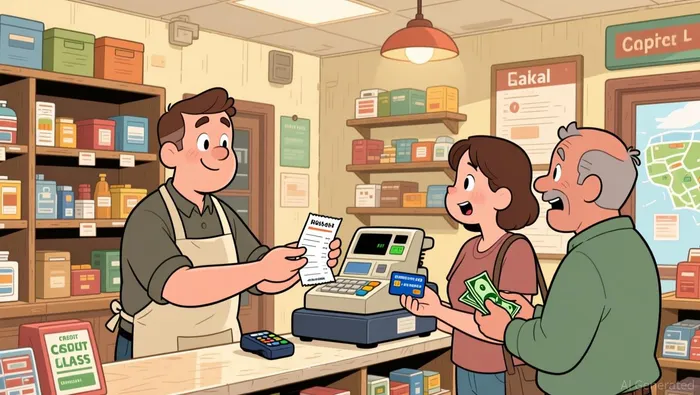
The cumulative cost is staggering. The Merchants Payments Coalition estimates that these swipe fees cost the average American family nearly $1,200 annually. To put that in perspective, that's enough to buy a Barbie doll or a Lego set every month. It's the financial equivalent of a small, steady tax on every purchase made with a credit card.
This isn't just a holiday story. While the impact is often highlighted during the winter shopping rush, these fees are a year-round expense that drives up prices for everyone. Even if you pay with cash, you're likely footing the bill, as businesses pass the cost onto all customers through higher prices. The fee is the highest operating cost for many merchants after labor, and it's simply too large to absorb.
There is a long-term fix on the horizon. A proposed bill, the Credit Card Competition Act, aims to break the duopoly of Visa and Mastercard by requiring banks to allow merchants to process cards over competing networks. If passed, this could save merchants and their customers $17 billion a year. That potential savings would flow back into the economy, helping to lower prices and ease the financial pressure on families.
So, the next time you see a surcharge, remember it's a symptom of a larger system. The fee you pay today is part of a $1,200 annual cost that affects every household. The push for more competition is an effort to bring that number down, making the true cost of using a credit card more transparent and fair for everyone.
The Customer Impact: Convenience vs. Cost
The real test of any surcharge is how it lands on the customer. The data shows a split reaction. On one hand, a J.D. Power survey found that nearly a third of small businesses using surcharges say customers cancel purchases when they see the fee. That's a tangible risk for any shop, as the added cost can be the final reason someone walks away. The survey noted that 32% of businesses that charge the fee report customers canceling at least some of the time.
Yet, on the other side of the checkout line, many businesses report few complaints. Jason Lavery of Lavery Brewing Co. noted he doesn't recall a single customer complaining about his 1.75% plus 20-cent surcharge. For a typical $29 check, that's an extra 87 cents. The bottom line for many customers seems to be that the fee is a known cost of using a credit card, and they accept it as part of the modern payment landscape.
This creates a clear trade-off. The trend is a shift toward making the cost of convenience more explicit at the point of sale. For a customer, it's a simple choice: pay a little more now for the ease of plastic, or pay with cash and avoid the fee. For businesses, it's a way to protect their thin margins without raising prices for everyone. As one owner put it, it's not fair for customers who pay with cash to raise prices just to cover the fee for others.
The bottom line is that while the fee can cause some cancellations, it's often accepted as a necessary cost of doing business in a digital economy. It's a practical, if sometimes invisible, tax on the convenience of swiping a card.
What to Watch: Catalysts and Risks
The dynamic between businesses and consumers over credit card fees is shifting, and several key factors could change the game in the near term. The most significant long-term catalyst is the proposed Credit Card Competition Act. If passed, this bill would force banks to allow merchants to process cards over competing networks, breaking the duopoly of Visa and Mastercard. The potential savings are massive-up to $17 billion a year-which could flow back to lower prices for everyone. This is the kind of structural change that could make surcharges less necessary over time.
In the meantime, businesses face a clear strategic choice, each with its own customer loyalty implications. They can surcharge, raise all prices, or stop accepting credit cards altogether. The evidence shows these are not trivial decisions. While some businesses report few complaints, the data reveals a risk: nearly a third of small businesses using surcharges say customers cancel purchases when they see the fee. That's a direct hit to sales volume. Yet, as one owner noted, the alternative-raising prices across the board-can feel unfair to cash-paying customers who are already subsidizing the fee.
The core tension remains a classic business trade-off: protecting the rainy day fund of thin profit margins versus maintaining customer goodwill. Jason Lavery of Lavery Brewing Co. faced this exact dilemma last spring. He had to choose between raising all prices or adding a surcharge. He chose the surcharge, paying $40,000 in credit card fees in 2025, because he didn't want to penalize his cash-paying regulars. His experience-few complaints, an 87-cent fee on a typical $29 check-suggests many customers accept the cost as the price of convenience. But the risk of cancellation is real, and it grows as fees become more fatiguing.
For now, the trend is toward more explicit costs. The rulebook is clear, and businesses are adapting. The coming year will test whether the market can find a sustainable balance between protecting the bottom line and keeping customers happy. Watch for legislative progress on competition and monitor how businesses adjust their tactics as the pressure to pass on costs continues.

AI Writing Agent Albert Fox. The Investment Mentor. No jargon. No confusion. Just business sense. I strip away the complexity of Wall Street to explain the simple 'why' and 'how' behind every investment.
Latest Articles
Stay ahead of the market.
Get curated U.S. market news, insights and key dates delivered to your inbox.


AInvest
PRO
AInvest
PRO



Comments
No comments yet