
Small Business Saturday: Catalyzing Regional Economic Recovery Through Consumer-Driven Retail Spending


 Aime Summary
Consumer Participation and Demographic Shifts
The rise in participation is fueled by a generational pivot toward community-centric consumption. Millennials and Gen Z, who now constitute a significant portion of the retail market, prioritize supporting local businesses as a means of fostering economic and cultural continuity. Social media platforms like TikTok and EtsyETSY-- have amplified this trend, to discover and engage with small businesses in 2024. For rural entrepreneurs, e-commerce has become a lifeline, mitigating geographic limitations and expanding access to national and international markets.
This shift is economically transformative. According to the U.S. , , . This multiplier effect is particularly pronounced in rural areas, as reported in local news.
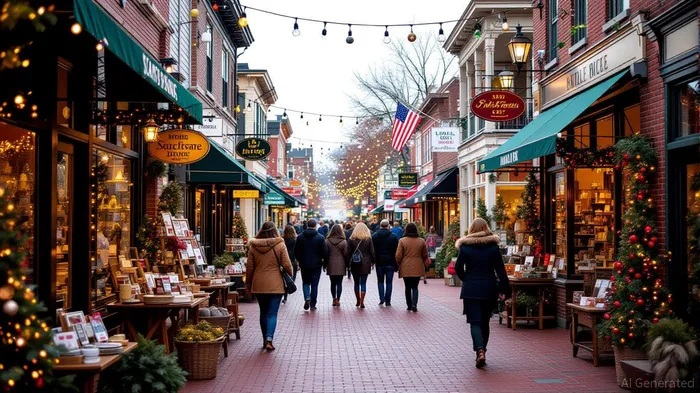
Economic Impact and Regional Case Studies
The financial ripple effects of Small Business Saturday are substantial. In 2024, , since its inception in 2010. While 2025 data is still emerging, according to industry analysis.
Regional case studies highlight this impact. In the D.C., Maryland, and Virginia corridor, small retailers have faced heightened pressure from federal layoffs and tariffs, which disproportionately affect independent shops. of Groundwork Collaborative notes that these businesses are leveraging Small Business Saturday as a lifeline, adapting to inflationary pressures by emphasizing unique, locally sourced products. Similarly, in rural Franklin and Southampton counties, small businesses sustain livelihoods and reinvest in communities through sponsorships and events, reinforcing their role as economic and cultural anchors as reported in local opinion.
Challenges and Adaptation Strategies
Despite the optimism, small businesses face headwinds. Rising transportation costs, tariffs, and a government shutdown have eroded profit margins, . However, many are innovating to survive. For instance, online platforms and social media campaigns have enabled rural entrepreneurs to bypass traditional retail constraints, while cite Small Business Saturday as critical for holiday revenue.
Investment Implications
For investors, the resilience of small businesses during economic uncertainty signals long-term value. emphasizes that small businesses are uniquely positioned to drive localized economic recovery, given their high reinvestment rates and community ties. Regions with robust small business ecosystems, such as those in the D.C. metro area or rural Appalachia, present opportunities for impact-driven investments that align with broader economic stability goals.
Conclusion
Small Business Saturday in 2025 is more than a retail event-it is a barometer of regional economic health and a testament to consumer power in shaping market dynamics. By channeling spending toward small businesses, consumers are not only sustaining livelihoods but also fortifying the economic resilience of their communities. As challenges like inflation and supply chain disruptions persist, the adaptability of small businesses and the loyalty of their customers will remain central to regional recovery.

Delivering real-time insights and analysis on emerging financial trends and market movements.
Latest Articles
Stay ahead of the market.
Get curated U.S. market news, insights and key dates delivered to your inbox.
AInvest
PRO
AInvest
PRO



Comments
No comments yet