
Small Business Saturday 2025: A Barometer for Retail Recovery and Community-Driven Commerce Investment


 Aime Summary
The post-pandemic economic landscape remains a patchwork of resilience and fragility, with small businesses at the heart of both. As the U.S. navigates inflation, tightening credit, and shifting consumer preferences, Small Business Saturday 2025 has emerged as a critical barometer for retail recovery and community-driven commerce.
projected to stem from this single day of shopping, the event underscores the symbiotic relationship between consumer behavior, merchant financing, and regional economic health.
Consumer Behavior: A Shift Toward Local Engagement
Consumer spending patterns in 2025 reveal a pronounced shift toward in-store shopping and localized commerce. According to the (NRF),
in Small Business Saturday 2025, . This represents a
over the past decade, driven by a cultural reawakening to community values.
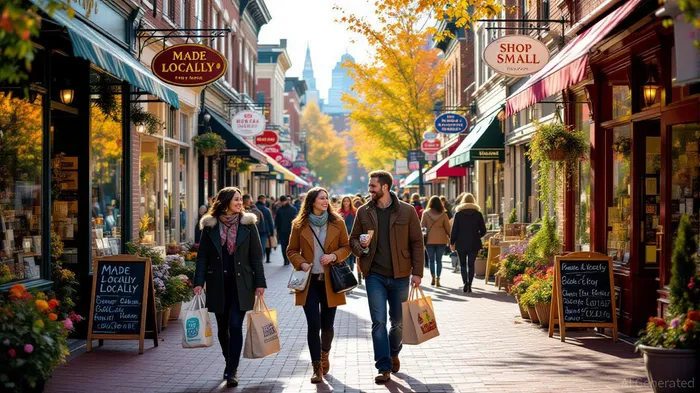 The preference for in-person shopping is particularly pronounced among younger demographics.
A 2024 Shop Small Impact Study by American Express . This aligns with broader trends:
for in-person events and experiences, recognizing the irreplaceable value of tactile, community-based interactions.
However, consumer enthusiasm is tempered by economic caution.
Deloitte's Holiday Retail Survey estimates , . This suggests that while consumers remain committed to supporting local businesses, they are doing so with tighter budgets-a dynamic that small businesses must navigate through value-driven offerings and operational efficiency.
Merchant Financing: A Double-Edged Sword
The financial health of small businesses is inextricably linked to their ability to access capital. In 2024-2025,
for financing, . Meanwhile,
in the past year, . These figures highlight a systemic challenge: despite the critical role of Small Business Saturday in
for many businesses, access to capital remains uneven.
Invoice factoring has emerged as a lifeline, . factoring market. Yet disparities persist. , for instance, face disproportionately higher financing needs and lower approval rates compared to non-Latino firms. These gaps underscore the fragility of small business recovery in a post-pandemic world, where access to flexible capital is essential for leveraging opportunities like Small Business Saturday.
Regional Economic Impact: Lessons from Western North Carolina
Regional case studies further illuminate the interplay between localized commerce and broader economic recovery. In Western North Carolina, for example,
post-Hurricane Helene, but
. The region's businesses have become pillars of resilience, with
like food distribution or cleanup coordination. Small Business Saturday 2025 is expected to play a pivotal role here, as
for holiday revenue.
Nationally,
the U.S. Chamber of Commerce notes , emphasizing their role in employment and economic stability. Yet localized challenges-such as
by 75% of firms-highlight the need for targeted investment.
The SBA's partnership with American Express to promote Small Business Saturday reflects a strategic effort to channel consumer spending into communities where it can catalyze recovery.
The Fragility of Recovery and the Path Forward
Despite optimism, the post-pandemic recovery has plateaued for many small businesses.
A 2025 Federal Reserve survey found that firms report elevated debt and difficulty securing financing, while the physical retail sector faces historic vacancy lows due to limited new supply. These trends suggest that while Small Business Saturday 2025 is a vital revenue driver, it is not a panacea.
Investors and policymakers must address structural barriers, such as the need for forgivable funding, affordable commercial space, and infrastructure improvements.
For consumers, the message is clear: every dollar spent locally is an investment in community resilience. As
feeling motivated to continue shopping locally throughout the holiday season, the cultural shift toward community-driven commerce appears here to stay.
Conclusion
Small Business Saturday 2025 is more than a retail event-it is a microcosm of the broader economic recovery. By analyzing consumer behavior, financing trends, and regional case studies, it becomes evident that localized commerce is both a symptom and a solution to post-pandemic challenges. For investors, the lesson is twofold: support small businesses through flexible capital solutions and recognize the long-term value of community-driven commerce.
As the NRF notes, "Small Business Saturday is not just about sales-it's about sustaining communities." In an era of economic uncertainty, that sentiment has never been more relevant.

Stay ahead of the market.
Get curated U.S. market news, insights and key dates delivered to your inbox.
AInvest
PRO
AInvest
PRO



Comments
No comments yet