
Slowing U.S. Job Growth and Its Impact on Cyclical Sectors: Investor Strategy in a Soft Landing Scenario


 Aime Summary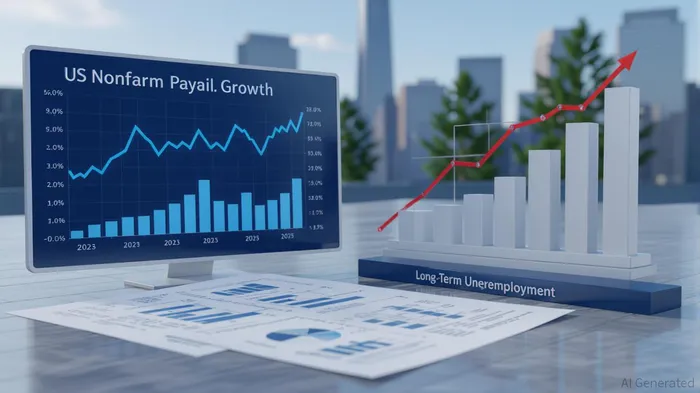
The U.S. labor market is showing signs of fatigue. July's employment report painted a bleak picture: just 73,000 jobs added, far below the 80,000 to 100,000 needed to keep pace with population growth. Over the past three months, the average has plummeted to 35,000—a stark contrast to the inflated initial estimates for May and June, which were later revised down by 258,000 jobs. The labor force participation rate has hit its lowest level since 2022, while long-term unemployment has surged to 24.9% of the total unemployed. This isn't just a slowdown—it's a warning shot.
Cyclical sectors, which thrive on economic expansion and consumer spending, are now under pressure. Manufacturing, construction, and retail—industries that rely on a robust labor market—are feeling the pinch. For example, the ADP report highlights a stagnation in hiring across these sectors, with education and health services even posting net job losses. Meanwhile, the Federal Reserve's high interest rates and President Trump's aggressive tariff policies have created a perfect storm of uncertainty, deterring businesses from expanding and workers from entering the labor force.
But here's the silver lining: a soft landing is still possible. If inflation cools without triggering a full-blown recession, investors can position themselves to capitalize on both defensive and growth-oriented opportunities. Let's break it down.
1. Defensive Sectors: The Bedrock of Stability
When the labor market falters, consumers prioritize essentials. That's where consumer staples, utilities, and healthcare shine. These sectors offer consistent demand, even in downturns. For instance, healthcare added 55,000 jobs in July, driven by ambulatory services and hospitals—a trend likely to continue as aging demographics and chronic care needs rise.
Dividend-paying stocks in these sectors, like Procter & Gamble (PG) or UnitedHealth GroupUNH-- (UNH), provide not just income but also a buffer against volatility. Utilities, with their regulated cash flows, are another safe haven. Consider NextEra EnergyNEE-- (NEE) or Dominion EnergyD-- (D): their yields and low volatility make them ideal for preserving capital.
2. Growth Sectors: Betting on the Soft Landing
If the economy avoids a hard landing, sectors tied to innovation and productivity gains could outperform. Artificial intelligence, semiconductors, and clean energy are prime examples. These industries benefit from stable interest rates and continued investment in digital transformation.
Take NVIDIANVDA-- (NVDA), whose AI chips are fueling demand across data centers and autonomous systems. Or TeslaTSLA-- (TSLA), which is doubling down on its AI-driven manufacturing and energy storage solutions. Even in a slower economy, companies that solve big problems—like reducing carbon emissions or automating workflows—will attract capital.
3. Sector Rotation and Real-Time Tools
The key to navigating a soft landing is agility. Investors should rotate into sectors that align with the current economic climate. For example, if consumer confidence holds up, consumer discretionary stocks like NikeNKE-- (NKE) or AmazonAMZN-- (AMZN) could rebound. But if the labor market weakens further, pivot to defensive plays.
Real-time tools like Bookmap or liquidity analysis platforms can help spot institutional buying or selling before traditional data is released. These tools are invaluable for identifying shifts in order flow and adjusting positions proactively.
4. The Gold and Bond Play
In times of uncertainty, gold and U.S. Treasuries act as safe havens. Gold's price often inversely correlates with the dollar, making it a hedge against inflation and geopolitical risks. For bonds, focus on high-quality corporate debt with strong credit ratings. Companies like MicrosoftMSFT-- (MSFT) or Johnson & Johnson (JNJ) issue bonds that offer yields without the risk of default.
5. Diversification: Your Best Defense
No one can predict the future, but a diversified portfolio can weather almost any storm. Balance your holdings across equities, bonds, and commodities. For example, pair a growth stock like MetaMETA-- (META) with a utility like Dominion Energy (D) and a Treasury ETF like IEF. This mix ensures you're not overly exposed to any single sector or asset class.
Conclusion: Stay Nimble, Stay Ahead
The U.S. labor market is at a crossroads. While cyclical sectors face headwinds, a soft landing scenario offers a path to growth. By leaning into recession-resistant industries, embracing innovation-driven stocks, and using real-time tools to stay ahead of the curve, investors can position themselves to thrive—even in a slowing economy.
Remember: the goal isn't to predict the future but to prepare for it. Diversify, rotate sectors, and keep an eye on the data. The market may be wobbly, but with the right strategy, you'll be standing strong.

Stay ahead of the market.
Get curated U.S. market news, insights and key dates delivered to your inbox.


AInvest
PRO
AInvest
PRO



Comments
No comments yet