
Sling TV's Live TV Niche: A Steady Hand in the Streaming Wars?
The cord-cutting revolution has reshaped the media landscape, with over 2.3 million U.S. pay-TV subscribers abandoning traditional services in the first quarter of 2025 alone. Amid this upheaval, Sling TV—a virtual multichannel video programming distributor (vMVPD) owned by EchostarSATS-- Corp.—faces a critical juncture. While its subscriber base has dwindled to 2 million as of Q2 2025, down from 2.09 million a year earlier, Sling's focus on live TV could carve out a defensible niche—if its strategy adapts to the evolving demands of viewers and investors.
The Niche Advantage: Live TV's Persistent Appeal
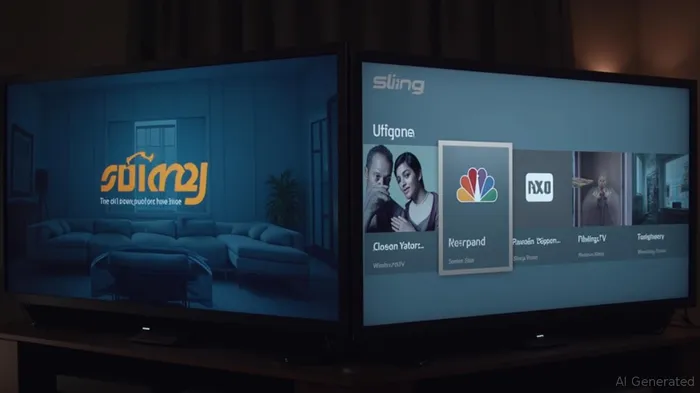
Sling TV's core strength lies in its unapologetic focus on live linear TV, a format still preferred by 35% of U.S. households, per Nielsen. Unlike Netflix or Disney+, which dominate on-demand consumption, Sling offers access to regional sports networks (RSNs), live news, and primetime programming—a value proposition that resonates with sports enthusiasts and news junkies. This niche is under threat, however. Competitors like YouTube TV and Hulu + Live TV now offer comparable packages with added perks: seamless integration with Disney+, NFL Sunday Ticket, or ad-free tiers. Sling's lack of exclusive content partnerships (e.g., no ESPN+ bundle) and limited access to marquee sports rights leaves it vulnerable.
Pricing Strategy: A Double-Edged Sword
Sling's $40/month base package (including 85+ channels) positions it competitively against rivals like FuboTV ($64.99/month) and YouTube TV ($72.99/month). Yet its segmentation into Orange and Blue bundles—forcing users to pay extra for premium channels—creates friction compared to the simplicity of all-in-one platforms like Hulu ($74.99/month). Echostar's pivot to retaining “higher-quality subscribers” (those with higher ARPU) reflects an acknowledgment of this challenge. While this strategy slowed the bleeding in Q2 2025, it risks alienating casual viewers who might prefer cheaper, flexible options.
Source: Echostar Corp. Q1/Q2 2025 reports and competitor disclosures.
Risks: Cord-Cutting, Regulation, and Financial Strain
The headwinds are formidable. Cord-cutting shows no signs of slowing: the average U.S. household now subscribes to 4.5 streaming services, up from 3.7 in 2021, and younger demographics increasingly favor TikTok-style short-form content. Sling's legacy infrastructure—reliant on satellite dishes and transponders—also burdens Echostar with high maintenance costs, contrasting sharply with the internet-based agility of rivals.
Regulatory uncertainty adds another layer. While the FCC currently lacks authority to regulate vMVPDs—a stance supported by Republican lawmakers—this could change. A potential push for modernized regulations (e.g., content bundling mandates or consumer protection rules) might disrupt Sling's model.
Financially, Echostar's struggles are stark: its operating loss hit $653 million in Q1 2025, with pay-TV revenue down 10% year-over-year. Meanwhile, its 5G ambitions (e.g., Boost Mobile) have yet to offset declines in traditional services.
Data-Backed Thesis: Caution Ahead
The numbers paint a cautious picture. Sling's subscriber count has fallen to levels last seen in 2018, and its Q2 stabilization (adding 80,000 subscribers) masks a broader industry shift: vMVPD market share now faces competition not just from YouTube TV but also from FAST platforms (free ad-supported streaming), which lure cost-conscious users.
Source: Echostar Corp. SEC filings.
Investment Takeaway: Sling TV's niche in live TV offers a sliver of defensive potential, but its declining subscriber base, financial fragility, and competitive pressures make it a high-risk bet. Investors seeking exposure to streaming's growth should look elsewhere—for example, to platforms with ecosystem synergies (e.g., Disney+) or those dominating fast-growing niches like sports (Dazn). For now, Sling's story remains one of survival, not growth.
In a landscape where cord-cutting is irreversible and streaming giants consolidate power, Sling TV's fate hinges on whether it can reimagine its value proposition—perhaps through strategic partnerships, price flexibility, or integration with Echostar's 5G services. Until then, the “steady hand” of its live TV focus is more of a lifeboat than a life raft.

Stay ahead of the market.
Get curated U.S. market news, insights and key dates delivered to your inbox.
AInvest
PRO
AInvest
PRO



Comments
No comments yet