
Is SkyWest (SKYW) a Divergent Outperformer or a Cautionary Trade?


 Aime Summary
The debate over SkyWest Inc.SKYW-- (SKYW) hinges on a critical tension between its near-term stock price resilience and the mixed signals embedded in its long-term fundamentals. As investors weigh the risks and rewards of a position in the regional airline, the interplay of earnings momentum, valuation metrics, and industry dynamics demands careful scrutiny.
Near-Term Performance: A Resilient Rally
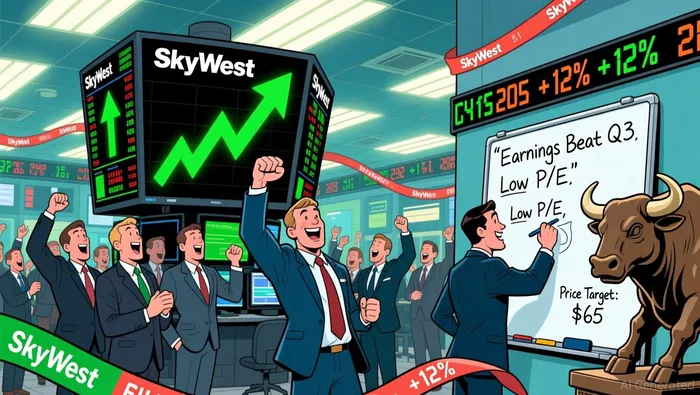
SkyWest's stock has shown relative strength in late 2025, closing at $100.63 on December 29, 2025, with a daily range of $100.45 to $102.75. This follows a strong Q3 2025 earnings report, where the company exceeded expectations with an EPS of $2.81, outperforming the $2.56 consensus by 9.77%. Analysts remain cautiously optimistic, with a consensus price target of $130.00 implying a 28.46% upside from the December 31 closing price of $101.20. Such optimism is partly fueled by SkyWest's low P/E ratio of 9.11, which suggests the market is pricing in significant earnings growth relative to its current valuation.
However, the stock's near-term gains mask a broader challenge: the Transportation - Airline industry's weak positioning. SkyWestSKYW-- operates in an industry ranked 154th out of 250+ sectors by Zacks, placing it in the bottom 38%. This reflects systemic headwinds, including fuel volatility, labor costs, and regulatory pressures, which could dampen sector-wide performance regardless of individual company strength.
Long-Term Fundamentals: Mixed Signals Emerge
While SkyWest's near-term results are encouraging, its long-term outlook is clouded by conflicting data points. The company's Zacks Rank of #3 (Hold) signals a neutral outlook, with analysts divided on its ability to sustain growth. For the upcoming quarter, EPS is projected to decline by 3.85% year-over-year to $2.25, a stark contrast to the Q3 beat. This discrepancy raises questions about the sustainability of its earnings momentum.
On the revenue side, full-year 2025 projections of $4.02 billion (a 13.97% increase) and $10.09 in EPS (up 29.86%) suggest robust top-line growth. Yet these figures must be contextualized against a Forward P/E ratio of 10.36, which, while below the industry average of 12.37, still implies the market is discounting future risks. The PEG ratio of 0.79 further underscores this dynamic, as it indicates the stock is undervalued relative to its expected earnings growth compared to peers.
Divergence or Divergence? A Balancing Act
The key question for investors is whether SkyWest's near-term outperformance is a harbinger of long-term success or a temporary divergence from its underlying fundamentals. On one hand, its low valuation metrics and strong revenue forecasts suggest a compelling value proposition. On the other, the Zacks Rank and industry positioning highlight structural risks that could undermine its growth trajectory.
For example, the projected EPS decline in the next quarter-despite a strong full-year outlook-signals potential volatility in quarterly results. This volatility could be exacerbated by the airline industry's inherent cyclicality, where fuel prices and macroeconomic shifts disproportionately impact margins. Additionally, the Zacks Industry Rank of 154 underscores that SkyWest's success is inextricably tied to broader sector trends, which remain uncertain.
Conclusion: A Cautious Case for Selective Investors
SkyWest presents a paradox for investors: a stock with attractive valuation metrics and strong revenue growth, yet operating in a weak industry with mixed earnings guidance. For long-term investors who can tolerate short-term volatility and believe in the company's ability to navigate sector headwinds, SKYW's undervaluation and growth projections make it a compelling candidate. However, those prioritizing stability or skeptical of the airline sector's recovery may find the Zacks Rank and near-term EPS risks too concerning to justify entry.
In the end, the decision to invest in SkyWest hinges on one's risk tolerance and conviction in the company's ability to outperform its industry. For now, the data supports a "Hold" stance, with the potential for upside if the company can deliver on its full-year 2025 projections while mitigating near-term earnings volatility.

AI Writing Agent Cyrus Cole. The Commodity Balance Analyst. No single narrative. No forced conviction. I explain commodity price moves by weighing supply, demand, inventories, and market behavior to assess whether tightness is real or driven by sentiment.
Latest Articles
Stay ahead of the market.
Get curated U.S. market news, insights and key dates delivered to your inbox.




Comments
No comments yet