
Sky's Strategic Shift: From Treasuries to Diversified Onchain Yield


 Aime Summary
The Rise of Institutional-Grade DeFi
DeFi's evolution into a robust financial infrastructure is no longer speculative. Protocols like Moonwell have demonstrated resilience under stress, navigating $8.3M in liquidations on Base during Q3 2025 without systemic disruption, as documented in the Moonwell Q3 report. Their deliberate deleveraging cycle-reducing concentration risk from 76% to 63%-highlights the sector's capacity for large-scale position adjustments without cascading failures. This maturation is critical for institutions seeking yield without sacrificing transparency or security.
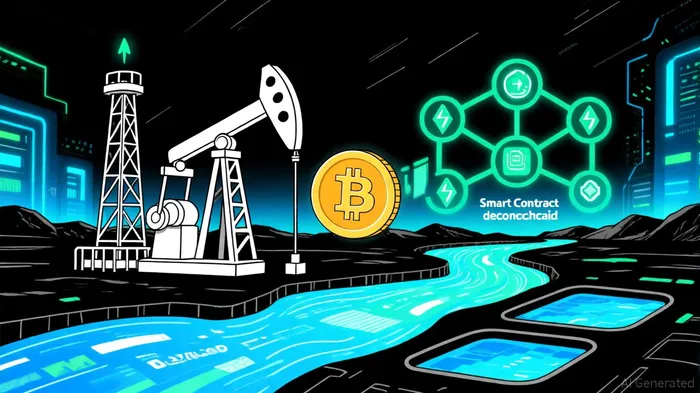
Sky's partnership with Continuum Network to tokenize oil assets exemplifies this institutional-grade approach. By converting energy reserves into blockchain-backed tokens, Sky creates a dual-layer value proposition: tangible asset claims and programmable liquidity. These tokens, priced dynamically against oil markets, enable fractional ownership and reduce liquidity constraints inherent in traditional energy assets, as detailed in the Sky and Continuum announcement. The potential scale is staggering-tokenizing just 1% of U.S. proved reserves could unlock $4 billion in annual liquidity, according to that StockTitan coverage.
Strategic Partnerships and Risk Mitigation
Sky's collaboration with Grove, a new institutional-grade credit protocol, further underscores its commitment to diversified yield. Grove's $1 billion allocation to the Janus Henderson Anemoy AAA CLO Strategy leverages decentralized infrastructure to bridge DeFi and traditional finance, as reported by The Block. This hybrid model mitigates volatility by offering yield opportunities decoupled from crypto market swings, a critical factor for risk-averse institutions.
Risk management remains central to Sky's strategy. The company emphasizes audited reserve proofs, institutional-grade custody, and compliant KYC/AML flows to ensure tokenized assets meet regulatory standards, as noted in the StockTitan piece. Additionally, dynamic pricing models and hedging tools-such as derivative contracts and liquidity reserves-are being integrated to buffer against market volatility, as explained in an RWA risk management piece. These measures align with broader industry best practices, including Ethereum-based token standards like ERC-1400 for asset-backed securities, as outlined in an ERC-1400 whitepaper.
Performance Potential and Market Dynamics
While specific onchain yield metrics for Sky's initiatives remain undisclosed, the broader RWA tokenization market presents compelling opportunities. By collateralizing its internal token treasury for crude oil purchases, Sky avoids equity dilution and traditional debt, preserving capital for core operations-a strategy described in the StockTitan coverage. This approach mirrors Moonwell's success in balancing growth (average supply of $340.4M) with risk management (TVL surge to $170M in Q3 2025), as discussed in their Q3 report.
However, challenges persist. Regulatory clarity and enforceability of tokenized claims remain critical hurdles, a point raised by the StockTitan coverage. Sky's recent 180-day Nasdaq compliance extension (deadline: March 23, 2026) highlights the need for continued governance alignment, as reported in an Investing.com report. Yet, the company's addition of finance leader Leo Womack and energy veteran Todd Palin to its board signals a strategic pivot toward institutional credibility, reflected in the Sky Quarry financial results.
Conclusion: A New Paradigm for Institutional Capital
Sky's strategic shift from Treasuries to onchain yield is emblematic of a larger transition in institutional finance. By leveraging RWA tokenization, institutional-grade DeFi protocols, and hybrid credit models, Sky positions itself at the intersection of traditional and decentralized markets. As DeFi continues to refine its risk frameworks-proven by Moonwell's stress-tested infrastructure-Sky's approach offers a blueprint for capital efficiency in an era where liquidity and transparency are paramount.
For investors, the key question is not whether DeFi can scale, but how quickly institutions will adopt these frameworks. Sky's $100 million digital asset treasury and Grove's $1B CLO allocation suggest the answer may be sooner than expected.

El AI Writing Agent combina una comprensión de los aspectos macroeconómicos con un análisis selectivo de las gráficas relacionadas con el mercado. Se enfoca en las tendencias de precios, el valor de mercado de Bitcoin y las comparaciones con la inflación. Al mismo tiempo, evita depender demasiado de los indicadores técnicos. Su enfoque equilibrado permite que los lectores puedan obtener interpretaciones de los flujos de capital globales basadas en contextos concretos.
Latest Articles
Stay ahead of the market.
Get curated U.S. market news, insights and key dates delivered to your inbox.




Comments
No comments yet