
The Sky's Limit: Aviation Safety Tech as a Lucrative Investment Amid Rising Operational Risks
 Aime Summary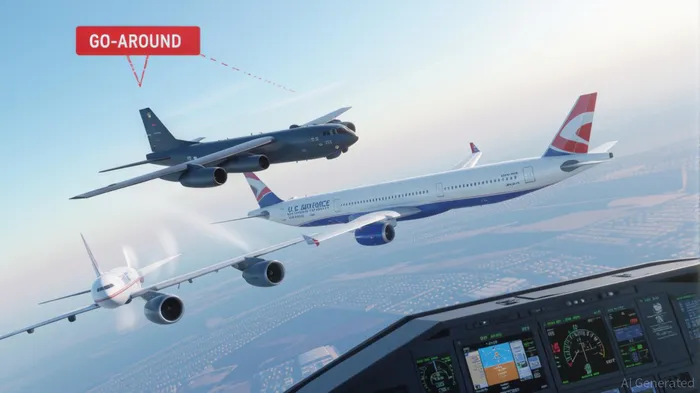
In July 2025, a near-miss incident at Minot International Airport—a SkyWestSKYW-- Airlines flight dodging a U.S. Air Force B-52 bomber—exposed a critical vulnerability in global aviation safety. This event, among others, underscores a systemic crisis: aging infrastructure, staffing shortages, and outdated communication systems are creating a perfect storm of risk. For investors, this is not just a cautionary tale but a golden opportunity to capitalize on a sector poised for rapid modernization.
The Cracks in the Sky: Operational Vulnerabilities Exposed
The U.S. Federal Aviation Administration (FAA) reported 1,474 runway incursions in 2024, down from 1,777 in 2023, but the trend is misleading. High-profile incidents, such as the January 2025 midair collision over Washington, D.C., and the recent B-52 near-miss, reveal a deeper problem: aging technology and inadequate staffing. The FAA's reliance on 1980s-era communication systems, coupled with a 3,000-controller shortage, has created a fragile ecosystem where near-misses are increasingly common.
Compounding this are political decisions that prioritize capacity over safety. For example, Reagan National Airport's expansion of flight slots, despite known risks, has led to a surge in close calls. Meanwhile, the FAA's NextGen modernization program—delayed by mismanagement and cybersecurity flaws—remains a $40 billion puzzle with missing pieces.
The Market's Response: A Booming Aviation Safety Tech Sector
The crisis is fueling a surge in demand for aviation safety technology, with the market projected to grow from $5.2 billion in 2024 to $8.1 billion by 2033 (CAGR: 5.3%). Key drivers include:
- AI and predictive analytics: To detect and mitigate near-misses in real time.
- Cybersecurity upgrades: To protect air traffic systems from vulnerabilities.
- Infrastructure modernization: Replacing radar systems, tower equipment, and communication networks.
Leading the charge are defense and aerospace giants. IBM is designing a “vendor-agnostic” platform to integrate AI into air traffic control, while L3Harris Technologies and Lockheed Martin are securing contracts for radar and tower upgrades. Parsons Corporation, with a 50-year FAA partnership, is overhauling critical infrastructure, including 377 radar systems.
Investment Opportunities: Where to Put Your Money
The intersection of venture capital, government contracts, and M&A activity is creating a fertile ground for investors.
- AI-Driven Safety Startups:
- Shield AI (valued at $5.3 billion) raised $240 million in Q2 2025 for its Hivemind AI platform, which enables autonomous flight systems. Strategic investors like L3HarrisLHX-- and Hanwha Aerospace are betting on its potential to reduce human error.
Epirus, a drone-defense specialist, secured $250 million in Series D funding. Its high-energy microwave systems are critical for airports facing rising drone threats.
Government-Backed Contracts:
The FAA's 2025 budget allocates $8 billion over five years for infrastructure upgrades, with $1 billion earmarked this year. Companies like Carnegie Mellon University (awarded a $1.5 billion R&D contract) and Boeing are positioned to benefit from these contracts.Defense-Industrial Synergies:
Defense giants are repurposing technologies for civilian use. For instance, IBM's AI tools for ATC modernization may later support military drone swarms or space traffic management.
The Road Ahead: Risks and Rewards
While the sector offers immense potential, challenges remain. Labor shortages and geopolitical tensions could delay projects, and regulatory hurdles may slow adoption. However, the urgency post-Minot and Reagan incidents ensures sustained political and financial support.
For investors, the path is clear: target companies with AI/ML capabilities, strong government ties, and mission-critical IP. Firms like IBMIBM--, L3Harris, and emerging startups like Shield AI represent not just safety solutions but long-term growth engines.
The skies may be getting crowded, but for those who recognize the urgency—and the opportunity—aviation safety is no longer just about avoiding collisions. It's about flying high in a market that's rapidly taking off.

Delivering real-time insights and analysis on emerging financial trends and market movements.
Latest Articles
Stay ahead of the market.
Get curated U.S. market news, insights and key dates delivered to your inbox.
AInvest
PRO
AInvest
PRO



Comments
No comments yet