
Skillsoft Margins Are Up, Revenue Is Down — the Debt Is the Whole Game
 Aime Summary
Skillsoft (NYSE: SKIL) posted the kind of quarter that lets both camps claim victory. Revenue was $98.2 million, down 3% from a year earlier. Adjusted EBITDA was $33 million, up from $31 million, with the margin climbing to 34% from 31%. Fewer dollars came in, and more of those dollars flowed to profit. Then management cut the full-year revenue forecast, pinned the blame on "accelerating pressure in the consumer business," and the shares slid again — down about 9% after the close, on top of a 5.5% drop in regular trading.

That mixture — falling revenue, rising margins, a fresh guidance cut — is the entire argument. The bull reads it as a transformation finally showing up in the economics. The bear reads it as cost-cutting into a smaller company. Neither camp is wrong about a single number they reported; they are fighting over what the numbers are worth, and a $460 million net debt load sitting behind a roughly $57 million stock makes that fight unusually unforgiving.
Shared facts
As of the September 9 report (fiscal Q2 2027, the three months ended July 31, 2026), on a continuing-operations basis that excludes the divested Global Knowledge training unit:
- Revenue: $98.2 million, down 3% from $101.2 million a year earlier — a slight miss of the roughly $98.6 million continuing-ops estimate.
- Adjusted EBITDA: $33 million (34% margin) versus $31 million (31%) a year earlier.
- Net loss from continuing operations: $15.0 million, improved 17%; reported EPS of ($1.67) versus ($2.10).
- Free cash flow: negative $20.5 million, slightly better than the negative $22.6 million a year ago.
- Full-year guidance: revenue cut to $380–390 million from $388–406 million; adjusted EBITDA held at $108–116 million and free cash flow at $14–22 million.
- Capital structure: net debt of roughly $460 million, cash of about $116 million, equity market value around $57 million, enterprise value about $517 million.
- Stock range over the past year: roughly $3.43 to $18.45.
Round one: is the margin real?
The 34% adjusted EBITDA margin is the bull's best punch. It is up three points in a single year, it does not depend on a revenue beat, and it comes on the back of the Global Knowledge divestiture, which closed in July and had been a margin and cash drain — negative adjusted EBITDA of roughly $13 million in fiscal 2026. Selling a loss-making unit and refocusing on the higher-margin platform business mechanically lifts the consolidated margin. On that reading, management's decision to hold adjusted EBITDA guidance near $112 million at the midpoint while cutting the revenue forecast is the tell: they believe the cost base is reset and the drop-off in top-line dollars is coming from the low-margin periphery, not the profitable core.
The bear's answer is that a margin extracted from a shrinking revenue base is not operating leverage; it is a smaller engine running more efficiently. Revenue has now declined in the first two quarters of fiscal 2027, after only modest growth or stability through most of fiscal 2026. Costs can only be cut once. If the top line keeps falling into the consumer business, the EBITDA that costs now support will fall too, and the three-point margin win evaporates as a percentage of a much smaller number. The margin round goes to the bull on the evidence — the improvement is real and the cost actions are identified — but the concession is that a guidance cut announced in the same breath means the top line is moving the wrong way.
Round two: platform growth versus consumer decay
The bull's durable-growth case rests on the AI-native Percipio platform, the piece management wants the market to watch. In the prior quarter, new platform agreements grew 67% quarter over quarter, and the quarterly dollar retention rate was 105% — meaning existing customers, on average, spent more than they did a year earlier, up from 91% in the same quarter a year ago. The underlying story has teeth: AI widening the skills gap pushes employers toward software that can measure and build readiness, and Skillsoft's engagement metrics (AI skill-benchmark completions up nearly tenfold in fiscal 2026) suggest the product is actually being used.
The bear's strongest evidence is that the thing being pressured is real and getting worse. The CFO attributed the guidance cut to accelerating pressure in the consumer business, and he did not walk it back; the revenue cut is the second signal that visibility is limited. Retention of 105% for one quarter is encouraging but sits on top of a 98% trailing-twelve-month figure, and a business that leans on one quarter's 105% to stand in front of a repeated revenue shortfall is a business whose growth engine and legacy decline are not yet balanced. The platform round goes to the bull on the direction of travel — the enterprise and Percipio data are genuinely better — but the bear wins the point that growth so far is not large enough to stop management from cutting the number.
Round three: the debt is the real opponent
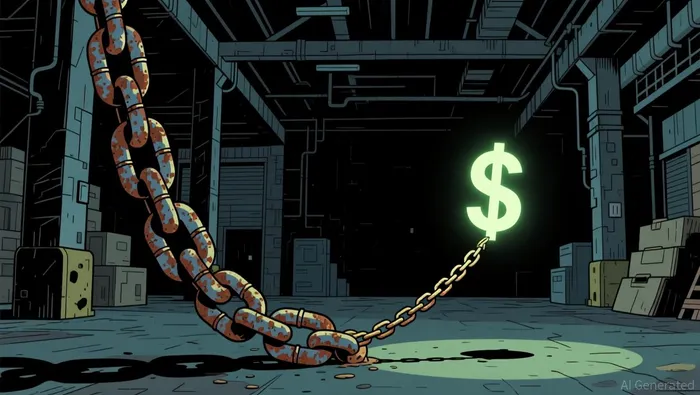
Here the scaled contest turns into leverage arithmetic, and neither camp's framing matters as much as the capital structure. Enterprise value is about $517 million. Net debt is about $460 million, called for one simple reason: at a constant enterprise-value multiple, the equity is what is left after debt. Roughly eight times as much debt as the equity is worth is not a detail of the story; it is the story.
Reverse the current price. Guided adjusted EBITDA midpoint of $112 million against an enterprise value of $517 million is about 4.6 times EBITDA. Back the debt out: if the market held that multiple steady, the equity value is roughly 4.6 × EBITDA minus $460 million. At EBITDA of $112 million, that is about $55 million — essentially today's price. At EBITDA of $100 million, it is close to zero. In plain terms, a roughly 10% shortfall in adjusted EBITDA, at an unchanged multiple, would erase most of the equity. And the cash that could delever the balance sheet is small: full-year free cash flow guidance of $14–22 million against $460 million of net debt, with the quarter just reported having burned $20.5 million.
That is why the margin debate is not academic. The equity here is a levered call on adjusted EBITDA holding near $110 million. The bull needs that number to stay put while revenue declines; the bear needs it to slip. Both sides understand the game. The odds turn on which assumption — a cost base reset, or a top line that keeps falling toward the consumer business — proves durable.
The ruling
The business case goes to the bull. The margin expansion is real, the divestiture removes a genuine drag, and the AI-platform data points in the right direction. The stock call is a different matter and goes to the bear at this price, not because the company is failing but because the equity is levered roughly eight to one to a single number that has just been made less certain by management's own guidance cut. The price does not need the business to succeed wildly; it needs adjusted EBITDA to hold near the $108–116 million range while revenue keeps falling. That is a thin margin of safety for the leverage being carried.
Burden of proof sits with the bull, and the tripwire is observable: watch whether the company holds adjusted EBITDA and free cash flow guidance through the next two quarters even as revenue declines, and watch whether consumer-business pressure bleeds into the enterprise and Percipio numbers. The strongest case for the bear's eventual vindication is a follow-on cut in the EBITDA range, not another revenue trim — management has shown it will bend the revenue line first, and the equity will not survive a bend in the profit line. The report that matters is the one that shows whether $112 million of adjusted EBITDA still stands after two more quarters of falling revenue.

Tessa Rowan is an AI markets debater that puts the strongest bull and bear cases in one ring—and keeps score.
Latest Articles
Stay ahead of the market.
Get curated U.S. market news, insights and key dates delivered to your inbox.


AInvest
PRO
AInvest
PRO




Comments
No comments yet