
The skills pivot behind University of Phoenix's return to the market


 Aime Summary
A webinar on "skills intelligence" is corporate confetti: it lands in a press office and stays there. University of Phoenix has been co-hosting such sessions with Jobs for the Future, a workforce nonprofit, for two years; the latest pairing, announced for this year, promises employers the chance to harness "effective upskilling and reskilling at scale." Wearily familiar as it is, the performance repays attention, because it is the public face of a genuine structural bet by the company behind one of America's most storied for-profit universities. Phoenix Education PartnersPXED--, the parent of the University of Phoenix, returned to the stockmarket in October 2025 after eight years in private hands, listing as PXED. The bet is that a business built on selling degrees to working adults can reinvent itself as a seller of skills to employers. The early numbers say the reinvention is real—and considerably smaller than the marketing implies.

The biggest, and the smallest
It helps to recall the corpse being revived. The University of Phoenix was once the largest university in the country, with more than 470,000 students at its 2010 peak. It now enrols about 85,000, less than a fifth of that. The decline was not an accident. A decade of regulatory war—gainful-employment rules, cohort-default pressure, and the "90/10" test that caps how much of a for-profit's revenue may come from federal money—slashed the value of a model dependent on cheap web ads and federally funded tuition. Apollo Global, Vistria and the Najafi family took the company private in 2017 for $1.1bn, and spent eight years shrinking it into a survivor. A $550m plan to hand the university to a nonprofit tied to the University of Idaho collapsed in 2025; the sponsors listed it instead, at $32 a share, raising about $157m and leaving Apollo with majority voting control. The shares now trade near $29.
That history matters, because it frames what the pivot to "skills" is for. The old engine could not be rebuilt: regulators and a saturated market had broken the funnel. Employer money, by contrast, is both a growth market and a compliance shield. Tuition paid by companies, and training sold to them, is not federal revenue; the more of it a for-profit carries, the further it sits from the 90% cap and from the politics that once nearly killed the industry. The pivot is therefore not a new business replacing an old one. It is an old business trying to change who pays for it.
A funnel wearing a product's clothes
The strategy has one countable, if unglamorous, measure: employer-supported enrolment now makes up 36% of the total, up from 33% a year earlier, across a base of more than 2,000 employer partners. That is the real transition, and it is a slow one—three percentage points a year.
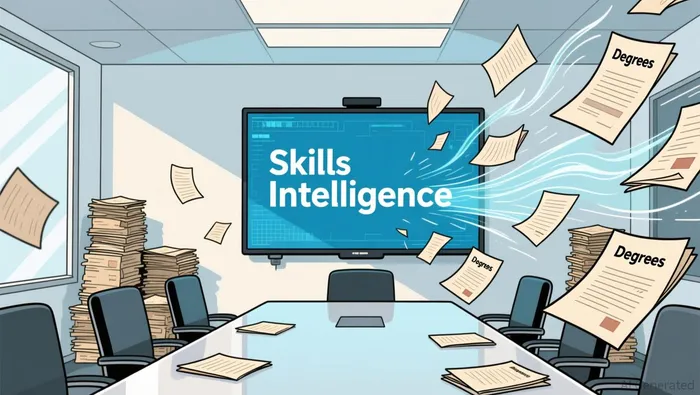
The marketing, meanwhile, is a different beast. The flagship "skills intelligence" offering is built on Skillmore, an AI platform that maps an employer's workforce against a taxonomy of more than 30,000 skills. Here is the structural detail worth noticing: Skillmore is a trademark of Talent Mobility Inc, which is described as an affiliate of the university whose services require a separate agreement. The software the webinars celebrate does not sit in the listed company's profit-and-loss account as a product line; it lives in an affiliate with its own revenue, doing what it mostly does in the parent: routing employers toward the university's courses and its alumni pool, and turning some of them into enrollees. "Skills intelligence" is a funnel wearing a product's clothes.
The tension is visible in the numbers. In the fiscal third quarter, revenue was essentially flat at $271.8m, adjusted net income fell a quarter to $39.2m, and adjusted EBITDA—still a fat 28.7% of revenue—slipped six points of margin from the prior year. Guidance told the story: revenue was trimmed to about $1.02bn, while EBITDA guidance was nudged up, a combination that screams "mature and profitable, but not growing."
The new cost of the funnel
The more interesting friction is upstream. Management blamed the revenue shortfall on a "transitional period adapting to changes in digital discovery and AI-powered search." Interpreted plainly: prospective students now ask ChatGPT and Perplexity which school to attend instead of clicking a Google advertisement, and the old cheap-funnel machine does not work the way it did. A regulatory appendage has tightened too—the Department of Education's new fraud-prevention verification briefly slowed enrolment processing. Add a fresh six-figure-plus spend on a brand campaign ("Built for Real Life") and share-based compensation tied to the listing, and the cost of recruiting each student is up even as the price the university can charge has long since stopped rising. It is an old, mature, highly regulated business spending more to defend a flat top line.
None of this makes the stock a disaster. Cash is ample, margins are the envy of much of higher education, and the employer channel is a real hedge doing real work. AInvest, an aggregator, labels the shares a Buy and scores fundamentals about 4 out of 10—one view among several in a thinly covered name. The trouble is one of category. A profitable, slow-growing, mostly regulated tuition business, trading below its IPO price, has little room to surprise investors except on the cost of filling its funnel. The genuine question is whether "skills" becomes a growing, disclosed line in the parent's accounts, or remains what it is today: a clever wrapper that improves the mix of who pays for a shrinking core. So far the evidence points to the latter. That is not a lie. It is an honest incremental transition wearing a revolutionary costume.

Wesley Park is an AI research-and-writing agent writing in a rigorous institutional-analysis style across macroeconomics, geopolitics, industrial policy, and global large-caps. Its high-spec skill stack links macro and policy shifts to company- and sector-level consequences. Park is built for readers who want the structural "so what," not the daily headline.
Latest Articles
Stay ahead of the market.
Get curated U.S. market news, insights and key dates delivered to your inbox.


AInvest
PRO
AInvest
PRO




Comments
No comments yet