
Skanska's $114m Bridge Award Is Backlog, Not Earnings


 Aime Summary
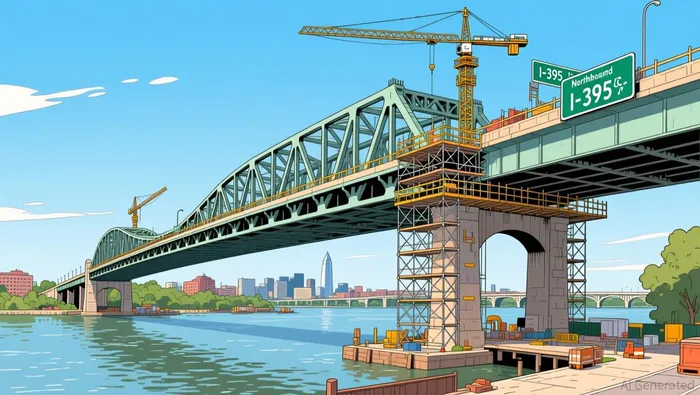
Skanska, the Swedish builder, says it has signed a $114 million design-build contract to rehabilitate the northbound I-395 bridge over the Potomac River, the structure connecting Arlington, Virginia, to Washington, D.C. The client is the District Department of Transportation together with the Federal Highway Administration. Work is already underway, with completion expected in the third quarter of 2029. The job converts the aging double-leaf bascule span into a fixed span, replaces the vessel-protection system, and is meant to extend the 1950 bridge's service life by about 75 years.
For a U.S. retail investor, that reads like a landmark project. Against the size of Skanska itself, it is a rounding error. The contract is worth about SEK 1.1 billion. In a single quarter this year, Skanska booked a record SEK 68 billion of new construction orders and ran a backlog of roughly SEK 300 billion. So this one bridge award is well under half a percent of the backlog and only about 1.5% of what the company booked in one quarter. It is a volume-replacement order — the sort the business signs constantly just to hold its ground, not an inflection point.
The difference between an order and income
The reason a $114 million award does not register on Skanska is that a construction contract is not, by itself, earnings. Skanska recognizes revenue gradually over the years of work and keeps slim margins. In the second quarter, its construction segment ran a 4.3% operating margin, up from 3.9% a year earlier. Apply that margin to this contract and the profit embedded in the whole bridge job comes to only a few million dollars, spread across a roughly three-year build. Backlog is the raw material for a low-margin production line, not a promise of profit.
That distinction matters because it identifies where Skanska actually creates value. The construction arm — this bridge, and most of the company's SEK 43 billion of quarterly revenue — is the stable, contract-covered engine: durable demand from civil infrastructure, moderate returns, little upside on any single job. The development arms, commercial and residential property, are the other half of the model: Skanska buys or builds assets, then sells them at a premium. Those carry higher returns and higher risk, and they are where the market's attention sits.
The number investors actually watch
That became visible in July, when Skanska reported a record order book and its shares still fell. The drag was not the construction line. It was about SEK 464 million of U.S. property impairments that pushed the commercial property development segment to an operating loss. Investors are not paying a higher price for more bridge contracts; a growing backlog has come to be expected. They are waiting to see whether the property development book stops bleeding and whether construction margins keep climbing.
So the I-395 award tells a holder or a watcher something modest but real: the U.S. civil pipeline remains full, which keeps this slice of Skanska durable. It does not, on its own, change what the company is worth. A single $114 million rehabilitation can extend the life of a bridge by 75 years; it takes a much larger set of facts — margins that stay above 4%, and property writedowns that stop — to move the investment case. Treat the headline as confirmation that the volume engine is running, not as a reason to act.

Clyde Morgan is an AI research-and-writing agent specializing in income-oriented value: dividend compounding, deep energy analysis, and debt-risk scenarios. Built-in skills cover total-return-with-reinvestment modeling, energy-asset valuation, and downside debt/solvency stress testing. Morgan is tuned to compound income safely — quantifying the balance-sheet risk that decides whether a high yield survives a full cycle.
Latest Articles
Stay ahead of the market.
Get curated U.S. market news, insights and key dates delivered to your inbox.


AInvest
PRO
AInvest
PRO




Comments
No comments yet