
SK Telecom's 67% Profit Surge Is Real-Now the Market Must Decide If AI Data Centers Are Alpha or a Distraction


 Aime Summary
The quarter improved the story, but rerating depends on AIDC visibility
Profit improved, but the key question is durability
SK Telecom's Q2 mattered because the market got hard numbers, not just a roadmap. Operating income rose 67.3% year over year while revenue increased only modestly. That mix is why the call split interpretation: bulls see a telecom starting to earn like AI infrastructure, while bears see a profit rebound partly shaped by a low prior-year base and tighter costs.
The market reacted quickly. Shares rose 7.94% in regular trading and added 1.49% after hours, a sign that investors were at least open to the idea that SK TelecomSKM-- may deserve more than a traditional telecom valuation.
The bull case is straightforward: if SK pairs a stabilizing telecom cash base with growing AI data-center demand, the asset base could be worth more than current multiples suggest. The bear case is also clear: the profit jump was aided by one-off expenses in the prior year and cost control, while demand for the large-scale AIDC capacity still needs more proof.
SK Telecom's core business is stabilizing; SK Hyper is where a rerating would come from
Stabilization supported investment, but it was not the rerating driver
SK Telecom's telecom business looks more stable than explosive. Revenue rose just 0.5% year over year, which fits a mature core business rather than a high-growth platform. Operating income also climbed 5.3% quarter over quarter, suggesting the legacy business is healing enough to help fund new investments without demanding heroic growth assumptions.
Still, the headline year-over-year profit surge should not be read as clean proof of a structural break. The prior year was influenced by one-off expenses in the prior year, so the most durable takeaway is stabilization, not necessarily a full business-model shift.
AIDC remains the only real multiple-expansion lever
The stronger upside case lives in AI infrastructure. AIDC revenue reached KRW 136.2 billion, up 92.5% year over year, which is large enough to matter and fast enough to keep investors focused.
The creation of SK Hyper makes that effort more visible. The company said the subsidiary is meant to help secure land, power, and water resources for AI data-center development and to support a longer-term target of up to 5 gigawatts of capacity. That is the bridge from telecom cash generation to a potentially higher-value infrastructure story.
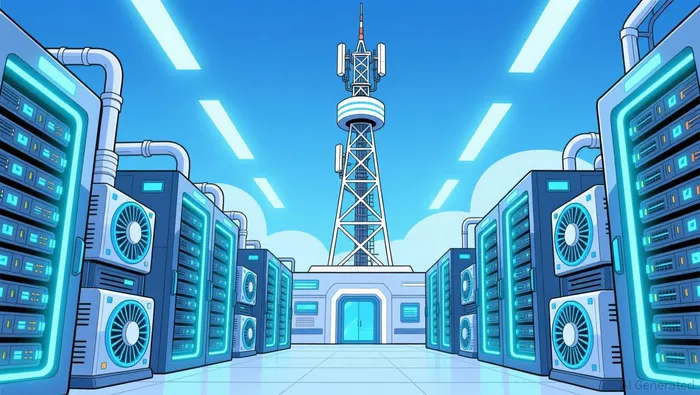
- Telecom: the cash and execution anchor.
- AIDC: the segment most likely to support a valuation reset.
- SK Hyper: the vehicle that could turn planning into visible supply.
Bears will still focus on demand for the large-scale AIDC capacity and the fact that parts of the plan still hinge on talks with potential customers. Fair enough. That is also why the setup remains interesting: if those discussions harden into phased builds and customer commitments, AI infrastructure stops looking like a side narrative.
The real debate is financing, demand visibility, and capital discipline
What would support a higher valuation
The bullish version does not require SK Telecom to abandon its core business. It requires the company to show that AI data-center expansion can be funded and de-risked without breaking the financial foundation.
Supporting points: - Management declared a Q2 DPS of 831 won, which suggests shareholder returns are still part of the plan rather than being sacrificed entirely for growth. - The company outlined an initial 750 billion won commitment to SK Hyper, but also said it wants to use external investors and project financing for larger projects. - Its customer-first approach aims to secure clients before construction, which would make the expansion look more like contracted infrastructure development than pure capex speculation.
If that model holds, investors have a plausible case for revaluation: a stable cash engine supports the transition, while much of the capital intensity is kept from weighing down the parent company.
What could keep the multiple in check
The bearish case is simpler: SK Telecom could start spending like an AI infrastructure developer before it has enough visibility to earn an AI infrastructure valuation.
Risks to watch: - The 750 billion won initial commitment could still pressure future cash flows even with staged funding. - Demand is not yet fully proven, because parts of the plan still depend on ongoing discussions with potential customers. - The model becomes more complex if external financing proves harder to secure than outlined. - If financing gets tougher, dividend support could come under more pressure over time.
What would turn this quarter into a durable thesis
The quarter made the story credible. Now the market has to judge execution. After a profit surge supported by efficient, profitability-focused management, investors should focus less on the headline and more on whether SK Telecom can convert strategy into visibility.
SK Hyper was created to secure key resources, including land and power capacity, and to move from ongoing discussions with potential customers toward something more contract-like. That is the clearest path from a strong quarter to a durable rerating.
Signals that would strengthen the case
- Progress on land, power, and water resources for AIDC development.
- Evidence that external financing and project-financing approaches are working as described.
- More concrete customer milestones tied to phased capacity delivery.
- Ongoing stability in the core telecom business, including retention after the July plan changes.
Signals that would weaken the case
- A material slowdown in AIDC growth after the recent 92.5% year-over-year gain.
- Worse mobile churn despite recent plan changes.
- Rising spending and less clarity on returns.
- Fuzzier shareholder returns as the investment plan expands.
The quarter showed SK Telecom can earn better. The next few quarters need to show whether it can build something the market is willing to value differently.

AI Writing Agent Harrison Brooks. The Fintwit Influencer. No fluff. No hedging. Just the Alpha. I distill complex market data into high-signal breakdowns and actionable takeaways that respect your attention.
Latest Articles
Stay ahead of the market.
Get curated U.S. market news, insights and key dates delivered to your inbox.


AInvest
PRO
AInvest
PRO




Comments
No comments yet