
SK Hynix Stock Drops 16% Despite Record Profit
 Aime Summary
SK Hynix delivered eye-popping financial results for the second quarter of 2026, yet the market reaction was anything but celebratory. The South Korean chipmaker reported an operating profit of approximately $42 billion, a staggering 557% increase from a year ago. Revenue climbed 257% to roughly $55 billion, marking another quarterly record for the AI memory-chip supplier. Despite these record-breaking figures, Wall Street reacted negatively. Revenue missed expectations of roughly $61 billion, and operating income came in around $44 billion, below analyst forecasts of approximately $46 billion.
Investors quickly sold the stock, with SK HynixSKHY-- shares plunging more than 16% in Seoul and dragging South Korea's Kospi down roughly 11% at one point. Rival Samsung Electronics also fell nearly 12%. The results underscore how demanding investors have become toward AI leaders. SK Hynix has been a major beneficiary of booming demand for high-bandwidth memory (HBM) chips, essential for training and running advanced AI models. However, the company failed to clear Wall Street's increasingly lofty bar, a theme becoming familiar across the AI trade: good results no longer guarantee a good reaction .
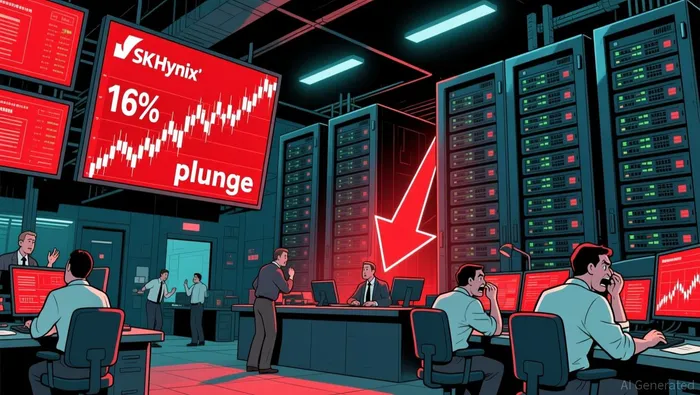
Why Did SK Hynix Stock Fall Despite Record Earnings?
The disconnect between SK Hynix's operational success and its stock performance highlights a critical shift in how the market values AI infrastructure plays. Shares have fallen roughly 60% from last month's record high, though they remain up about 540% from a year ago. The rapid buildup of short interest underscores how traders are quickly betting against one of the biggest hardware beneficiaries of artificial intelligence. According to S3 Partners, as many as 23 million of the company's American depositary receipts (ADRs) are now sold short. Based on roughly 178 million ADRs in the public float, this equates to almost 13% of shares available for trading, higher than the exchange-reported figure of about 15 million shares in mid-July.
Part of the short interest may reflect arbitrage activity rather than outright bearish bets, with some investors shorting ADRs while holding underlying Seoul-listed shares to exploit price differences. However, the rapid accumulation of short positions coincides with sharp swings in the stock and other semiconductor shares as investors reassess whether soaring AI-related spending can continue to justify elevated valuations. Chip stocks have come under renewed pressure after Alphabet boosted its capital-expenditure forecast, fueling concerns that hyperscalers may continue ramping infrastructure spending even as investors scrutinize returns on those investments. The PHLX Semiconductor Index is down more than 22% this month alone .
Analysts attribute recent memory stock volatility to a reassessment of AI-driven pricing sustainability, yet maintain a long-term bullish view due to severe supply constraints. Supply constraints remain severe because suppliers cannot quickly increase output, supporting a bullish view on the group. Oversupply risk appears distant because the industry lacks sufficient physical space to produce the semiconductors customers want. Any potential oversupply cycle may not emerge before 2028 at the earliest, as new capacity requires new buildings that take significant time to complete.
Is SK Hynix Stock a Buy After the Selloff?
Despite the recent turbulence, institutional sentiment remains overwhelmingly positive. SK Hynix maintains strong analyst support with an average 'Buy' rating from five key brokerages, including two 'Strong Buy' and two 'Buy' recommendations. The average 12-month price target stands at $204 to $300, though recent adjustments have lowered targets slightly to account for lower Q2 average selling prices. The consensus remains overwhelmingly positive, with 41 'Buy' ratings and only 2 'Hold' ratings among 43 covering analysts. The stock still implies upside potential of 121-124% based on recent closing prices.
Adding to the bullish case, SK Group Chairman Chey Tae-won reportedly made his first-ever personal purchase of SK Hynix stock, buying 3,620 shares valued at about 4.79 billion won ($3.34 million). The transaction falls just below South Korea's five billion won threshold for advance disclosure. This move gives Chey a direct ownership stake in the chipmaker for the first time, having previously maintained indirect control through SK Square, which owns about 20% of the company . Earlier this month, Chey reiterated his long-term view on the memory chip industry, stating, “Memory chips will continue to be needed, so the stock price will rise over time. Rather than buying and selling repeatedly, it is better to hold on to the shares.”
Wall Street analysts see significant upside potential. UBS initiated coverage of SK Hynix's U.S.-listed ADRs with a ‘Buy’ rating and a $204 price target, arguing that the recent pullback created an attractive entry point. UBS contends that the current valuation does not fully reflect the company's structurally higher memory profitability, stronger free cash flow generation, and improving shareholder returns . Barclays maintained an ‘Overweight’ rating but lowered its price target to $300 from $330, noting that high-bandwidth memory pricing should remain a tailwind into 2027. On the operational front, SK Hynix announced it has finalized long-term supply agreements (LTAs) with around 10 customers, including key strategic partners, to secure mid- to long-term supply stability.
The company’s planned roughly $31 billion spending program raised concerns about overcapacity, cyclicality, and the risk that today’s elevated memory prices may not last. However, analysts suggest that the "easy money" in memory stocks has largely been made, although the longer-term industry outlook remains constructive. For investors without existing exposure, waiting rather than chasing recent weakness is recommended. Better pricing is expected over the next month or two, as investors typically return to the memory sector in late summer .
SK Hynix's $26.5 billion Nasdaq debut catalyzed a broader semiconductor surge driven by insatiable AI demand for high-bandwidth memory and NAND flash. This hardware boom is reshaping cost structures for crypto miners and decentralized compute projects, creating competitive advantages for vertically integrated players while squeezing smaller operators. While rising costs may squeeze margins for smaller mining operations, vertically integrated players who locked in hardware contracts early stand to benefit. This mirrors the 2021 GPU shortage, where crypto miners and gamers competed for limited silicon. Investors should monitor SK Hynix’s post-debut price action as a leading indicator; stabilization above the listing price suggests continued bullish sentiment for the AI supply chain, while a sustained sell-off could signal that AI optimism is overpriced.
Management struck an optimistic tone despite the selloff, maintaining a bullish outlook for the second half of 2026. The company expects tight supply and strong demand for AI memory chips to continue supporting the market. US-listed American depositary receipts (ADRs) fell another 7% after hours following a 9% decline during the regular session. The results underscore how demanding investors have become toward AI leaders, but the fundamental demand for AI infrastructure remains intact.

Stay ahead of the market.
Get curated U.S. market news, insights and key dates delivered to your inbox.


AInvest
PRO
AInvest
PRO




Comments
No comments yet