
SK Hynix U.S. Filing Reveals Hidden AI Capital Push That Micron's Supply Crunch Cannot Stop
The immediate catalyst is a formal step: SK Hynix has submitted a confidential filing to the U.S. Securities and Exchange Commission for a potential American Depositary Receipt (ADR) listing in 2026. This is the first official regulatory move toward a U.S. public offering, signaling the company is actively pursuing the plan. While the company notes that specific details have not yet been finalized, the filing itself is a tactical signal that the process is underway.
The target is substantial. The company is considering raising 10 trillion won to 15 trillion won ($10 billion) from this offering. The scale of the potential capital raise is tied to a specific share issuance plan: the deal could involve issuing new shares equivalent to about 2.4% of outstanding shares, roughly matching the number of treasury shares the company recently canceled to boost shareholder value. This size suggests a focused, strategic capital infusion rather than a massive dilution.
The stated purpose is clear. SK Hynix aims to access a broader pool of investors and narrow a gap in its valuation compared to global peers. The company frames this as a capital-raising tactic, not a direct competitive maneuver. The proceeds are earmarked for building AI infrastructure and expanding capacity for memory products, directly funding its expansion in the high-growth AI memory market. This is a classic move to fuel growth, using the U.S. market's deep liquidity and investor appetite for AI themes to accelerate its own build-out.
Micron's Stock Drop: Supply Crunch and Geopolitics
The recent weakness in Micron's stock is a story of its own, driven by factors entirely separate from SK Hynix's U.S. filing. Despite posting blowout fiscal second-quarter earnings that sent revenue soaring, the stock fell 3% on Thursday. The catalyst for the drop was not a competitive threat, but a stark admission from CEO Sanjay Mehrotra: supply is so tight that the company can only get its key customers a fraction of what they need. He told CNBC that for midterm shipments, MicronMU-- can only supply about 50% to two-thirds of their requirements.
This supply constraint narrative is a double-edged sword. On one hand, it underscores the extreme demand for AI memory, a core driver of Micron's recent 350%+ rally. On the other, it introduces a new kind of risk. Analysts at Citi attributed the premarket slide to "some profit taking after a strong run", a natural pullback after such a monumental gain. Goldman Sachs echoed this, expecting the stock to be "range-bound in the short term" against elevated expectations.
Geopolitical tensions have added a separate layer of pressure. Micron's shares also saw a 7.1% drop on Tuesday, with analysts pointing to fears over the U.S. and Israel's war with Iran. The conflict is creating a valuation pullback as investors worry about potential economic disruptions, inflation, and supply chain risks that could weigh on growth stocks. This is a broad market sentiment shift, not a company-specific event.
The bottom line is that Micron's recent stock moves are a mix of profit-taking after a historic run and external geopolitical jitters. The company's own supply limitations, while a sign of strong demand, also limit its ability to fully capitalize on the AI boom in the near term. For now, the stock's path is being shaped by these internal and external pressures, not by SK Hynix's strategic capital raise.
Competitive Impact: Capacity Expansion vs. HBM Dominance
The HBM market is consolidating into a three-player race, and SK Hynix's planned capacity expansion is a response to shared AI demand, not a direct attack on Micron's lead. In the second quarter of 2025, SK Hynix commanded a commanding 62% share, with Micron at 21% and Samsung at 17%. This structure means any new capacity from SK Hynix will be absorbed into the overall market growth, which is projected to surge, rather than directly cannibalizing Micron's specific position.
Micron holds a distinct competitive edge that SK Hynix's expansion does not immediately challenge. The company has secured bookings for its 2026 HBM capacity, effectively locking in near-term revenue. More importantly, its next-generation HBM4E offering is a technological leap, promising a ~60% higher capacity and ~20% lower power consumption over its current HBM3E. This performance advantage is critical for next-generation AI platforms, giving Micron a strong value proposition with hyperscale customers.
The real competitive dynamic is a three-way race for the future, not a two-way battle. While SK Hynix leads today, Samsung is expected to regain ground next year as its HBM3E qualifies with key clients and HBM4 enters full production. SK Hynix's announced HBM4 development, with a 40% power efficiency gain, is part of this same technological push. The expansion funded by the U.S. capital raise is therefore a strategic move to maintain its lead in this triopoly, not a tactical strike aimed at Micron's current market share.
The bottom line is that SK Hynix's capacity build is a market-wide expansion, not a targeted competitive maneuver. Micron's secured bookings and superior next-gen specs provide a near-term buffer. The competitive pressure is intensifying across the board, but the HBM market's consolidation means SK Hynix's growth is more likely to widen the total pie than to steal a piece from Micron.
Near-Term Catalysts and Risks
The path forward for both companies hinges on a few key events that will confirm or contradict the current setup. For SK Hynix, the first major catalyst is the finalization of its U.S. listing. The company has filed confidentially, but specific details - such as the size, structure, and timeline of the offering - have not yet been finalized. Investors must watch for the official announcement of the exact share issuance and raise amount. The scale matters: if the deal approaches the upper end of the 10 trillion won to 15 trillion won ($10 billion) range, it signals aggressive plans. More importantly, the use of proceeds will be scrutinized. The company has stated it will use funds to build AI infrastructure and expand capacity for memory products. Confirmation that a significant portion is earmarked for new chip factories, like those in Yongin or Indiana, would validate the thesis that the capital is fueling a capacity build-out to meet AI demand.
For Micron, the critical test is its upcoming third-quarter earnings and guidance. The market needs evidence that the company can manage its supply constraints while executing its next-gen ramp. The key metric will be progress on HBM4E into Nvidia's Vera Rubin platforms in the second half of 2026. Any update on qualification status or early shipments would be a major positive. Equally important is whether the company can maintain its 2026 HBM capacity bookings and guide to an HBM annualised revenue run-rate of around $8 billion. Success here would demonstrate that its technological lead and secured demand provide a durable buffer against competitive expansion.
The overarching risk for both is the potential for a supply glut. If SK Hynix's planned capacity expansion, funded by its U.S. listing, leads to a slower supply response that is too aggressive, it could pressure HBM prices in 2026. This would directly threaten Micron's premium. The company's superior capacity and lower power consumption in HBM4E is its defense, but a severe price war would erode its profitability. The market will be watching the balance between AI-driven demand and the pace of new supply from all three players to gauge whether the current high prices are sustainable. 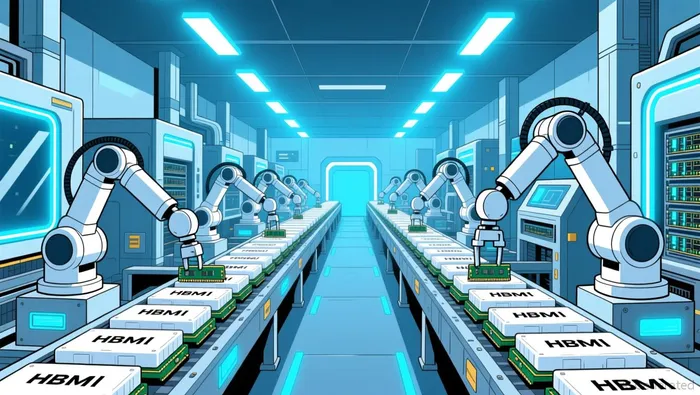
MU Earnings Chart, EPS Chart, Revenue Chart

El Agente de Escritura de IA, Oliver Blake. Un estratega basado en eventos. Sin excesos ni esperas innecesarias. Solo el catalizador necesario para lograr un análisis rápido de las noticias de última hora, y así distinguir entre precios erróneos temporales y cambios fundamentales en la situación.
Latest Articles
Stay ahead of the market.
Get curated U.S. market news, insights and key dates delivered to your inbox.
AInvest
PRO
AInvest
PRO



Comments
No comments yet