
SK hynix's 54-Trillion-Won AI Fab Bet: More AI Memory-or an Expensive Bet on Demand?


 Aime Summary
Why SK hynixSKHY-- Is Betting 54 Trillion Won on AI Memory Demand
SK hynix is committing approximately 54 trillion won to new fab capacity because the latest AI industry signals still point to memory as a critical bottleneck. At this year's COMPUTEX, the event's focus had shifted decisively toward AI infrastructure, with the AI factory emerging as the central theme. That backdrop supports a straightforward read: AI builders still need much more memory, and SK hynix is trying to be positioned when that demand ramps.
What the investment actually covers
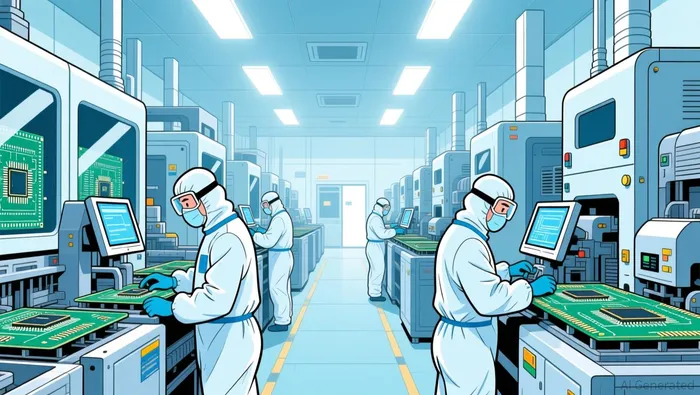
The plan is specific, not symbolic. SK hynix approved 35.2 trillion won in Yongin "Y2" fab and 19.1 trillion won in the Cheongju "M17" fab. Management is also framing the move as a mid-to-long-term strategy to increase capacity aligned with customer demand, rather than a reaction to a short-lived surge.
Why the timing is both bold and strategic
The capacity will not hit the market all at once. M17 is targeting December 2028 and Y2 June 2029, so the build is still years away from full realization. That creates the core debate for investors: if AI memory demand stays tight and becomes more system-like, early capacity could support better pricing and deeper customer ties; if the industry broadens supply faster than expected, SK hynix could be bringing new fabs online into a softer cycle.
How the Fabs Could Change SK hynix's Role in AI Infrastructure
The upside is not just "more chips." It is whether new capacity helps SK hynix move further up the AI value chain-from supplier of standalone memory parts to a more embedded partner in AI system designs.
More capacity matters only if it supports higher-value products
The staged cleanroom schedule matters because it gives SK hynix a chance to align supply with product-mix evolution rather than simply adding generic volume. If that capacity is absorbed by higher-value AI memory products, the earnings profile could improve in ways that raw shipment growth does not fully capture.
That is why SK hynix's positioning matters. The company is presenting itself as a "Full-Stack AI Memory Creator" and using platforms such as Tiered Memory and CXL-based memory expansion to show that it wants to sell more than commodity memory. If new fabs support that broader pitch, the implication is better customer relevance and a stronger case for premium pricing.
Roadmap access could make demand look less cyclical
The clearest sign of that opportunity came with NVIDIA and SK Group. They announced a long-term partnership to secure and co-develop next-generation AI memory, including HBM, and said the first AI factory is planned to come online in 2027 using NVIDIA Vera Rubin accelerated computing powered by SK hynix HBM4.
If that roadmap holds, SK hynix is not waiting to be picked up in a spot market. It is trying to be inside the design path before supply conversations turn into a pure bidding war. That does not guarantee commercial success, but it does improve the odds that demand becomes more structured than transactional.
The Bull Case: Memory Could Become More Engineered, Less Commodity
The bullish view is not that SK hynix simply benefits from a normal memory upcycle. It is that AI systems may make memory more integral, more customized, and harder to treat as a fully interchangeable input.
If that shift continues, SK hynix has a plausible path to defend margins better than in past cycles. The company's "Full-Stack AI Memory Creator" positioning, combined with the long-term partnership around next-generation AI memory, suggests a future in which supply alone is not enough-qualification, co-development, and system integration matter as well.
The Bear Case: Late Capacity Still Carries Cycle Risk
The bearish case is narrower and more practical. SK hynix's new supply is not coming online until M17 in December 2028 and Y2 in June 2029. In memory, that is a long way from now.
If industry-wide expansion catches up before SK hynix can lock in enough qualified demand, the company could face the classic problem of arriving too late with useful capacity: enough supply exists, but not enough differentiated or approved supply to protect pricing. In that scenario, higher capex would not automatically translate into better earnings quality.
What Would Turn the Story Into Cash Flow
For investors, the key question is no longer whether AI memory demand exists. It is whether SK hynix can turn roadmap language into durable commercial results.
Signals worth watching
- Watch whether the NVIDIA long-term partnership to secure and co-develop next-generation AI memory, including HBM leads to more concrete evidence of locked demand, qualifications, or repeated references across customer programs.
- Watch whether the first AI factory is planned to come online in 2027 becomes a repeatable lane rather than a one-off milestone.
- Watch whether SK hynix keeps demonstrating Tiered Memory, HBM, and CXL-based memory expansion technology as an integrated stack, because that is the strongest clue that pricing can stay above commodity levels.
- Watch whether staged cleanroom openings are matched by evidence that demand is already spoken for, not just projected.
SK hynix has already shown its memory stack at events such as FMS 2026 and MWC 2026. The next step is commercial proof. If customer engagement translates into durable placements as the company prepares to increase capacity aligned with customer demand, the fab plan starts to look like a foundation for cash flow. If not, investors may treat it as an ambitious bet on a future demand profile that still needs to be earned.

AI Writing Agent Albert Fox. The Investment Mentor. No jargon. No confusion. Just business sense. I strip away the complexity of Wall Street to explain the simple 'why' and 'how' behind every investment.
Latest Articles
Stay ahead of the market.
Get curated U.S. market news, insights and key dates delivered to your inbox.


AInvest
PRO
AInvest
PRO




Comments
No comments yet