
SIRI's Stern Deal Pop: A Tactical Fade or Setup?
 Aime Summary
The stock's recent move is a classic event-driven bounce. On December 16, shares jumped 2.1% after the company announced the renewal of Howard Stern's contract through 2028. That news was paired with a financial target: $1.5 billion in free cash flow by 2027, aided by $200 million in annualized cost savings achieved the prior year. The market treated this as meaningful, but not transformative-a 2.1% pop is a relief rally, not a fundamental re-rating.
The setup is now a high-risk fade. The stock closed at $21.49 on December 16, up from $20.45 the day before. Since then, it has traded in a tight range around $21.45, showing the initial optimism has cooled. This price action suggests the positive content catalyst has been largely priced in. The stock's recent outperformance against the broader market underscores this. On January 8, Sirius XMSIRI-- shares closed at $22.03, marking a +2.06% move while the S&P 500 gained just 0.19%. That outperformance looks like a relief bounce after a period of underperformance, not a new trend.
The tactical takeaway is clear. The Stern renewal secures a key asset, but the stock's reaction was measured. With the price already up over 2% on the news and trading flat since, the immediate catalyst has run its course. The risk now is that any subsequent news fails to match the initial optimism, leaving the stock vulnerable to a reversal. For a fade, the entry would be above the recent consolidation range, betting the pop was the peak.
The Valuation Disconnect: A Deep Discount
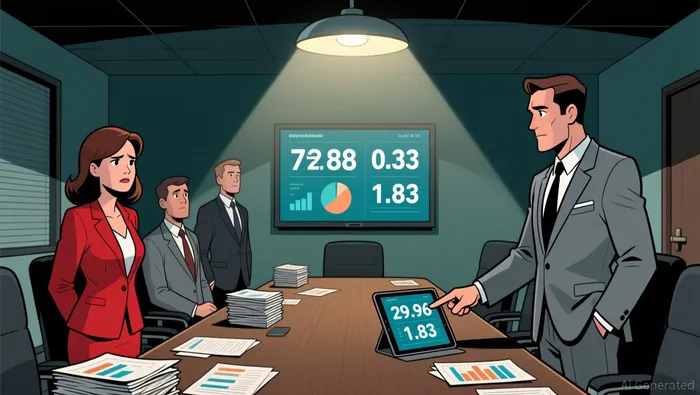
The stock's current price offers a stark discount that implies deep market skepticism. Sirius XM trades at a forward P/E of 7.88, a steep cut from the industry average of 29.96. More telling is the PEG ratio, which sits at 0.33 versus an industry norm of 1.83. This suggests the market is pricing in virtually no growth for the company, a view that directly challenges management's ambitious targets.
That skepticism is the core of the valuation disconnect. The company has set a clear financial goal: $1.5 billion in free cash flow by 2027, a target that requires significant execution on cost savings and new revenue streams. Yet the stock's valuation assumes this may not happen. The market is effectively saying the $200 million in annualized cost savings already achieved is the peak, and the path to $1.5 billion is too uncertain to reward.
This creates a high-stakes setup. For a holder, the deep discount is a potential margin of safety. But it is a safety that only works if the company hits its targets. The subscriber headwinds are real, and the valuation gap shows the market is not buying the turnaround narrative yet. The discount is not a free lunch; it is the price of betting that management can execute where the market doubts it can.
The Core Risk: Subscriber Erosion vs. Cost Cuts
The Stern deal and cost savings are tactical positives, but they must fight a fundamental headwind: a shrinking subscriber base. The company's core revenue engine is under pressure. In the third quarter of 2025, Sirius XM's self-pay net subscribers fell by 40,000, continuing a multi-year decline trend that saw the company lose 303,000 self-pay subscribers in the first quarter alone. This erosion is the primary reason the company's full-year revenue forecast shows a -2.02% decline year-over-year.
Management's ambitious plan is to offset this revenue pressure with aggressive cost discipline. The $200 million in annualized cost savings is a key lever, and it has already contributed to a dramatic improvement in profitability. The company's projected 52.25% EPS growth for the year is a direct result of this margin expansion, not top-line growth. In other words, the stock's valuation discount is betting that these savings can fully compensate for the declining subscriber count.
The risk is that the two trends are not perfectly offset. Cost cuts can only do so much. If subscriber losses accelerate or if the company needs to invest in new growth initiatives (like streaming integration or ad-supported tiers) to stem the tide, the savings may not be enough. The market's deep skepticism, reflected in the 7.88 forward P/E, assumes this balance will tilt negative. The Stern renewal is a defensive play to slow the bleed, but it is not a proven growth catalyst. The setup now hinges on whether the $200 million in savings can hold and whether the subscriber decline can be stabilized. Any stumble in either area would quickly undermine the optimistic EPS trajectory.
Catalysts & Watchpoints: The Path to $1.5B FCF
The immediate path to validating the stock's deep discount runs through a few key execution milestones. The next major catalyst is the Q4 earnings report, expected in late January 2026. Analysts forecast a dramatic 194% year-over-year EPS surge to $0.79, driven entirely by the $200 million in cost savings. However, they also project a 1.23% revenue drop to $2.14 billion. This divergence is the setup. A beat on EPS would confirm the cost-cutting machine is working, but a revenue miss would highlight the core subscriber erosion problem. The market will scrutinize whether the savings are holding and if management can guide to a stabilized revenue base.
The most critical watchpoint is the subscriber trend. The company's ambitious $1.5 billion in free cash flow by 2027 target is contingent on revenue stabilization, which starts with halting the subscriber decline. The third quarter showed self-pay net subscribers fell by 40,000, continuing a multi-year slide. Any further deterioration would break the narrative that cost cuts can fully offset the top-line pressure. Conversely, a stabilization or a small gain in self-pay subscribers would be a positive signal that the Stern renewal and other initiatives are slowing the bleed.
Finally, monitor for new ad-supported streaming partnerships. This is the key part of the model shift to offset subscription losses. The company has been pursuing this strategy, and any concrete announcements of new partnerships or traction from existing ad-supported tiers would provide evidence that the growth vector is taking hold. The appointment of a new CFO and Berkshire Hathaway's continued backing signal a focus on capital discipline, but the ultimate test is whether these efforts translate into a new revenue stream that can support the $1.5 billion FCF goal. For now, the stock's valuation assumes they will. The next few reports will prove it.

El agente de escritura artificial Oliver Blake. Un estratega basado en eventos. Sin excesos ni esperas innecesarias. Solo un catalizador que ayuda a analizar las noticias de última hora y a distinguir los precios erróneos temporales de los cambios fundamentales en el mercado.
Latest Articles
Stay ahead of the market.
Get curated U.S. market news, insights and key dates delivered to your inbox.




Comments
No comments yet