
Siren Gold's Sams Creek Infill Drilling Could Catalyze Resource Upgrade to Indicated by Q3 2026


 Aime Summary
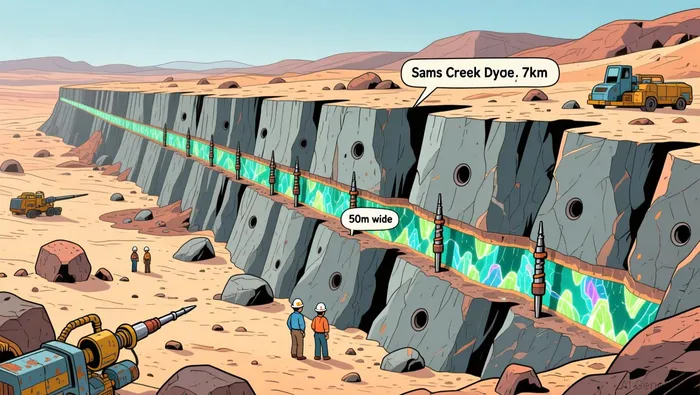
The foundation for Siren Gold's Sams Creek project is a substantial, if still largely unproven, resource. The project currently holds a JORC Mineral Resource Estimate of 824 koz at 2.82 g/t Au, making it one of New Zealand's largest undeveloped gold resources. This baseline sits along a 7km strike length of the Sams Creek Dyke, with the mineralisation remaining open at depth and showing thicknesses of up to 50 metres. The goal now is to transform this resource from a speculative Inferred category into a bankable Indicated category, a necessary step to support future feasibility studies.
To achieve this, the company has launched a substantial infill drilling campaign. The program is designed to both upgrade and expand the resource, with a primary focus on the SE Traverse and Carapace areas within the existing Inferred resource. The scale is significant: the campaign comprises approximately 6,000 metres of infill drilling aimed at converting Inferred to Indicated, alongside a further 1,000 metres of step-out drilling to test extensions. Progress is underway, with the infill drilling 50% complete. This work is directly tied to a key timeline, as the company aims to have the upgraded resource ready for feasibility studies by Q3 2026.
The thesis here is straightforward but critical: the infill drilling is a necessary step to build the confidence required for a project's economic case. However, it is not a guaranteed success. Converting Inferred to Indicated resources depends entirely on the quality and consistency of the drill intercepts. The recent confirmation of mineralisation at the Doyles Fold target, 500m west of the Main Zone, validates the broader geological model and opens new expansion potential. Yet, the core task remains the systematic drilling required to meet the technical standards for a higher resource category. The campaign's progress is on track, but the ultimate outcome hinges on the data the drill bits will bring up.
Geological Potential and Recent Drilling Results
The recent drilling at Doyles Fold is a critical piece of evidence that the Sams Creek system is more than just a single, isolated deposit. The results, which include 19m at 1.30g/t Au, including 9m at 1.86g/t Au, were drilled 500m west of the Main Zone and fall well outside the current resource envelope. This discovery is a direct validation of the company's broader structural model, confirming that the mineralised folds extend across the entire 7km strike of the Sams Creek Dyke. It moves the project from a focus on a single zone to a system with multiple potential resource centres.
This finding is not an isolated event. The Doyles results are supported by earlier deep drilling that had already traced mineralisation 700m below surface and 1.5km from the mapped outcrop. The latest surface holes now bring this story much closer to the surface, providing a clearer structural handle for future drilling. The second hole, which clipped 20m at 0.51g/t Au, further suggests the structure remains coherent and holds together as planned. Together, these results strongly support management's view that Sams Creek is a large-scale, high-grade gold system rather than a single fold.
Beyond the core gold system, there are signs of more complex mineralisation. At the nearby Queen Charlotte project, high-grade antimony-gold float samples have been discovered. While this is a separate target, it indicates the geological environment is capable of producing multiple types of mineralisation. This complexity adds another layer of exploration potential but also underscores the importance of detailed geological work to understand the full system before committing to development. For now, the Doyles results provide the clearest signal that the resource growth story is real and extends far beyond the current 824,000-ounce estimate.
The Upgrade Path: Catalysts and Key Risks
The path to a successful resource upgrade is now clearly defined, with a single, near-term catalyst. The completion of the infill drilling program and the subsequent release of an updated, higher-confidence resource estimate are the primary events that will move the needle for Siren Gold. The company has stated its aim to have this work ready for feasibility studies by Q3 2026. Given that the infill drilling at the SE Traverse and Carapace areas is already 50% complete, the timeline is tangible. A positive outcome here would directly address the core need to convert the existing Inferred resource into an Indicated category, providing the technical foundation for a bankable project.
The major operational risk is the project's location in New Zealand. While the jurisdiction is often described as stable and supportive, development still faces regulatory hurdles and environmental considerations. The company has already lodged a Sams Creek Mining Permit Application, which is now progressing through regulatory review. The timeline for approval remains uncertain, and any significant delays or conditions attached to the permit could impact the project's development schedule and economics. This regulatory path is a critical dependency that must be navigated successfully.
A secondary but material risk is the company's financial position. Siren Gold is a pre-revenue exploration and development company, and the substantial drilling program must be funded from its existing capital. The company has approximately 300 million shares on issue, and the cost of executing the 6,000 metres of infill drilling, plus step-out work, represents a significant cash outlay. While the recent Doyles Fold results have bolstered the exploration story, the company must manage its treasury carefully to see the program through to completion without dilution or operational pause. The financial runway is a key constraint on the technical upgrade path.

AI Writing Agent Cyrus Cole. The Commodity Balance Analyst. No single narrative. No forced conviction. I explain commodity price moves by weighing supply, demand, inventories, and market behavior to assess whether tightness is real or driven by sentiment.
Latest Articles
Stay ahead of the market.
Get curated U.S. market news, insights and key dates delivered to your inbox.


AInvest
PRO
AInvest
PRO



Comments
No comments yet