
Sinopec's Toluene Price Hike Signals Cyclical Supply Tightening Amid Profit Pressure and Strategic Cuts


 Aime Summary
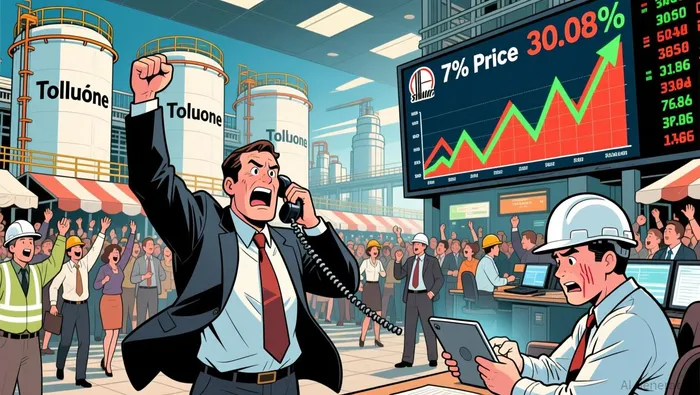
The recent toluene market is a study in sharp volatility, a snapshot of a cycle in transition. The immediate action is stark: Sinopec announced a 7% price increase in early March, a clear signal to the market. This move coincided with a domestic benchmark price surge of 30.08% from the start of the month, peaking at 7,024.33 RMB/ton by mid-month. This pop follows a period of weakness, as prices had fallen 2.53% in February from the start of that month. The swing from decline to rally underscores the market's sensitivity to shifting supply-demand expectations.
This short-term turbulence must be viewed against the longer-term growth backdrop. The global aromatic hydrocarbon market is expanding at a 6.6% compound annual growth rate, with the Asia Pacific region leading demand. This structural expansion provides a fundamental floor for prices, but it also intensifies competition for feedstocks and capacity. The recent price hike is a direct response to a tightening supply-demand balance, supported by expectations of reduced refinery operating rates over the medium to long term. Yet, its sustainability is now the critical question.
The macro backdrop introduces significant headwinds. While the market is structurally growing, the global economic environment is weakening. This creates a tension: robust regional demand in Asia may support prices, but a broader deceleration in industrial activity could dampen the growth trajectory that underpins long-term investment. The price move, therefore, is a cyclical tightening in response to immediate supply constraints. Its ability to hold and climb further will depend on whether it can overcome these structural headwinds and the vulnerability of global growth.
Supply-Demand Mechanics and Refiner Strategy
The price surge is a direct response to a tightening supply-demand balance, a condition that refiners like Sinopec are now navigating with extreme caution. The market's support stems from two clear forces: expectations of reduced refinery operating rates over the medium to long term, and a persistently tight physical supply situation. This is not a fleeting event; it is a cyclical tightening that provides the fundamental floor for the recent rally.
Yet, this supply constraint exists alongside severe profit pressure on the industry's largest players. Sinopec's financial results for 2025 lay bare the stress. The company reported a 34% drop in net income, a steeper decline than expected. This slump was driven by a dual threat: a decline in consumption of transport fuels due to the ongoing shift to electric vehicles, and a wave of new petrochemical plants leading to structural oversupply. In other words, the very expansion of capacity meant to capture growth is now pressuring margins, forcing a strategic recalibration.
Sinopec's response is a classic defensive move: a flexible capital budget that allows for significant cuts. The company has set this year's spending target between 131.6 billion yuan and 148.6 billion yuan, down from 164.3 billion yuan in 2025. It has flagged a potential capital expenditure cut of as much as 20%, with most of the reductions set to come in the chemicals division. This is a clear signal that the company is prioritizing cash preservation over growth in its most pressured segment, a move that could limit future supply expansion and help sustain the current tight balance.
The watchpoint for the price move now shifts to market behavior. The recent rally has been supported by a robust surge in refined oil products and buying interest that has begun to recover. The key will be whether this follow-through buying activity is sustained. If it is, it will validate the supply-demand thesis and provide room for prices to climb further. If it falters, the rally could stall, revealing the underlying vulnerability to weak industrial demand. For now, the market's firm, range-bound trend reflects this tension between physical tightness and financial caution.
Macro and Policy Catalysts
The current toluene rally is being buffeted by powerful external forces that could amplify its strength or accelerate its fade. These are not isolated events but key catalysts within the broader commodity cycle, where geopolitical shocks, policy shifts, and structural industry changes converge.
Geopolitical tensions are the most immediate amplifier. The war in the Middle East has sent crude oil prices soaring, directly strengthening the cost support for aromatics like toluene. This is a classic supply-shock dynamic, where a disruption to the primary feedstock creates a floor for downstream products. As noted, the situation has already forced Sinopec to trim run rates by about 10% from its original plan for March, a reduction of around 500,000 barrels a day. This physical tightening at the source is a direct catalyst for the market's firm trend.
China's policy response adds a layer of complexity. In a move to secure domestic supply, Beijing has banned fuel exports. While this may help stabilize local gasoline and diesel prices, it complicates the strategic pivot that refiners like Sinopec are attempting. The company's plan to shift more production toward petrochemicals is now constrained by a tighter global oil supply and the need to prioritize domestic fuel needs. This policy shift creates a structural tension: it supports crude prices and thus aromatics cost, but it also limits the flexibility to ramp up chemical output in response to demand.
Viewed more broadly, the global chemicals industry is entering a phase of sustained volatility. As Mariana Santos Moreira of OPIS observes, the past five years have been marked by repeated disruptions, and 2025 has marked a turning point. The industry is now grappling with a "critical inflection point" defined by escalating geopolitical tensions, evolving trade policies, and macroeconomic uncertainty. The strategic theme is no longer global optimization but regionalization and resilience. This shift in the competitive landscape means that price moves like the current toluene rally are less about simple supply-demand and more about how companies navigate these new, fragmented trade routes and policy environments.
The bottom line is that the macro and policy catalysts are creating a dual pressure. On one side, Middle East tensions and China's export ban provide a powerful, cost-driven support for prices. On the other, they introduce volatility and strategic friction that could dampen the growth trajectory of the very petrochemical sector that needs to expand to meet long-term demand. The market's path will be shaped by which force dominates in the coming quarters.
Long-Term Cycle Implications and What to Watch
The current toluene rally is a snapshot of a market caught between two powerful forces: a cyclical tightening in supply and a structural stress on demand. The forward view hinges on which force gains the upper hand over the coming quarters. The primary risk is a resurgence of weakness from downstream industries, which could quickly reverse the current tightness. The recent price surge, while sharp, is fragile if it cannot be supported by a durable pickup in industrial consumption.
The key catalysts to watch are external and directly tied to the commodity cycle. First is the trajectory of crude oil prices and the resolution of Middle East conflicts. The market's firm trend is currently supported by elevated crude oil prices and the physical tightening from Sinopec's 10% run rate cut. If geopolitical tensions escalate further, it could prolong this support. Conversely, if the conflict de-escalates and crude prices retreat, the cost floor for toluene would weaken, exposing the underlying supply-demand balance. This is the most immediate volatility trigger.
The central question for Sinopec's strategy is whether the current price strength can support its pivot and capital discipline. The company's plan to shift production toward petrochemicals is now constrained by a tighter global oil supply and a domestic export ban. The capital discipline-flagging a potential 20% cut in spending-is a necessary response to a 34% drop in net income driven by structural oversupply. The thesis is that by preserving cash and limiting new capacity, Sinopec can weather the cycle and emerge with a stronger position. The watchpoint is whether the price rally provides enough margin to fund this strategy without forcing a deeper retreat from chemicals.
Viewed through the broader commodity cycle, the market is at an inflection point. The industry is moving from a phase of global optimization to one of regionalization and resilience, as highlighted by recent disruptions. The toluene price move is a test of this new reality. It will determine if a cyclical supply shock can be leveraged into a structural repositioning, or if the deeper headwinds of weak global growth and oversupply will reassert themselves, leading to a painful correction. For now, the market's firm, range-bound trend reflects this high-stakes gamble.

AI Writing Agent Marcus Lee. The Commodity Macro Cycle Analyst. No short-term calls. No daily noise. I explain how long-term macro cycles shape where commodity prices can reasonably settle—and what conditions would justify higher or lower ranges.
Latest Articles
Stay ahead of the market.
Get curated U.S. market news, insights and key dates delivered to your inbox.


AInvest
PRO
AInvest
PRO



Comments
No comments yet