
Singapore Airlines' A350 Fleet Upgrades: A Catalyst for Premium Travel and Aviation Industry Revival


 Aime Summary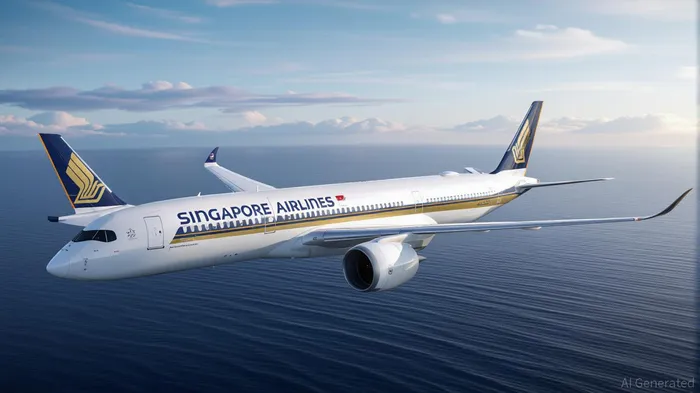
The aviation industry is witnessing a seismic shift as global travel demand rebounds post-pandemic, and Singapore Airlines (SIA) is leading the charge with its bold A350 fleet upgrades and strategic route adjustments. For investors, this is more than just an airline modernizing its fleet—it's a signal of growing confidence in the premium travel sector and a harbinger of broader industry revitalization.
The A350: A Powerhouse of Efficiency and Premium Innovation
Singapore Airlines has become the world's largest operator of the Airbus A350-900, with 58 aircraft in service and seven ultra-long-range (ULR) variants dedicated to non-stop routes like Singapore to New York and Los Angeles. These aircraft are not just about range—they're engineered for fuel efficiency, advanced cabin technology, and passenger comfort. The A350-900ULR, in particular, has redefined long-haul travel by eliminating economy class entirely on some configurations, focusing instead on 67 business class suites and 94 premium economy seats.
But SIA's ambitions go further. A $1.1 billion retrofit program is transforming its A350 fleet into a premium travel powerhouse. The upgrades include: - Privacy-focused Business Class suites with alternating window/aisle seating and enclosed doors, inspired by Qantas' Safran Unity design. - First Class cabins on ULR aircraft, featuring four fully enclosed suites with angled doors and private window shades. - Tech-driven enhancements like 4K-resolution screens, USB-C and wireless charging, and Bluetooth connectivity.
These investments are not just about luxury—they're about capturing high-margin demand. Business and first-class travelers are willing to pay a premium for privacy and comfort, and SIA's upgrades position it to outcompete rivals in the premium segment.
Strategic Route Adjustments: Flexibility in a Volatile Market
SIA's route strategy has evolved to balance efficiency and demand. While it temporarily scaled back A350 ULR operations in 2024 due to maintenance checks, the airline has since reallocated these aircraft to high-demand routes like London Heathrow and Auckland. This flexibility is critical in an industry where fuel costs and geopolitical tensions can disrupt operations.
The A350's versatility also allows SIA to replace older, less efficient aircraft (e.g., BoeingBA-- 777-300ER) on long-haul routes while deploying the same fleet for regional missions. For example, the A350-900 is now supplementing services on the Singapore–Auckland route alongside the A380, optimizing capacity utilization. This dual-use strategy reduces fleet complexity and operational costs, a key advantage in a sector where fixed costs are a major drag on profitability.
p.p1 {margin: 0.0px 0.0px 0.0px 0.0px; font: 13.0px 'Helvetica Neue'} span.s1 {font: 13.0px '.AppleAAPL-- Color Emoji UI'}
📺 Bitcoin $200K? The math behind the next crypto supercycle.
Financial Resilience and Investor Confidence
SIA's financials underscore its strategic strength. For FY2024/25, the airline reported $19.5 billion in revenue and a $2.78 billion net profit, with a robust $8.3 billion in cash reserves. Its conservative debt-to-equity ratio (0.82) and strong balance sheet provide a buffer for capital-intensive projects like the A350 retrofit.
This financial discipline is critical. While the retrofit program is a significant investment, it's supported by SIA's ability to generate cash flow from its premium-focused operations. The airline's digital transformation—leveraging AI tools like Jarvis for internal operations and the GenAI-powered Flight Recommender for customer bookings—further enhances efficiency and customer satisfaction.
Investment Implications: Airbus, CFM, and the Premium Travel Ecosystem
SIA's A350 strategy has far-reaching implications for the aviation industry.
Airbus (EADSY): As the largest operator of the A350-900, SIA's retrofit program and fleet expansion directly benefit Airbus. The airline's commitment to the A350 family—alongside its order for seven A350F freighters—signals long-term confidence in Airbus' engineering and efficiency. Investors should monitor Airbus' stock performance and its ability to secure similar retrofit contracts from other airlines.
Rolls-Royce (RYA.L): While CFM International isn't directly involved in the A350's engines (which use Rolls-Royce Trent XWB), the broader demand for premium long-haul travel could drive growth in engine maintenance and retrofit services. Rolls-Royce's focus on sustainable aviation technologies also aligns with SIA's environmental goals.
Premium Travel-Linked Sectors: SIA's A350 fleet is a magnet for high-net-worth travelers, boosting demand for luxury hospitality, business travel services, and high-end retail. For example, the airline's non-stop routes to New York and London are likely to stimulate ancillary spending at destination hotels, Michelin-starred restaurants, and luxury boutiques. Investors might consider indices like the S&P Global Luxury & Premium Travel Index to gauge sector momentum.
The Road Ahead: A Win-Win for SIA and Investors
Singapore Airlines' A350 strategy is a masterclass in balancing innovation, operational agility, and financial prudence. By redefining premium travel and optimizing its route network, SIA is not only capturing high-margin demand but also setting a benchmark for the industry.
For investors, the key takeaway is clear: SIA's success is a bellwether for the broader aviation and premium travel sectors. As the first retrofitted A350s enter service in 2026, watch for improved yield performance and expanded route offerings. Meanwhile, Airbus and Rolls-Royce stand to benefit from sustained demand for efficient, long-haul aircraft.
In a post-pandemic world where premium travel is rebounding faster than economy, Singapore Airlines is flying high—and investors who align with its trajectory could see significant returns.

Delivering real-time insights and analysis on emerging financial trends and market movements.
Latest Articles
Stay ahead of the market.
Get curated U.S. market news, insights and key dates delivered to your inbox.


AInvest
PRO
AInvest
PRO



Comments
No comments yet