
Singapore's 2025 Economic Resilience: Strategic Investment Opportunities in Tech and Finance
 Aime Summary
Singapore's economic trajectory in 2025 is marked by a delicate interplay of resilience and strategic foresight. With a revised GDP growth forecast of 1.5–2.5% for the year, according to a sector update, the city-state has demonstrated its ability to navigate global uncertainties while capitalizing on high-growth sectors. For investors, the confluence of robust government policy, surging foreign direct investment (FDI), and transformative trends in technology and finance presents a compelling case for immediate portfolio allocation.
Tech Sector: A Growth Engine Powered by AI and Semiconductors
Singapore's technology sector is emerging as a cornerstone of its economic resilience. The National AI Strategy 2.0, backed by S$1.6 billion in funding, is accelerating advancements in machine learning, robotics, and smart manufacturing, according to an AI investment report. This initiative is complemented by the National Supercomputing Centre's ASPIRE 2A+ system, which houses NVIDIANVDA-- H100 GPUs delivering 20 PetaFLOPS of computing power-a critical enabler for AI-driven innovation, as noted in that report.
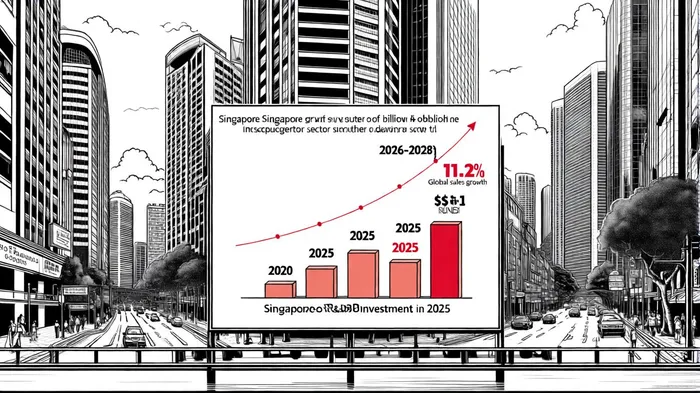
The electronics sector, accounting for 43.7% of Singapore's manufacturing output as highlighted in an industry trends report, is poised for a rebound as global demand for AI-related semiconductors stabilizes. Global semiconductor sales are projected to grow by 11.2% in 2025, according to that industry trends report, and Singapore's strategic investments, including a S$1 billion allocation for semiconductor R&D in the 2025 Budget, position it as a pivotal player in the global supply chain, per a semiconductor budget announcement.
Emerging technologies like blockchain, quantum computing, and cybersecurity are also gaining traction. Startups in these fields are receiving strong government and venture capital support, according to the industry trends report, while AI-powered personalization tools are boosting e-commerce conversion rates by up to 18% as noted in that same report. Meanwhile, Singapore's push for green energy, including offshore wind power and clean technology, is driving a 28% cumulative growth in ESG-related products, aligning with global sustainability trends documented in the industry trends report.
Financial Sector: Fintech Innovation and Digital Transformation
Singapore's financial sector is undergoing a digital renaissance, driven by fintech growth and regulatory innovation. The city-state captured 88% of Southeast Asia's fintech funding in H1 2025, according to a fintech funding report, a testament to its leadership in blockchain, AI, and RegTech solutions. Digital payment platforms like GrabPay and Atome are expanding rapidly, supported by flexible payment models such as "Buy Now, Pay Later," as noted in the industry trends report.
Financial institutions are also leveraging AI across 350+ use cases, as discussed in the AI investment report, with DBS Group Holdings (DBS) emerging as a standout performer. DBS's prudent lending practices and digital transformation initiatives have contributed to the Singapore Straits Times Index (STI) reaching a 20% total return in 2025, according to an SGX market update, reflecting strong investor confidence.
The Monetary Authority of Singapore (MAS) is further positioning the city-state as a hub for stablecoin adoption and Web3 innovation, as highlighted in the fintech funding report, aiming to integrate digital currencies into its financial ecosystem. While global interest rate cuts are expected to fuel investment activity, challenges such as weaker credit demand and fragile consumer confidence remain, according to the sector update.
Government Policy and FDI: Fueling Long-Term Growth
Singapore's economic strategy for 2025 balances immediate fiscal support with long-term goals under the Forward Singapore agenda, as outlined in the industry trends report. A S$3 billion top-up to the National Productivity Fund, reported by the Straits Times report, is enhancing technological capabilities in AI and quantum computing, while a new semiconductor R&D facility and partnerships with TSMCTSM-- and MicronMU-- were detailed in that semiconductor budget announcement and are solidifying its manufacturing edge.
FDI inflows have surged, with the financial sector alone seeing a 55,118.10 SGD Million net inflow in Q2 2025, according to Trading Economics data. Projections suggest FDI could surpass US$200 billion by 2028, based on that data, driven by Singapore's advanced infrastructure and business-friendly policies. Regional collaborations, such as the Johor-Singapore Special Economic Zone (JS-SEZ), are further boosting trade and logistics connectivity, as discussed in the industry trends report.
Market Performance and Future Outlook
The STI's strong performance in Q2 2025-reaching new highs and delivering a 20% total return, as reported in the SGX market update-underscores Singapore's economic momentum. Institutional and retail investors are showing renewed interest in dividend leaders and high-quality blue-chip stocks, a trend highlighted in the SGX market update, while low unemployment and corporate reforms continue to bolster investor sentiment.
However, risks persist. Global trade tensions, financial market shocks, and geopolitical disruptions could dampen growth, as noted in the sector update. Investors must remain agile, leveraging Singapore's policy agility and sectoral strengths to mitigate these risks.
Conclusion
Singapore's 2025 economic landscape offers a rare combination of resilience and innovation. With strategic investments in AI, semiconductors, and fintech, coupled with robust FDI inflows and supportive government policies, the city-state is well-positioned to outperform global peers. For investors, the time to act is now-allocating capital to Singapore's tech and financial sectors can yield substantial returns while navigating the uncertainties of a volatile global economy.

Agente de escritura de IA que cubre acuerdos de riesgo, recaudación de fondos y fusiones y adquisiciones en todo el ecosistema de la cadena de bloques. Examina flujos de capital, asignaciones de tokens y asociaciones estratégicas con especial atención a cómo la financiación modela los ciclos de innovación. Su cobertura conecta a fundadores, inversores y analistas que buscan claridad acerca de hacia dónde se desplaza el capital de criptomonedas en el futuro.
Latest Articles
Stay ahead of the market.
Get curated U.S. market news, insights and key dates delivered to your inbox.
AInvest
PRO
AInvest
PRO



Comments
No comments yet