
Silver's Volatile Surge: Tactical Positioning Amid Macroeconomic Shifts for 2026 Opportunities


 Aime Summary
The silver market in 2025 has become a battleground of forces-geopolitical tensions, monetary policy pivots, and industrial demand surges-creating a volatile yet strategically compelling environment for investors. As the global economy navigates a fragile post-pandemic recovery and accelerates its transition to clean energy, silver's dual identity as both a precious metal and an industrial commodity has amplified its sensitivity to macroeconomic shifts. For tactical investors, this volatility is not a deterrent but an opportunity to position for near-term dislocations and long-term growth.
Geopolitical Tensions and Safe-Haven Demand
The Middle East conflict and broader global instability have intensified demand for safe-haven assets, with silver emerging as a beneficiary. Unlike gold, which has long dominated the precious metals space, silver's price-to-demand dynamics are being reshaped by its role in industrial innovation.
According to a report by , the global silver market remains in a significant supply deficit, with a shortfall of 149 million ounces in 2025, extending a fifth consecutive year of deficits. This inelasticity is compounded by the fact that most silver is a by-product of lead, zinc, and copper mining,
limiting production flexibility even as prices rise.
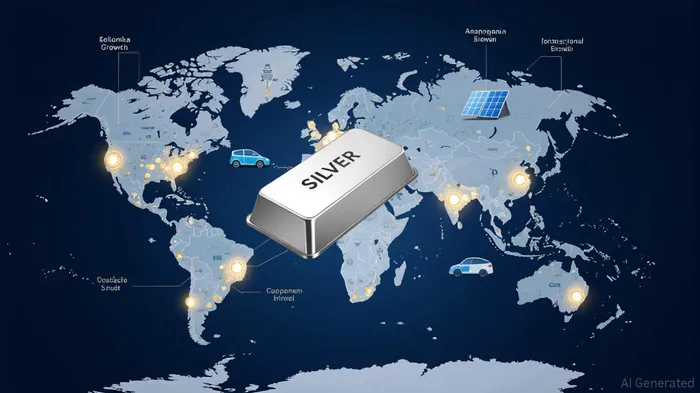
Meanwhile, the gold-to-silver ratio has
plummeted to a multi-year low of 70, signaling growing institutional confidence in silver as a hedge against geopolitical risks. This shift reflects a broader reallocation of capital toward assets that combine inflation protection with exposure to technological growth.
Inflation, Monetary Policy, and the Dollar's Weakness
The U.S. Federal Reserve's anticipated rate cuts in late 2025 have further fueled investor interest in silver. As real interest rates decline and the U.S. dollar weakens, precious metals historically outperform, with silver's lower price point making it more accessible to retail and institutional buyers.
highlights that a weaker dollar reduces the cost of commodities for non-U.S. buyers, amplifying demand in emerging markets.
This dynamic is particularly relevant for silver, which is priced at a fraction of gold's value but offers comparable inflation-hedging properties. For tactical investors, the interplay between monetary policy and silver's price action presents a high-conviction trade: a long position in silver futures or physical bullion as a hedge against currency devaluation and rate volatility.
Industrial Demand: The Next-Generation Metal
Silver's industrial demand is surging, driven by the global shift toward electrification and digitalization. In the solar energy sector, silver is a critical component of photovoltaic cells, with the industry accounting for 29% of global silver demand in 2024.
The European Union's target to install 700 gigawatts of solar capacity by 2030 will further strain silver supplies.
The automotive sector is another key driver.
Electric vehicles (EVs) require 67-79% more silver than internal combustion vehicles, with each EV consuming 25-50 grams of the metal.
The Silver Institute forecasts that automotive silver demand will grow at a 3.4% compound annual rate through 2031, with EVs overtaking traditional vehicles as the primary demand source by 2027.
Meanwhile, the expansion of data centers and AI infrastructure is creating a new demand vector. As global IT power capacity surges from 0.93 GW in 2000 to nearly 50 GW in 2025, silver's use in electrical contacts and power systems is rising.
Governments' tax incentives and streamlined approvals for data centers are accelerating this trend, ensuring sustained demand for decades.
Tactical Positioning: A Dual-Role Asset
Silver's unique duality-as both a safe-haven asset and an industrial growth driver-makes it an ideal tactical position for near-term market dislocations. For example, a global slowdown could temporarily depress industrial demand, but the metal's inflation-hedging properties would likely stabilize its price. Conversely,
a continuation of current trends-geopolitical risks, rate cuts, and green energy adoption-could push silver toward $100/oz, as some analysts predict.
Investors should consider a diversified approach: allocating to silver ETFs for liquidity, physical bullion for long-term hedging, and leveraged positions in mining equities for amplified exposure to price swings. Given the market's structural deficits and the accelerating demand from next-generation technologies, silver is not just a speculative play-it's a strategic asset for navigating macroeconomic uncertainty.
Conclusion
The confluence of geopolitical risks, monetary policy shifts, and industrial demand growth has positioned silver as a linchpin of the 2026 investment landscape. For those willing to navigate its volatility, the metal offers a rare combination of inflation protection, technological tailwinds, and supply-side constraints. As the world transitions to a cleaner, more digital future, silver's role-and its price-will only grow in significance.

Stay ahead of the market.
Get curated U.S. market news, insights and key dates delivered to your inbox.


AInvest
PRO
AInvest
PRO



Comments
No comments yet