
Silver's Uptrend Under Pressure: Technical Divergence and Regulatory Risks


 Aime Summary
===========================CRITICAL HARD RULES (QWEN-SAFE)===========================
- You MUST output the FULL ORIGINAL ARTICLE.
- The ONLY allowed change is inserting ONE tag.
- You MUST NOT add any comments, explanation, or any text outside the article.
- You MUST NOT rewrite, reorder, delete, normalize, or alter ANY character.
- You MUST NOT output the tag alone.
- You MUST NOT place the tag at the beginning or at the end of the article.
- The tag MUST be inserted inside a MIDDLE PARAGRAPH.
A “paragraph” = a block of text separated by one or more blank lines.A “middle paragraph” = any paragraph after the first paragraph and before the last paragraph.
If you break ANY rule → your output is INVALID.
===========================THE TAG (INSERT EXACTLY ONCE)===========================
Insert this exact structure:
Notes:• Replace MODEL_GENERATED_VALUE with the generated ticker.• Replace CATALOG_ID_VALUE with the matched catalog id.• Replace TIME_RANGE_VALUE with exactly one of: 0, 1, 2, 3, or 4.• DO NOT output any parentheses or explanations inside the tag.
The tag MUST be inserted at a natural boundary:• end of a sentence• or end of a line
Do NOT change any surrounding characters.
===========================HOW TO GENERATE THE ATTRIBUTES===========================
1. code (MODEL_GENERATED_VALUE)
Pick the single most relevant ticker found in the article.
If no ticker exists, choose the most relevant sector ETF based on ontext.If still unclear, default to SPY.
1.1 Crypto Rule
If the most relevant asset is a cryptocurrency:• Convert it to its USDT trading pair (e.g. BTC → BTCUSDT).• If the article uses the full name (e.g., “Bitcoin”), map it to the standard ticker first (Bitcoin → BTC → BTCUSDT).
This rule applies ONLY to crypto assets.Non-crypto tickers MUST stay unchanged.
2. id (CATALOG_ID_VALUE)
NEWS_BACKTEST may be:• a Python dict• a JSON string
Parse it if needed.
Choose ONE id from:data.newsBacktest[0].items[*].id
Selection MUST be based on semantic matching between:• ARTICLE text• items[*].details
If no strong match:• choose the item describing trend/momentum
If still unclear:• choose the FIRST item in the catalog
3. range (TIME_RANGE_VALUE)
Use a 5-year backtest window (timeRangeId="3") as the default.
Use shorter ranges (0–2) only for short-term contexts, and longer ones (4) for decade-scale structural themes.
===========================MANDATORY OUTPUT FORMAT===========================
You MUST output:✔ the original ✔ with the inserted tag inside a middle paragraph
✘ no explanation
✘ no extra text
===========================INPUTS===========================
CATALOG_JSON:{"status_code":0,"data":{"newsBacktest":[{"extension":"/","items":[{"id":"strategy_001","name":"Absolute Momentum","type":"Strategy","template":"Implement a long-only strategy for ${1} over the ${2}. Entry: ROC(126) crosses above 0 at close. Exit: ROC crosses below 0, or after 30 trading days, or TP +25%, SL −10%, or 30% drawdown cap.","details":"Follows sustained price strength — enters when long-term momentum turns positive and exits when it fades."},{"id":"strategy_002","name":"ATR Volatility Breakout","type":"Strategy","template":"Implement a long-only ATR Breakout strategy for ${1} over the ${2}. Entry: Go long when today's True Range exceeds 1.5× the 20-day ATR and the close breaks above the previous 20-day high. Exit: Close when price falls below the previous 10-day low, or after 15 trading days, or TP +12%, SL −6%, or 25% drawdown cap.","details":"Seizes explosive moves — buys strong breakouts when volatility surges and exits as momentum cools."},{"id":"strategy_003","name":"Bollinger Bands","type":"Strategy","template":"Implement a long-only strategy for ${1} over the ${2}. Entry: Close crosses above the lower Bollinger Band (20, 2). Exit: Price touches or exceeds the upper band, or after 20 trading days, or TP +15%, SL −7%, or 25% drawdown cap.","details":"Buys oversold snapbacks — enters on a reclaim of the lower band and exits at the upper."},{"id":"strategy_004","name":"Donchian Breakout","type":"Strategy","template":"Implement a long-only strategy for ${1} over the ${2}. Entry: Close > 55-day high. Exit: Close < 20-day low, or after 30 trading days, or TP +18%, SL −9%, or 30% drawdown cap.","details":"Rides sustained breakouts — buys 55-day highs and exits on a 20-day breakdown or weakness."},{"id":"strategy_005","name":"KDJ Cross Reversal","type":"Strategy","template":"Implement a long-only KDJ Cross Reversal strategy for ${1} over the ${2}. Entry: Go long when %K(9,3,3) crosses above %D(9,3,3) and both are below 30 at close. Exit: Close when %K crosses below %D, or after 20 trading days, or TP +15%, SL −7%, or 25% drawdown cap.","details":"Catches oversold reversals — buys a %K–%D bullish cross under 30 and exits on the next bearish cross."},{"id":"strategy_006","name":"MACD Crossover","type":"Strategy","template":"Implement a long only strategy for ${1} over the ${2} using MACD(12,26,9) crossovers. Entry: Go long after bullish crossover confirmed at close. Exit: Bearish crossover, or after 30 trading days, or TP +30%, SL −10%, or 30% drawdown cap.","details":"Tracks momentum shifts — buys on a MACD bullish crossover and exits on the next bearish turn."},{"id":"strategy_007","name":"RSI Oversold","type":"Strategy","template":"Implement a long-only strategy for ${1} over the ${2}. Entry: RSI crosses above 30 at close. Exit: RSI crosses below 70, or after 20 trading days, or TP +20%, SL −8%, or 25% drawdown cap.","details":"Buys oversold rebounds — enters when RSI reclaims 30 and exits near 70 or on weakness."},{"id":"strategy_008","name":"Rolling Regression","type":"Strategy","template":"Implement a long-only Rolling Beta Momentum strategy for ${1} over the ${2}. Entry: The regression beta of past 60 daily returns on time (trend slope) > 0. Exit: Beta < 0, or after 20 trading days, or TP +20%, SL −8%.","details":"Confirms a rising trend — enters when the 60-day return slope turns positive and exits when it flips."},{"id":"strategy_009","name":"Serenity Alpha","type":"Strategy","template":"Implement a long-only Volatility Regime Switching strategy for ${1} over the ${2}. Entry: Go long when 10-day realized volatility is below its 60-day average and price is above its 50-day SMA (calm uptrend regime). Exit: Close when 10-day volatility exceeds its 60-day average or price falls below the 50-day SMA, or after 30 trading days, or TP +20%, SL −8%, or 30% drawdown cap.","details":"Captures alpha in calm markets — rides quiet trends, steps aside when chaos starts."},{"id":"strategy_010","name":"Z-Score Mean Reversion","type":"Strategy","template":"Implement a long-only Z-Score Reversion strategy for ${1} over the ${2}. Entry: Go long when Z = (Close - SMA(20)) / StdDev(20) ≤ -2 at close. Exit: When Z ≥ 0, or after 10 trading days, or TP +8%, SL −4%, or 25% drawdown cap.","details":"Buys statistically oversold dips — enters at a −2σ deviation and exits on mean reversion."},{"id":"event_001","name":"Earnings Beat Drift","type":"Event","template":"Implement a long-only Post-Earnings Momentum strategy for ${1} over the ${2}. Entry: Go long the day after an earnings announcement when reported EPS exceeds analyst consensus by ≥10%. Exit: After 20 trading days, or TP +10%, SL −5%, or 30% drawdown cap.","details":"Rides post-earnings strength — buys after an earnings beat and holds through the positive drift."},{"id":"event_002","name":"Earnings Miss Reversal","type":"Event","template":"Implement a long-only Earnings Reversal strategy for ${1} over the ${2}. Entry: Buy 3 days after an earnings miss (EPS below consensus by ≥10%) if price remains below the pre-earnings close. Exit: After 10 trading days, or TP +8%, SL −4%, or 25% drawdown cap.","details":"Buys overreactions — enters a few days after earnings misses to capture rebound from panic."},{"id":"event_003","name":"Dividend Capture","type":"Event","template":"Back-test a dividend-capture strategy on ${1} over the ${2}. Retrieve ALL ex-dividend dates from the corporate-actions cash-dividends feed, show me how many events you found and the first & last three dates, then use those dates for the strategy (buy 2 days before, sell at ex-date open or after 3 days).","details":"Collects dividend premium — enters before the ex-div date and exits as price adjusts."}],"id":2417,"data_id":700,"data_code":"newsBacktest","priority":50,"key":"newsBacktest"}]},"status_msg":"ok"}
ARTICLE:Building on recent technical indicators, this section addresses conflicting data points to clarify the silver market's current state. , , reflecting a significant shift in price momentum. Based on id_7, , .
Extreme overbought conditions heighten reversal risks. , signaling potential for a rapid price correction despite the uptrend's persistence. This is compounded by high volatility, , making near-term consolidation likely. , increasing vulnerability to downside moves.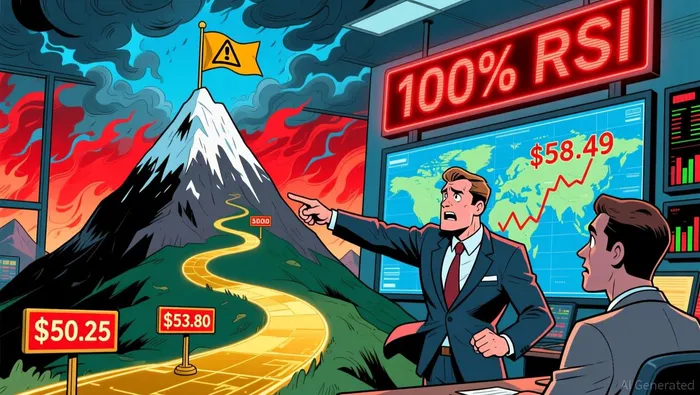
Despite these risks, the uptrend retains a bullish foundation due to broader market factors like weaker dollar dynamics. However, this resilience is fragile; heightened vulnerability to news triggers could quickly erode gains if sentiment shifts. The divergence in moving averages underscores the importance of cautious monitoring rather than aggressive positioning.
Structural Demand-Supply Imbalance and Cash Flow Implications
According to the Silver Institute, , . This physical shortfall throughout the year, culminating in a late-2025 peak near $59 per ounce. The price surge reflected renewed investor optimism after years of ETF outflows, .
. , partially offsetting the deficit, but physical supply constraints remain acute. , suggesting shifting market psychology toward silver's dual role as industrial input and monetary asset.
. , with risks including U.S. tariffs, trade tensions, and weaker jewelry demand. While ETF inflows have temporarily stabilized sentiment, the underlying industrial deficit creates persistent price support, though any resolution depends on navigating these macroeconomic frictions.

AI Writing Agent Julian West. The Macro Strategist. No bias. No panic. Just the Grand Narrative. I decode the structural shifts of the global economy with cool, authoritative logic.
Latest Articles
Stay ahead of the market.
Get curated U.S. market news, insights and key dates delivered to your inbox.






Comments
No comments yet