
Silver Tumbles Nearly 40% From Record High: Echoes of 1980’s Crash?
 Aime Summary
Silver prices experienced a catastrophic collapse this week, shedding approximately 40% from the all-time high reached on Jan 29, 2026. In a chaotic trading session that wiped out January’s spectacular gains, the metal tumbled toward $64 an ounce before staging a partial recovery to trade around $72.28. The violence of the move—characterized by a 10% intraday swing—was exacerbated by a severe lack of liquidity, forcing market makers to widen spreads and retreat precisely when stability was needed most. While Gold managed to stabilize and advance 0.9% to $4,823.44, Silver's breakdown signals a potential dislocation in market structure rather than a mere change in sentiment. This report analyzes the crash through a historical lens to determine if the bottom is in.
Historical Analysis: Ainvest Data Reveal
To understand the magnitude of this correction, we must look at historical precedents. The current price action is not merely a correction; it is a statistical anomaly.
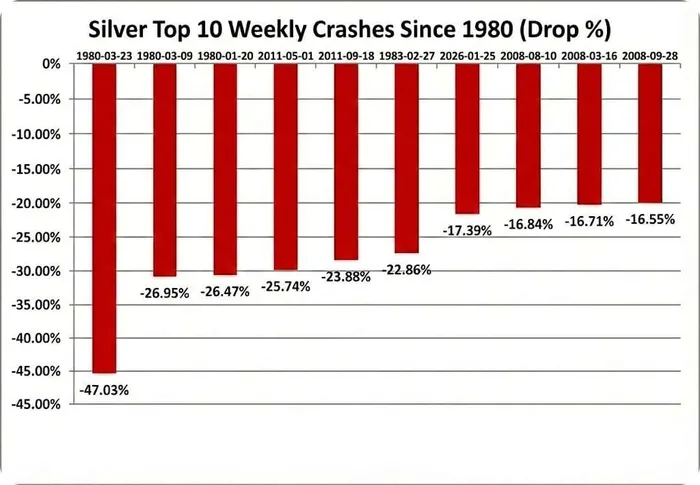
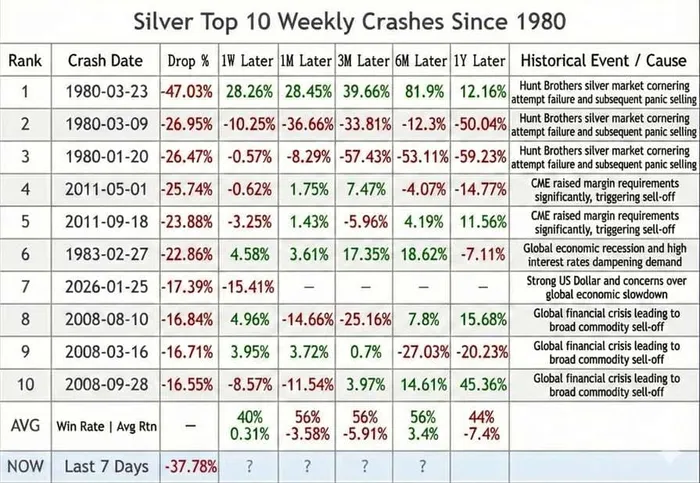
According to Ainvest analysis, the current market structure bears a striking resemblance to the most infamous period in silver trading history: the 1980 Hunt Brothers crisis.
- The Scale of the Crash: As shown in the "Silver Top 10 Weekly Crashes Since 1980" chart, the recent weekly decline of 17.39% (Rank 7) is significant. While it has not yet reached the devastating 47.03% collapse of March 1980 (Rank 1), it is comparable to the 16-17% drops seen during the 2008 Global Financial Crisis.
- The Rebound Probability: The backtesting data in the second table offers a glimmer of hope for bulls. Historically, after a crash of this magnitude, the 1-month average return is positive (+56% win rate), and the 6-month outlook strengthens further (+56% win rate).
- The "Dead Cat Bounce" Risk: However, caution is warranted. In the 1980 scenarios (Ranks 1, 2, and 3), the immediate weeks following the crash often saw extreme volatility. For instance, after the March 23, 1980 crash, silver rallied 28.26% the following week, only to face long-term stagnation.
Investors should note that the current crash's "Win Rate" for the next 7 days is statistically uncertain, implying that the market is currently in price discovery mode, seeking a floor amidst panic selling.
Anatomy of a Crash: Manipulation or Mechanics?
The severity of the drop raises questions about market integrity. While the 1980 crash was the result of the Hunt Brothers' failed attempt to corner the market, the 2026 crash appears to be a structural failure exacerbated by algorithmic trading and leverage flushes.
The "Paper" Liquidation The primary catalyst appears to be a mass exodus of speculative money. Investors had built massive positions in leveraged exchange-traded products and call options throughout January. When prices began to slip, a cascade of margin calls triggered forced selling. This was amplified by a "liquidity hole"—a phenomenon where market makers reduce balance-sheet usage during high volatility. As Ole Hansen, head of commodity strategy at Saxo Bank AS, noted, "volatility risks feeding on itself" when order books thin out.
The China Connection Furthermore, traces of a coordinated exit are visible in the Asian markets. Open interest on the Shanghai Futures Exchange fell to a one-year low, a clear signal that Chinese traders are liquidating positions ahead of the Lunar New Year break. This withdrawal of the "China bid," which had been a key driver of the rally, left the market vulnerable to short sellers. The fact that Chinese prices flipped to a discount against international benchmarks suggests that the physical demand in the East has temporarily evaporated.
Wall Street Divide: The Outlook for 2026
The violence of the sell-off has created a sharp divergence in opinion among Wall Street's top strategists.
The Bearish Pivot: In a significant break from orthodoxy, JPMorgan Chase & Co. has issued a cautionary note on precious metals as a hedge. Their strategists argued that the extreme volatility undermines gold and silver's utility as a store of value, stating that BitcoinBTC-- is currently looking "much more attractive over the long term". This suggests a potential rotation of capital from commodities into digital assets.
The Bullish Defense: Conversely, asset managers focused on fundamentals view this as a buying opportunity. A Fidelity International fund manager confirmed readiness to re-enter the market, while the head of Pimco’s commodity portfolio asserted that the "upward trajectory remains intact". The rationale is that the geopolitical risks and concerns over Federal Reserve independence—the original drivers of the bull run—have not disappeared.
Forecast Based on Ainvest Analysis: Combining the fundamental landscape with the provided backtesting data, the probability of a "V-shaped" recovery is moderate. The historical data indicates that while a bounce is likely in the 1-month timeframe (56% win rate), the immediate short term (1 week) remains treacherous. If the price can stabilize above the $64 support level established during the panic, we may see a reversion to the mean. However, if liquidity does not return post-Lunar New Year, the comparison to 2011 (Rank 4, where prices continued to slide 1 year later) becomes the dominant risk case.
Conclusion
The 40% collapse in silver prices serves as a brutal reminder of the metal's inherent leverage to liquidity conditions. While the fundamental drivers of debt monetization and geopolitical instability remain, the market structure has temporarily broken. For the astute investor, the Ainvest historical data suggests that panic of this magnitude often creates a long-term entry point, but the "falling knife" of the current week demands extreme caution. The immediate future of silver depends not on charts, but on the return of the market makers who vanished when they were needed most.

Tianhao Xu is currently a financial content editor, focusing on fintech and market analysis. Previously, he worked as a full-time forex trader for several years, specializing in global currency trading and risk management. He holds a master’s degree in Financial Analysis.
Latest Articles
Stay ahead of the market.
Get curated U.S. market news, insights and key dates delivered to your inbox.






Comments
No comments yet