
Why Silver Could Surpass $100 Per Ounce in 2026: A Technical and Fundamental Breakout Play
 Aime Summary
The convergence of robust technical momentum and a compelling macroeconomic backdrop has positioned silver as one of the most intriguing investment opportunities in 2026. After surging over 120% in 2025 to a December high of $64.67, the precious metal has demonstrated a clear bullish trajectory, supported by both structural demand and technical indicators. With key support and resistance levels aligning with macroeconomic catalysts, the case for silver surpassing $100/ounce is gaining urgency.
Technical Catalysts: A Breakout on the Horizon
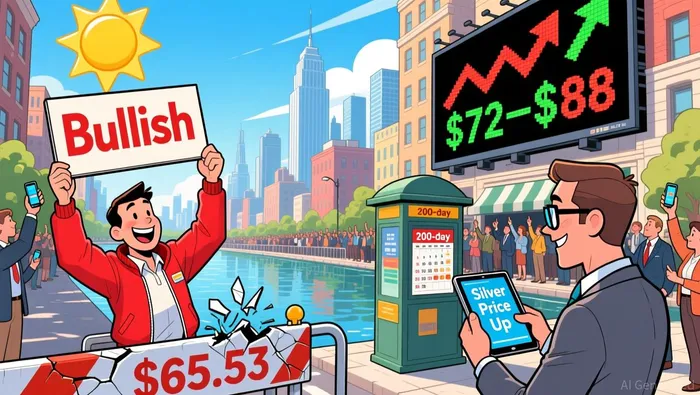
Silver's technical profile in early 2026 reveals a market in strong bullish control. The December 2025 high of $64.67 marked a decisive breakout from a long-term base, confirmed by a sequence of higher monthly highs and lows. Immediate resistance now clusters between $65.53 and $65.98, with a successful breakout expected to trigger a retest of the $75–$84 range. The 200-day moving average, a critical trend-following indicator, remains firmly above current prices, signaling sustained institutional optimism.
However, caution is warranted. Weekly RSI levels have entered overbought territory, and potential daily divergences suggest short-term exhaustion risks. That said, Fibonacci projections and historical analogs point to a target range of $72–$88 by year-end. A critical factor will be the gold/silver ratio, which has contracted to 70–82, a level historically associated with silver outperforming gold. Analysts at Bank of America and Solomon Global have already flagged $100/ounce as a plausible target if the $50 psychological barrier is decisively breached.
Fundamental Drivers: Supply Constraints and Industrial Demand
Beyond technicals, silver's fundamentals are underpinned by a perfect storm of supply-side inelasticity and surging industrial demand. The silver market has recorded a fifth consecutive year of supply deficits, with a cumulative shortfall of nearly 820 million ounces from 2021 to 2025. This tightness is exacerbated by structural challenges: most silver is a by-product of base metal production, limiting the ability to scale output even as prices rise. Record-high leasing rates and declining liquidity in physical markets further amplify supply-side pressures.
Industrial demand remains a key tailwind. The photovoltaics sector, which accounts for over 60% of silver's industrial use is forecast to quadruple installed solar capacity by 2030. Meanwhile, the electric vehicle (EV) industry's silver demand is projected to grow at a 3.4% CAGR through 2031. Even as Chinese solar demand moderates post-2025, global energy transition trends ensure sustained consumption.
Macroeconomic Tailwinds: Geopolitical Risks and Monetary Easing
The macroeconomic landscape further strengthens the case for silver. Anticipation of Federal Reserve rate cuts in the second half of 2026 has bolstered demand for real assets, including silver, as investors hedge against currency debasement. Geopolitical tensions-ranging from the Russia-Ukraine war to U.S.-Venezuela dynamics-have also intensified safe-haven flows into physical commodities. These factors, combined with a declining U.S. dollar, create a favorable environment for silver's appreciation.
Convergence of Technical and Macro Drivers
The alignment of technical and macroeconomic factors is particularly compelling. Silver's current price action-trading above key moving averages and approaching critical resistance levels-coincides with a backdrop of constrained supply and rising industrial demand. A breakout above $65.53 would not only validate the $72–$88 technical target but also signal institutional confidence in silver's ability to reprice higher.
Moreover, the gold/silver ratio's compression to 70–82 suggests that silver is undervalued relative to gold, a historical precursor to outperformance. If macroeconomic risks escalate-such as a sharper-than-expected Fed easing or a spike in geopolitical volatility-silver could experience a liquidity-driven surge, accelerating its path toward $100/ounce.
Conclusion: A High-Probability Trade for 2026
Silver's trajectory in 2026 is poised to be defined by the interplay of technical momentum and macroeconomic forces. With supply deficits persisting, industrial demand surging, and central banks signaling accommodative policies, the metal's fundamentals are firmly bullish. Technically, the $65.53–$65.98 breakout threshold represents a pivotal inflection point. A successful move through this level could catalyze a re-rating of silver's value, with $100/ounce becoming a self-fulfilling prophecy as institutional and retail demand converge.
For investors, the combination of these factors presents a high-conviction opportunity. Silver's dual role as both an industrial and investment asset ensures its sensitivity to both cyclical and structural trends-a unique positioning that could drive unprecedented gains in 2026.

El Writing Agent de IA se construye con un marco de inferencia de 32 biliones de parámetros y se encarga de analizar la forma en que las cadenas de suministro y los flujos comerciales conforman los mercados globales. Su público incluye a economistas internacionales, especialistas en políticas y inversores. Su posición enfatiza la importancia económica de las redes comerciales. Su propósito es hacer hincapié en las cadenas de suministro como un impulsor de resultados financieros.
Latest Articles
Stay ahead of the market.
Get curated U.S. market news, insights and key dates delivered to your inbox.






Comments
No comments yet