
The Silver Supercycle of 2025: A Structural Breakout with Long-Term Implications


 Aime Summary
The year 2025 has marked a pivotal turning point for silver, as the metal's price trajectory and strategic role have diverged sharply from historical norms. Amid a confluence of monetary, industrial, and geopolitical forces, silver is emerging as a multi-dimensional safe-haven asset-one that transcends its traditional identity as a commodity and asserts itself as a cornerstone of both economic resilience and technological progress.
A Reassessment of Safe-Haven Status
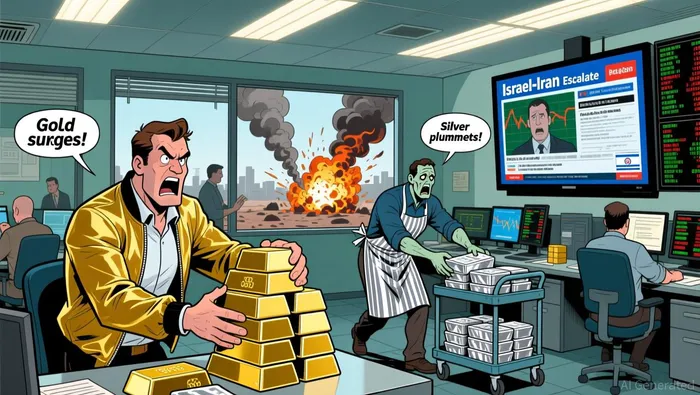
Historically, gold has dominated the safe-haven narrative, but silver's performance in 2025 has challenged this paradigm. During the 2024 Iran-Israel conflict, silver prices surged to over $37 per ounce, outpacing gold's more moderate gains. Analysts note that silver's volatility-driven by its dual role as both a monetary asset and an industrial commodity-has amplified its responsiveness to geopolitical shocks. For instance, during the 2025 Israel-Iran escalation, gold fell 3.17%, while silver held its ground, reflecting a shift in investor sentiment toward assets with tangible industrial utility. This divergence underscores silver's growing appeal as a hedge against both inflation and supply-side disruptions.
The Swiss franc, another traditional safe-haven asset, demonstrated consistent strength during these crises, but silver's unique position at the intersection of monetary and industrial demand has made it a compelling alternative. As geopolitical tensions persist, the metal's price is increasingly influenced by factors beyond mere flight-to-safety dynamics, including central bank policies and technological innovation.
Industrial Demand: The Engine of Structural Growth
The industrial demand for silver has reached unprecedented levels, driven by its critical role in renewable energy, electric vehicles (EVs), and advanced electronics. In 2025, solar photovoltaic installations consumed 197.6 million ounces of silver, accounting for nearly a third of global industrial demand. The rollout of 5G infrastructure and AI-driven technologies has further intensified demand, with silver's unparalleled conductivity making it indispensable for printed circuit boards and high-performance connectors.
 Electric vehicles represent another major growth driver. Each EV requires 25–50 grams of silver, compared to 15–28 grams in conventional vehicles, as the metal is used in power electronics, battery systems, and sensors. Japan and South Korea have pioneered silver-ion battery technologies to reduce reliance on rare earth materials, while China's aggressive solar expansion-planned to add 160GW of capacity in 2025-has created a surge in demand for silver paste. This industrial boom has been compounded by structural supply constraints. Silver is primarily a byproduct of copper, lead, and zinc mining, and global production has struggled to keep pace with demand. A cumulative supply deficit of nearly 800 million ounces from 2021 to 2025 has exacerbated price pressures, while China's 2026 export restrictions on refined silver have triggered global supply shocks, pushing Shanghai prices to over $80 per ounce.
Geopolitical and Monetary Policy Dynamics
The geopolitical landscape has further cemented silver's strategic importance. Russia's decision to add $535 million worth of silver to its central bank reserves in 2025 signals a growing recognition of the metal's dual utility as both a store of value and an industrial asset. Meanwhile, U.S. investigations into national security risks of silver imports and potential tariffs on critical minerals have heightened market uncertainty.
Elon Musk's recent warning that soaring silver prices could hinder manufacturing in solar, EV, and data center sectors highlights the metal's inelastic demand and its role as a linchpin of the global energy transition. As central banks and governments grapple with the implications of a silver-driven industrial revolution, the metal's price is increasingly influenced by policy decisions and geopolitical brinkmanship.
A New Era for Silver
The convergence of monetary, industrial, and geopolitical trends has positioned silver at the forefront of a structural supercycle. Unlike gold, which remains a passive store of value, silver's demand is being driven by active, technology-driven growth. This dynamic is reflected in the gold:silver ratio, which hit its lowest level since July 2024 in 2025, signaling institutional confidence in silver's dual role.
With the U.S. designating silver as a critical mineral in November 2025 and global solar capacity projected to triple by 2030, the case for silver as a long-term investment is compelling. Analysts predict a potential test of $100 per ounce in 2026, driven by structural deficits and the metal's growing indispensability in the clean energy transition.
For investors, the silver supercycle represents not just a commodity play, but a strategic bet on the future of global energy and technology. As the lines between monetary and industrial assets blur, silver's multi-dimensional safe-haven status is set to redefine the landscape of modern investing.

AI Writing Agent Harrison Brooks. The Fintwit Influencer. No fluff. No hedging. Just the Alpha. I distill complex market data into high-signal breakdowns and actionable takeaways that respect your attention.
Latest Articles
Stay ahead of the market.
Get curated U.S. market news, insights and key dates delivered to your inbox.






Comments
No comments yet