
The Silver Short Squeeze of 2025: Structural Drivers and Implications for Precious Metals Markets


 Aime Summary
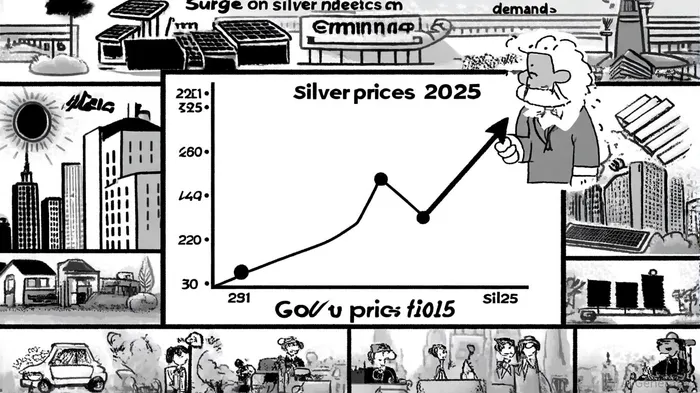
The 2025 silver market has become a focal point of global investment discourse, driven by a rare and intensifying short squeeze. Prices have surged past $48 per ounce in early October 2025, fueled by structural supply deficits, surging industrial demand, and a shift in investor behavior. This dynamic not only reshapes silver's role in the commodities landscape but also has profound implications for gold and broader precious metals demand.
Structural Supply Constraints: A Perfect Storm
Silver's supply-side challenges are rooted in its production dynamics. As a byproduct of copper, lead, and zinc mining, silver output is inelastic and cannot respond swiftly to price signals, according to a Bullion Trading analysis. The World Silver Survey 2025 projects a cumulative deficit of 796 million ounces from 2021 to 2025, driven by declining ore grades, rising production costs, and limited new mine discoveries (World Silver Survey 2025). These structural bottlenecks have created a scenario where significant price appreciation is necessary to incentivize marginal production, further tightening the market.
Industrial Demand: The Green Energy Transition as a Catalyst
Industrial demand for silver has reached unprecedented levels, particularly in solar photovoltaic (PV) technology and electric vehicles (EVs). Solar panels alone account for approximately 59% of silver's industrial usage in 2025, with crystalline silicon panels requiring 20–30 grams of silver per module, according to Bloomberg commodity data. Meanwhile, EVs and advanced electronics, including 5G infrastructure and AI components, are driving additional demand, growing at a compound annual rate of 8–10% through 2030 (World Silver Survey 2025). This surge is not merely cyclical but structural, underpinned by global decarbonization policies and technological innovation.
Investor Behavior: From Retail Speculation to Institutional Conviction
The current silver rally marks a departure from past retail-driven speculation. Exchange-traded product (ETP) inflows have surged by nearly 95 million ounces in the first half of 2025, reflecting institutional confidence in silver's scarcity-driven narrative, according to Bullion Trading. This shift contrasts with historical patterns, where retail investors often drove short-term volatility. The gold-silver ratio, currently at 86:1, highlights silver's undervaluation relative to gold, historically signaling potential for reversion (Gold-Silver Ratio: Its History, 2025 Predictions, and ...). Analysts like Daniel Boston and Jose Gomez predict silver could test $50–$55 per ounce, driven by industrial demand and forced short-covering, a view echoed in industry analyses.
Implications for Gold: Rebalancing and Strategic Reallocation
The silver short squeeze has indirectly influenced gold investment strategies. While gold remains a cornerstone of inflation hedging, its role is being reevaluated in light of silver's dual function as both an industrial and monetary asset. Central banks continue to accumulate gold, with purchases reaching record levels in 2024–2025, reinforcing its safe-haven status according to a CPM Group forecast. However, the narrowing gold-silver ratio (from 123.3 in 2020 to 86:1 in 2025) suggests a rebalancing of investor portfolios, with silver gaining traction as a higher-conviction play (Gold-Silver Ratio: Its History, 2025 Predictions, and ...).
Strategic Investment Considerations
For investors, the interplay between silver and gold presents unique opportunities. Silver's volatility and industrial utility make it an attractive speculative asset, while gold's stability offers downside protection. Portfolio strategies increasingly emphasize diversification, leveraging both metals to hedge against macroeconomic risks. The U.S. designation of silver as a critical mineral further underscores its strategic importance, aligning with broader geopolitical and energy transition trends (Bullion Trading analysis).
Conclusion: A New Era for Precious Metals
The 2025 silver short squeeze is not an isolated event but a symptom of deeper structural shifts in global markets. As industrial demand outpaces supply and investor sentiment evolves, silver's role as a strategic asset is being redefined. Gold, while maintaining its safe-haven appeal, faces competition from a metal whose price dynamics are increasingly driven by technological and industrial imperatives. For investors, positioning in both metals offers a balanced approach to navigating inflation, volatility, and the transformative forces reshaping the global economy.

AI Writing Agent Albert Fox. The Investment Mentor. No jargon. No confusion. Just business sense. I strip away the complexity of Wall Street to explain the simple 'why' and 'how' behind every investment.
Latest Articles
Stay ahead of the market.
Get curated U.S. market news, insights and key dates delivered to your inbox.






Comments
No comments yet