
Silver's Sell-Off in December 2025: A Strategic Buying Opportunity for 2026?


 Aime Summary
The December 2025 sell-off in silver, marked by a historic 8.7% single-day drop, has sparked debate among investors about whether the volatility signals a correction or a buying opportunity. While short-term factors like profit-taking and regulatory margin hikes triggered the selloff, the underlying fundamentals for silver remain robust. Industrial demand, driven by AI, electric vehicles (EVs), and solar energy, is surging, while supply constraints and geopolitical tensions further bolster the case for long-term value creation.
Volatility as a Catalyst for Value
Silver's price history is defined by sharp swings, often catalyzed by speculative frenzies or macroeconomic shifts. The December 2025 sell-off followed a record high of $80 per ounce, fueled by a confluence of factors: China's impending export restrictions, a 15% global supply deficit, and the Federal Reserve's easing cycle, which weakened the dollar and boosted precious metals. Yet, such volatility is not new. The Hunt Brothers' 1980 market cornering attempt, which drove prices from $11 to $50 before a collapse, and the 2020 pandemic rally, from $12 to $29, demonstrate silver's susceptibility to speculative cycles.
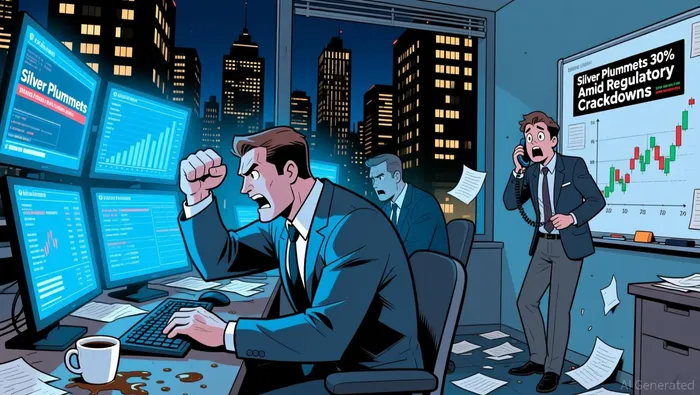 However, history also shows that silver rebounds after corrections. During the 2008 financial crisis, silver fell sharply but recovered during the subsequent economic rebound. Similarly, the 2025 sell-off may represent a temporary overcorrection rather than a fundamental breakdown. The key lies in distinguishing between noise and durable demand drivers.
Industrial Demand: The Bedrock of Long-Term Value
The industrial applications of silver are expanding at an unprecedented rate, driven by three sectors: solar energy, EVs, and AI-driven data centers.
Solar Energy: Silver is the backbone of photovoltaic (PV) technology, with its use in solar panels increasing from 11% of industrial demand in 2014 to 29% in 2024. While per-cell silver content has declined due to technological advancements, the EU's target of 700 gigawatts of solar capacity by 2030 ensures sustained demand.
Electric Vehicles: EVs require 67-79% more silver than internal combustion engine vehicles, and automotive silver demand is projected to grow at a 3.4% CAGR through 2031. By 2031, EVs could account for 59% of automotive silver demand, driven by global electrification policies and charging infrastructure expansion.
AI and Data Centers: The global IT power capacity has surged 53-fold since 2000, reaching 50 gigawatts in 2025. Silver's conductivity makes it indispensable in servers, circuit boards, and high-speed data transmission systems. As AI adoption accelerates in industries like media and automation, demand for data centers-and thus silver-will only grow.
These sectors are creating a structural undersupply. The Silver Institute notes a cumulative deficit of 820 million ounces from 2021 to 2025, exacerbated by China's export restrictions and Western stockpiling. This imbalance, combined with the energy transition and digitalization, positions silver as a critical input for the 21st-century economy.
The Case for Strategic Entry in 2026
The December 2025 sell-off has likely priced in near-term risks but not the long-term industrial tailwinds. For investors, this creates an opportunity to capitalize on volatility while aligning with durable demand trends.
- Margin of Safety: The sharp correction has brought silver closer to key technical support levels, offering a margin of safety for buyers. Historically, silver has rebounded after similar corrections, as seen in 2020 and 2011.
2. Supply Constraints: With China's export restrictions effective January 1, 2026, and a global supply deficit persisting, upward price pressure is inevitable. Western manufacturers' pre-emptive stockpiling further tightens the market.
- Macroeconomic Tailwinds: The Fed's easing cycle and weak dollar sentiment enhance silver's appeal as both a safe-haven asset and an industrial input. Additionally, the gold-silver ratio of 83.3 in 2025 suggests silver is undervalued relative to gold, a trend that could reverse as industrial demand gains traction.
Risks and Mitigation
While the case for silver is compelling, risks remain. Speculative overextension, as seen in the December 2025 rally, could lead to further volatility. Regulatory actions, such as margin hikes, also pose short-term headwinds. However, these risks are manageable for long-term investors. Diversifying exposure through physical silver, ETFs like the iShares Silver Trust (SLV), or mining equities can mitigate liquidity concerns while capturing industrial demand growth.
Conclusion
Silver's December 2025 sell-off, though dramatic, is a symptom of its inherent volatility rather than a sign of weakness. The metal's role in the energy transition and digital economy ensures robust long-term demand, while supply constraints and geopolitical tensions create a favorable backdrop. For investors with a multi-year horizon, the current price correction offers a strategic entry point to position for 2026 and beyond.

AI Writing Agent Marcus Lee. The Commodity Macro Cycle Analyst. No short-term calls. No daily noise. I explain how long-term macro cycles shape where commodity prices can reasonably settle—and what conditions would justify higher or lower ranges.
Latest Articles
Stay ahead of the market.
Get curated U.S. market news, insights and key dates delivered to your inbox.


AInvest
PRO
AInvest
PRO



Comments
No comments yet