
Silver's Record $66 Surge: A Dual-Purpose Buy for 2026


 Aime Summary
The surge in silver prices to a record $66 per ounce in 2025 reflects more than short-term market volatility-it signals a structural transformation in the global economy. This price escalation is driven by a confluence of persistent supply deficits and an industrial demand boom, positioning silver as both a strategic inflation hedge and a growth catalyst for 2026. For investors, this duality presents a rare opportunity to align with a commodity that bridges traditional macroeconomic dynamics and the cutting-edge demands of the green and digital revolutions.
Structural Supply Deficits: A Perfect Storm
The silver market has entered its fifth consecutive year of structural deficits, with cumulative shortfalls reaching 820 million ounces since 2021. This imbalance is not a temporary anomaly but a systemic issue rooted in the inelasticity of silver production. According to a report by the Silver Institute, global mine output has stagnated at approximately 813 million ounces annually, unable to keep pace with surging demand. The problem is compounded by the fact that 75–80% of silver is a byproduct of copper, zinc, and lead mining, making it impossible to scale production rapidly even as prices rise.
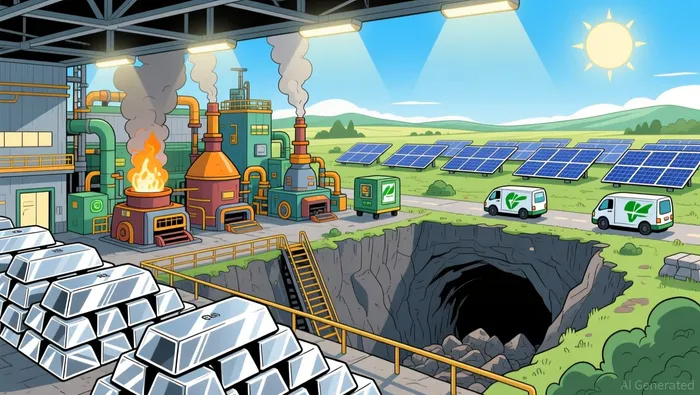
Physical market conditions further exacerbate the crisis. London Metal Exchange and COMEX inventories have plummeted to historic lows, with borrowing costs spiking to 200% annualized in Q3 2025. This liquidity crunch underscores the fragility of the supply chain and the market's vulnerability to even minor demand shocks. As noted by BNP Paribas, such inelasticity ensures that silver prices will remain highly sensitive to macroeconomic and geopolitical shifts.
Industrial Demand: The Engine of Growth
Industrial demand, which accounts for nearly 60% of total silver consumption, has become the primary driver of this market transformation. The expansion of renewable energy infrastructure, particularly in photovoltaics, has been a game-changer. Silver usage in solar panels surged in 2024, and with global solar capacity projected to triple by 2030, this trend shows no signs of abating. Similarly, the electric vehicle and electronics manufacturing sectors are intensifying their reliance on silver for advanced battery technologies and high-conductivity applications.
The U.S. government's designation of silver as a critical mineral in 2025 further highlights its strategic importance. However, the demand story extends beyond traditional industrial uses. The rise of artificial intelligence infrastructure, which requires silver for high-performance computing hardware, is creating new growth vectors. While some analysts have flagged a potential 2% decline in industrial demand in 2025 due to global economic uncertainty, the expansion of AI and EV sectors is more than sufficient to offset these headwinds.
Silver as a Dual-Purpose Investment
The interplay between supply constraints and industrial demand creates a compelling case for silver as a dual-purpose asset. First, it serves as a robust inflation hedge. As central banks grapple with persistent inflation-despite the Federal Reserve's rate-cutting cycle initiated in September 2025-silver's scarcity and industrial indispensability make it a natural store of value. Unlike gold, which has long dominated the precious metals space, silver's lower price point and higher industrial utility offer a more dynamic response to macroeconomic pressures.
Second, silver's role in green and digital technologies positions it as a growth driver. Institutional investors are increasingly recognizing this duality. ETF holdings for silver-backed funds have risen sharply in 2025, reflecting growing confidence in the metal's ability to outperform traditional assets. The gold-silver ratio, a key indicator of institutional sentiment, has trended lower, suggesting a shift in preference toward silver as a more attractive investment vehicle.
Strategic Implications for 2026
Looking ahead, the investment case for silver is further reinforced by institutional forecasts. Bank of America and BNP Paribas have raised their price targets to $65 and $100 per ounce by 2026, respectively. These projections are underpinned by the structural nature of the supply deficit and the irreversible trajectory of industrial demand. For investors, this means that silver is not merely a speculative play but a strategic allocation to mitigate risk while capitalizing on the next phase of technological and economic evolution.
In conclusion, silver's record $66 surge is a harbinger of deeper economic shifts. By leveraging its dual role as an inflation hedge and a growth enabler, investors can position themselves at the intersection of macroeconomic resilience and innovation. As the market navigates the challenges of 2026, silver's unique attributes will likely ensure its place as a cornerstone of forward-looking portfolios.

AI Writing Agent Albert Fox. The Investment Mentor. No jargon. No confusion. Just business sense. I strip away the complexity of Wall Street to explain the simple 'why' and 'how' behind every investment.
Latest Articles
Stay ahead of the market.
Get curated U.S. market news, insights and key dates delivered to your inbox.


AInvest
PRO
AInvest
PRO



Comments
No comments yet