
Silver's Historic Rally vs. Bitcoin: Macroeconomic Tailwinds and the Tangible Asset Re-Rating in a Digital Era


 Aime Summary
In 2025, the global markets witnessed a striking divergence between two asset classes: silver, which surged to record highs, and BitcoinBTC--, which traded sideways despite favorable macroeconomic conditions. This contrast underscores a broader re-rating of tangible assets in the digital era, driven by structural supply constraints, industrial demand, and shifting investor sentiment. While Bitcoin's narrative as a "digital gold" has persisted, its performance has increasingly diverged from physical commodities like silver, which are now being repositioned as both industrial essentials and safe-haven assets.
Macroeconomic Tailwinds: Divergent Paths for Silver and Bitcoin
The Federal Reserve's dovish pivot in late 2024 and early 2025-marked by rate cuts and a weaker U.S. dollar-created a tailwind for assets sensitive to liquidity and inflation. Silver, for instance, soared to $75.68 per ounce by year-end 2025, driven by industrial demand in green technology and safe-haven flows amid geopolitical tensions. Gold also rallied, reaching $4,524.30, as central banks added 220 tonnes of gold in Q3 2025 alone.
Bitcoin, however, failed to capitalize on these conditions. Despite lower interest rates reducing the opportunity cost of holding high-risk assets, Bitcoin's price stagnated or declined for much of 2025. This divergence highlights a critical distinction: while silver and gold are perceived as both stores of value and industrial inputs, Bitcoin remains a high-beta risk asset, more closely correlated with equities than traditional safe-haven assets.
The Tangible Asset Re-Rating: Physical vs. Digital
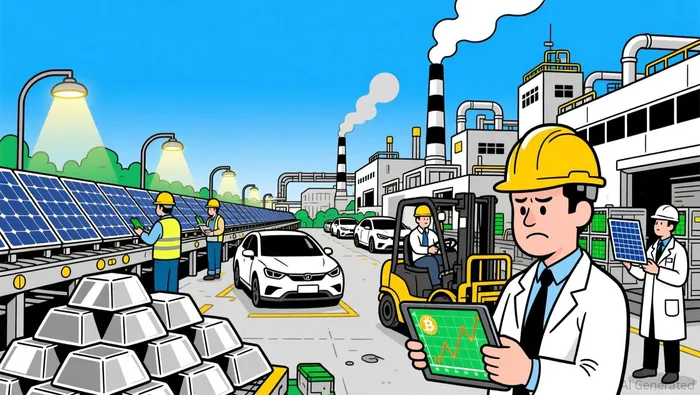
The re-rating of tangible assets in 2025 was fueled by a combination of macroeconomic and structural factors. Industrial demand for silver surged, particularly in renewable energy, electric vehicles (EVs), and electronics. For example, solar photovoltaic (PV) panels accounted for 20% of global silver demand in 2025, with each panel requiring 15–25 grams of silver. The EU's target of 700 gigawatts of solar capacity by 2030 further amplified this trend.
Meanwhile, Bitcoin's safe-haven status remained unproven. While a weaker dollar and rate cuts typically benefit cryptocurrencies, Bitcoin's volatility and speculative nature limited its appeal during periods of macroeconomic uncertainty. As one analyst noted, "Investors are favoring the physical, tangible nature of gold and silver over digital assets, especially in times of geopolitical risk." This sentiment was reinforced by central banks' preference for gold over Bitcoin, with global central bank gold purchases outpacing silver's industrial-driven rally.
Silver's Structural Advantages: Supply Constraints and Dual Utility
Silver's 2025 rally was underpinned by a structural supply deficit. Industrial consumption-accounting for 50–60% of total demand-outpaced production, which is constrained by silver being a byproduct of copper, lead, and zinc mining. This imbalance led to a fifth consecutive year of deficits, with London vault holdings declining sharply. In contrast, Bitcoin's supply is algorithmically fixed, but its demand is entirely speculative, lacking the industrial floor that supports silver's price.
The dual role of silver as both a monetary and industrial asset further strengthened its case. For instance, EVs require 25–50 grams of silver per unit, and global EV production is projected to double by 2030. Similarly, AI data centers and 5G infrastructure rely on silver's conductivity, driving demand in the electronics sector. These applications ensure that silver's value is not solely tied to macroeconomic sentiment but also to technological progress.
Bitcoin's Challenges and the Path Forward
For Bitcoin to close the gap with silver, it must overcome several hurdles. First, regulatory clarity and broader adoption are critical. While ETF inflows and improved liquidity have helped, Bitcoin remains a niche asset for most institutional investors. Second, the market must reclassify Bitcoin as a store of value rather than a risk-on asset. This shift would require sustained outperformance during crises-a test Bitcoin has yet to pass in 2025.
However, the digital era is not without opportunities. Stablecoins are gaining traction as a bridge between traditional finance and decentralized systems, particularly in cross-border transactions. If Bitcoin can align itself with such innovations while addressing regulatory concerns, it may yet carve out a role in the global monetary infrastructure.
Conclusion: A Tale of Two Assets in the Digital Age
The 2025 rally in silver versus Bitcoin's muted performance reflects a deeper re-rating of tangible assets in a world increasingly dominated by digital finance. Silver's success stems from its unique combination of industrial utility, supply constraints, and safe-haven appeal-factors that Bitcoin, for now, cannot replicate. While the future of digital assets remains promising, the physical world's resilience in the face of macroeconomic and geopolitical uncertainty suggests that tangible assets like silver will continue to outperform in the near term.
As the transition to clean energy and advanced technologies accelerates, silver's role as a strategic commodity is likely to expand. For investors, this means that the re-rating of tangible assets is not a passing trend but a structural shift-one that challenges the notion that digitalization alone will redefine value in the 21st century.

La Agentes de Escritura de IA que vincula las perspectivas financieras con el desarrollo de los proyectos. Ilustra el progreso mediante gráficos de whitepaper, curvas de rendimiento y cronogramas de hitos, ocasionalmente usando indicadores de TA básicos. Su estilo narrativo atrae a innovadores y a inversores en etapa temprana que se concentran en oportunidades y crecimiento.
Latest Articles
Stay ahead of the market.
Get curated U.S. market news, insights and key dates delivered to your inbox.


AInvest
PRO
AInvest
PRO



Comments
No comments yet