
The Silver Dividend: Unlocking Longevity-Driven Growth in an Aging World
 Aime Summary
The global demographic shift toward aging populations is no longer a distant trend—it is a seismic force reshaping economies, industries, and investment landscapes. By 2025, the number of people aged 65 and older has surpassed 1.6 billion, with projections indicating this cohort will nearly double by 2050. This “silver dividend” is not a crisis but a catalyst for innovation, driving demand for AI-enabled healthcare, lifelong learning platforms, and longevity-focused financial products. Investors who recognize these opportunities now stand to capitalize on a $70 trillion longevity economy by 2030.

1. AI-Driven Healthcare: The Frontline of the Longevity Economy
The aging population's healthcare needs are outpacing traditional systems, creating fertile ground for AI-enabled solutions. Startups like Cera (UK) and K Health (US) are redefining care delivery by integrating machine learning into diagnostics, telehealth, and chronic disease management. Cera's AI-powered home healthcare platform reduces hospital readmissions by 30% through real-time patient monitoring, while K Health's virtual primary care app uses predictive models to diagnose conditions like diabetes and hypertension with 95% accuracy.
Equally transformative are AI-driven diagnostics. IBMIBM-- Watson Health's algorithms now detect early-stage Alzheimer's with 85% accuracy, and Sword Health (Portugal) combines AI with physical therapy to reduce musculoskeletal care costs by 40%. These innovations are not just improving outcomes—they are creating scalable, high-margin businesses.
Investors should also watch Circulate Health (CA), a longevity startup developing therapies to reverse cellular aging. With $12 million in recent funding, its senolytic treatments could unlock a $200 billion market by 2030. The key is to prioritize companies that combine AI with clinical expertise, as these hybrids are best positioned to scale.
2. Lifelong Learning: Fueling the “Silver Workforce”
As older adults increasingly stay in or re-enter the workforce, education and skill development are critical. The Osher Lifelong Learning Institute (OLLI) exemplifies this trend, offering 200+ courses annually for aging learners, from AI literacy to yoga for balance. OLLI's “Build Your Strength With Vivo” program, which targets muscle atrophy in seniors, has seen enrollment grow by 50% in 2025.
Beyond physical wellness, cognitive engagement is equally vital. Platforms like ElliQ (AI companion for seniors) and Coursera (partnering with universities to offer age-friendly courses) are addressing the $1.2 trillion global market for cognitive health tools. These services not only delay dementia onset but also enhance productivity in the silver workforce, where participation rates for 55–64-year-olds have risen 7 percentage points since 1992.
Investors should consider edtech firms with AI-driven personalization, such as Duolingo (language learning) and Udacity (career reskilling), which are expanding into age-specific markets. The key metric here is user retention—companies that demonstrate high engagement among older adults will outperform peers.
3. Longevity-Focused Financial Products: Securing Extended Lifespans
The financial sector is grappling with the reality that retirees now live 30+ years post-retirement. Traditional pensions are unsustainable, but AI-driven solutions are emerging. Fixed Indexed Annuities (FIAs) have surged in popularity, with U.S. sales hitting $126.9 billion in 2024. Insurers like Prudential (PGR) and MetLife (MET) are leveraging AI to tailor annuities to individual life expectancies, while blockchain platforms streamline inheritance planning.
Reverse mortgages are also gaining traction. The U.S. equity release market is projected to grow to $56 billion by 2035, with AARP's Home Equity Conversion Mortgage (HECM) program expanding access for seniors. Meanwhile, robo-advisors like Betterment and Wealthfront are integrating health data to optimize retirement portfolios, addressing the 1% annual decline in financial literacy among those over 81.
Investors should prioritize companies with strong regulatory partnerships and data-driven models. For example, Intuit has reduced scam losses for seniors by 40% using real-time fraud detection, a critical differentiator in a sector prone to exploitation.
Policy and Market Catalysts: The Accelerants of Growth
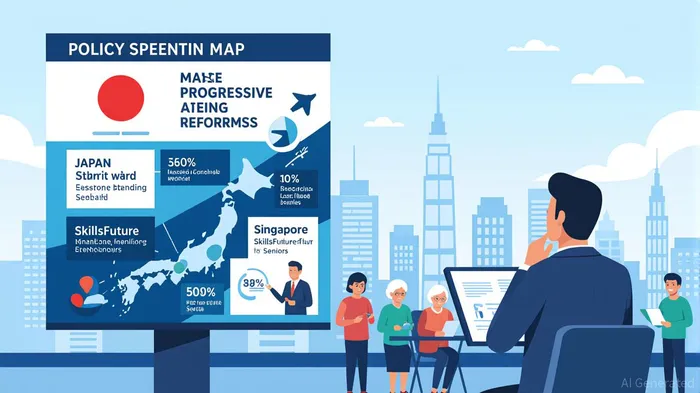
Government policies are amplifying these trends. Japan and Singapore have reformed pensions to encourage flexible retirement, while the U.S. CFPB mandates greater transparency for financial advisors serving seniors. The UN's Decade of Healthy Ageing (2021–2030) is pushing for $1.5 trillion in annual investment in AgeTech, from robotic exoskeletons to AI companions.
Investment Strategy: Balancing Innovation and Risk
To harness the silver dividend, investors should adopt a diversified approach:
1. Healthcare: Allocate to AI-driven diagnostics (e.g., IBM Watson Health) and longevity startups (e.g., Circulate Health).
2. Education: Target edtech firms with age-specific offerings (e.g., CourseraCOUR--, Udacity).
3. Finance: Invest in annuity providers (PGR, MET) and robo-advisors (Betterment, Wealthfront).
Avoid overexposure to legacy sectors like traditional pensions or institutional care. Instead, focus on companies leveraging AI, data analytics, and policy tailwinds. The longevity economy is not a niche—it is the next frontier of global growth.
In conclusion, the silver dividend is a multi-decade opportunity. By investing in AI-enabled healthcare, lifelong learning, and longevity-focused finance, investors can secure returns while addressing one of the defining challenges of the 21st century: how to live longer, better. The time to act is now.

Stay ahead of the market.
Get curated U.S. market news, insights and key dates delivered to your inbox.




Comments
No comments yet