
The Silver Dividend: Unlocking Long-Term Care Investment Opportunities in an Aging World
 Aime Summary
The global demographic shift toward an aging population is no longer a distant trend—it is a seismic force reshaping economies, healthcare systems, and investment landscapes. By 2025, the U.S. median age has surpassed 39, with 61.2 million Americans aged 65 and older. Globally, the population of those aged 60 and above is projected to double to 2.1 billion by 2050. This "silver tsunami" is creating a $2.168 trillion long-term care (LTC) market by 2032, driven by chronic disease prevalence, rising life expectancy, and policy reforms. For investors, this demographic dividend is unlocking high-conviction opportunities in three transformative sectors: healthspan extension biotech, AI-driven eldercare, and financial services tailored for cognitive decline.
1. Healthspan Extension: Biotech's Quest to Reverse Aging
The aging population's demand for therapies that delay or reverse age-related decline is fueling a biotech revolution. Companies like Altos Labs (backed by Jeff Bezos) and Unity Biotechnology are pioneering cellular rejuvenation and senolytic therapies. Altos Labs, for instance, is leveraging Yamanaka factors to reprogram aged cells, with Phase 1 trials targeting neurodegenerative and immune disorders. Unity's senolytics, which remove harmful senescent cells, have shown promise in treating diabetic macular edema and are poised for broader applications.
Investors should focus on firms with clinical-stage pipelines and partnerships with academic institutions. Insilico Medicine, a Hong Kong-based AI drug discovery leader, has entered Phase 2 trials for its first AI-designed longevity drug, targeting idiopathic pulmonary fibrosis. Its Pharma.AI platform is a key differentiator, accelerating drug development cycles. Similarly, BlueRock Therapeutics (a Bayer subsidiary) is advancing iPSC-based therapies for Parkinson's and myocardial repair, offering a dual play on aging and regenerative medicine.
2. AI-Driven Eldercare: Scaling Personalized Care
The LTC market's growth is outpacing traditional healthcare models, creating a vacuum for AI-driven solutions. Startups like Hippocratic AI and Babylon Health are redefining eldercare through predictive analytics and remote monitoring. Hippocratic AI's generative algorithms have reduced hospital readmissions by 20% in pilot programs, while Babylon Health's AI diagnostic tools are enabling early disease detection in aging populations.
The integration of wearables and telemedicine is another growth vector. ZebraZBRA-- Medical Vision's machine learning algorithms for medical imaging are being adopted in Europe and Asia, aligning with the UN's Decade of Healthy Ageing. For investors, the key is to identify platforms with scalable, data-driven models that reduce costs while improving outcomes. The LTC market's CAGR of 7.2% through 2032 underscores the urgency for tech-enabled solutions.
3. Financial Services for Cognitive Decline: Mitigating Longevity Risk
Cognitive decline affects 15% of seniors by age 70, creating a unique financial risk. Robo-advisors like Betterment and Wealthfront are integrating machine learning to optimize retirement portfolios, factoring in healthcare inflation and LTC costs. Meanwhile, dynamic annuities from insurtech firms like Ladder and Tempus are personalizing income streams based on health metrics and life expectancy.
The robo-advisory sector, valued at $41.8 billion in 2025, is growing at a 30.5% CAGR—far outpacing traditional finance. Investors should prioritize platforms with AI-driven behavioral analytics and partnerships with LTC providers. For example, Bank of America's Erica app uses biometric data to adjust annuity payouts in real time, offering a tailored approach to aging populations.
Policy Reforms: The Tailwinds for Longevity Innovation
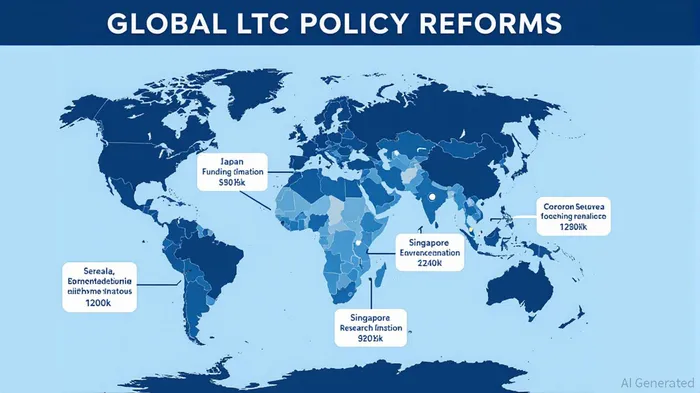
Government policies are accelerating the "silver dividend." The U.S. Strategic Framework for a National Plan on Aging emphasizes financial literacy and age-friendly infrastructure, while Japan's ¥1 trillion retraining fund for older workers supports tech-driven economies. Singapore's expansion of eldercare centers and the EU's Horizon Europe program for age-related disease research are creating regulatory tailwinds.
Investment Thesis: Diversify Across the Longevity Value Chain
The aging population is a megatrend with compounding returns. For investors, the optimal strategy is to diversify across healthspan extension, AI eldercare, and financial services. Biotech firms with clinical-stage pipelines (e.g., Altos Labs, UnityU-- Biotechnology) offer high-growth potential, while AI eldercare startups (e.g., Hippocratic AI) provide scalable, recurring revenue. Financial services addressing cognitive decline (e.g., Ladder, Betterment) capitalize on longevity risk.
Conclusion: The Silver Dividend Awaits
The aging population is not a burden—it is an opportunity. By 2032, the LTC market will nearly double in size, driven by demographic shifts, technological innovation, and policy support. Investors who position themselves in healthspan extension, AI eldercare, and cognitive decline financial services will not only mitigate risk but also capitalize on a $2.1 trillion market. The time to act is now: the silver dividend is here.

Stay ahead of the market.
Get curated U.S. market news, insights and key dates delivered to your inbox.


AInvest
PRO
AInvest
PRO



Comments
No comments yet