
The New Silk Road in the Sky: How Afghanistan's Airspace Emerges as a Geopolitical Lifeline for Airlines
The Middle East's escalating conflicts have turned the region's skies into a minefield, with no-fly zones stretching from Israel to Iran. In this chaotic landscape, airlines are pivoting to an unlikely savior: Afghanistan's airspace. Once avoided due to instability and limited infrastructure, Afghan routes are now critical arteries for global air travel. This shift offers investors a unique lens to assess geopolitical risk mitigation in aviation infrastructure—and where to place bets amid chaos.
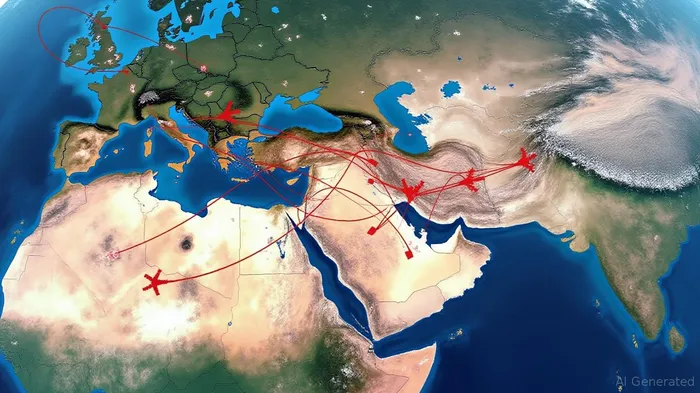
The Geopolitical Airspace Crisis
The Israel-Iran conflict has created a “geopolitical black hole” in the Middle East. Over 1,800 European flights were canceled in June alone, with airspace closures over Iraq, Jordan, and Syria diverting traffic into narrower corridors. Airlines face a brutal calculus: reroute via longer paths (adding up to two hours to London-Hong Kong flights) or halt services entirely. For example, Flydubai's Dubai-Moscow route now takes seven hours—two hours longer than before—due to detours through Pakistan and Afghanistan.
The financial toll is staggering. A BoeingBA-- 777 burns $14,000 extra fuel per rerouted flight, while overflight fees for new routes and crew overtime costs add pressure. Airlines like Lufthansa and Emirates have suspended services to conflict zones, but those agile enough to adapt are thriving.
Afghanistan's Unexpected Role
With Iranian and Iraqi airspace closed, airlines are funneling traffic through Afghanistan, which saw overflight traffic surge 500% since June 13. This shift has turned the country into a de facto air traffic hub, albeit one with risks.
Turkish Airlines (THYAO.IS), which controls 30% of Europe-Middle East traffic, has been a prime beneficiary. Its June passenger numbers rose 12% as it capitalized on rerouted flows through Istanbul. Similarly, EgyptAir (EGYPTAIR.CA) and Dubai Airports (DXB) are leveraging their Middle Eastern hubs to handle overflow traffic.
But Afghanistan's infrastructure struggles complicate the picture. Its air traffic control system, weakened by the U.S. withdrawal, now manages 280 daily overflights—up from 50—a strain that could lead to delays or safety risks. This creates an opportunity for firms like Honeywell (HON), whose anti-spoofing GPS systems are critical for navigating conflict zones.
Key Players and Their Playbook
- Airlines with Flexible Routing:
- Turkish Airlines: Its control over Istanbul's strategic hub and diversified fleet allows rapid rerouting.
EgyptAir: Cairo's position as a Middle East gateway and its partnership with Airbus for fuel-efficient A350s reduce reroute costs.
Infrastructure Developers:
- Dubai Airports (DXB): Expanding Al Maktoum International to handle overflow traffic, with plans to boost annual capacity to 200 million passengers by 2030.
Afghan Infrastructure Funds: Limited but emerging opportunities in rebuilding air traffic control systems, backed by regional governments.
Tech Solutions Providers:
- Honeywell (HON): Its Scorpion Avionics suite, which includes anti-jamming systems, is now standard on Middle East-bound aircraft.
- Satellite Communication Firms: Iridium (IRDM) and Inmarsat provide backup navigation systems critical for rerouted flights.
Investment Opportunities in Flux
The Afghanistan reroute trend offers three actionable strategies:
1. Short-Term Plays:
- Turkish Airlines (THYAO.IS): Its June 2025 revenue rose 18% versus 2024, but geopolitical volatility could cap gains. Monitor stock dips below $5.50/share.
- Dubai Airports (DXB)**: Infrastructure stocks often outperform during crisis-driven traffic surges.
2. Long-Term Infrastructure Bets:
- Dubai Airports (DXB): Its expansion projects are a hedge against Middle East instability.
- Afghan Air Traffic Control Rebuild**: While risky, this could be a government-backed opportunity in 2026–2027.
3. Tech Mitigation Leaders:
- Honeywell (HON): Its Q2 2025 earnings surged on aviation tech demand.
- Iridium (IRDM)**: Satellite services are now a must-have for airlines, with recurring revenue streams.
The Risks Remain
Afghanistan's airspace is not a silver bullet. Its control system could buckle under pressure, while geopolitical tensions—such as Iran's potential retaliation or U.S. sanctions—add uncertainty. Airlines with heavy debt, like Air France-KLM, face liquidity risks if rerouting costs escalate further.
Final Take: Bet on Resilience
The Middle East's no-fly zones have reshaped aviation into a high-stakes game of geopolitical Tetris. Investors should prioritize airlines with flexible routes, infrastructure firms in stable hubs, and tech providers that reduce navigation risks. While Afghanistan's rise is a short-term necessity, the real winners will be those who blend agility with long-term infrastructure investments.
Invest Now?
- Go Long: Honeywell (HON), Dubai Airports (DXB)
- Avoid: Airlines reliant on single routes (e.g., El Al, Emirates) until no-fly zones stabilize.
The skies over Afghanistan may be the new Silk Road, but investors must navigate with both eyes open.

Stay ahead of the market.
Get curated U.S. market news, insights and key dates delivered to your inbox.
AInvest
PRO
AInvest
PRO



Comments
No comments yet