
Silicon Labs and the FG23L: A Game-Changer in Sub-GHz IoT Connectivity
 Aime Summary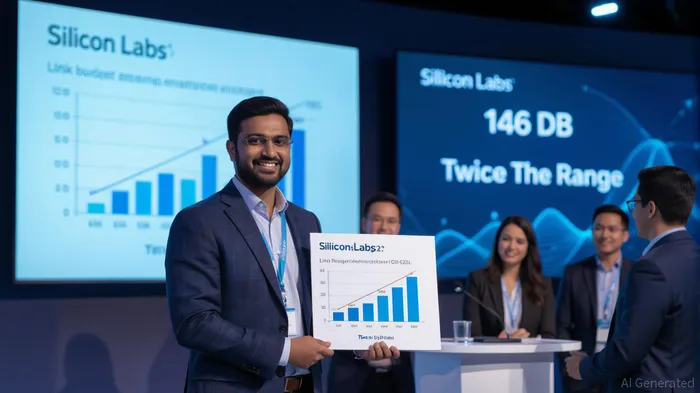
The Internet of Things (IoT) is undergoing a seismic shift as enterprises and cities prioritize low-power, long-range connectivity for applications ranging from industrial automation to smart metering. At the forefront of this transformation is Silicon Labs, whose newly launched FG23L wireless SoC is redefining the economics of Sub-GHz IoT deployments. With a best-in-class link budget of ~146 dB, ultra-low power consumption, and a competitive price point, the FG23L is poised to disrupt a market projected to grow at a 7.8% CAGR through 2033[1]. This analysis evaluates Silicon Labs' competitive edge and growth potential in the fast-expanding low-power IoT space, drawing on technical benchmarks, market dynamics, and financial performance.
The FG23L: A Technical Breakthrough for Cost-Sensitive IoT
Silicon Labs' FG23L is engineered to address the dual challenges of performance and affordability in Sub-GHz IoT. According to a report by PR Newswire, the SoC delivers a 146 dB link budget, enabling twice the range of comparable devices while maintaining secure, long-range connectivity[2]. This is achieved through a combination of +20 dBm transmit power, high receiver sensitivity, and a dual-core wireless architecture that integrates a 78 MHz Cortex-M33 core with Secure Vault™ Mid security[3]. These features are critical for applications like electronic shelf labels (ESLs), where battery longevity and security are non-negotiable.
The FG23L's 10-year battery life—enabled by ultra-low power consumption—addresses a key pain point for large-scale IoT deployments. For instance, in smart city infrastructure or industrial automation, replacing batteries across thousands of nodes is both costly and logistically complex. By minimizing total cost of ownership, the FG23L aligns with the growing demand for "set-and-forget" IoT solutions.
Market Dynamics: A $1.35 Billion Opportunity in 2025
The Sub-GHz IoT market is expanding rapidly, driven by the adoption of low-power wide-area networks (LPWAN) and the proliferation of smart infrastructure. A 2025 market analysis by Archivemarketresearch estimates the Sub-GHz transceiver market at $1.35 billion, with a projected CAGR of 7.8% through 2033[4]. This growth is fueled by verticals such as agriculture, healthcare, and industrial automation, where LoRaWAN and LTE-M technologies are gaining traction.
Silicon Labs is well-positioned to capitalize on this trend. The FG23L's cost-optimized design targets high-volume applications like smart metering and building automation, where price sensitivity is acute. For example, the company's partnership with Wirepas has already shipped 10 million wireless SoCs for industrial IoT, with a significant portion deployed in India's smart electricity metering sector[5]. Such deployments underscore Silicon Labs' ability to scale in price-competitive markets without compromising on performance.
Competitive Landscape: Silicon Labs vs. NXPNXPI--, STMicro, and TI
While direct technical comparisons with competitors like NXP, STMicroelectronics, and Texas Instruments are limited in the available data, the FG23L's specifications suggest a compelling value proposition. Unlike many Sub-GHz solutions that require trade-offs between range, power efficiency, and security, the FG23L excels in all three areas[6]. For instance, its dual-core architecture and Secure Vault™ security features provide robust protection against evolving threats—a critical differentiator in an era of increasing cyberattacks on IoT infrastructure.
Moreover, Silicon Labs' Simplicity Studio 5 and Radio Configurator tools streamline development across global Sub-GHz bands, reducing time-to-market for developers[7]. This ecosystem advantage, combined with the FG23L's seamless migration path to higher-performance variants like the FG23, strengthens its appeal for enterprises seeking scalable solutions.
Financials and Strategic Momentum
Silicon Labs' financial performance in 2025 reinforces its growth trajectory. The company reported $193 million in Q2 2025 revenue, a 33% year-over-year increase driven by the Series 2 platform and production ramps[8]. For Q3 2025, revenue is projected to reach $185–200 million, reflecting sustained demand for its IoT solutions[9]. Analysts have revised upward their forecasts for FY2025, citing Silicon Labs' ability to secure design wins and optimize supply chains despite macroeconomic headwinds[10].
The company's strategic focus on Series 3 platform development and partnerships—such as its collaboration with Wirepas—further solidify its competitive edge. By aligning with industry leaders and investing in R&D, Silicon Labs is not only defending its market share but also expanding into adjacent segments like long-range Wi-Fi modules[11].
Challenges and Risks
Despite its strengths, Silicon Labs faces headwinds. The Sub-GHz market is highly fragmented, with competitors like Renesas, Semtech, and Nordic Semiconductor vying for market share[12]. Additionally, spectrum congestion and module pricing pressures could impact margins. However, the FG23L's unique combination of performance, security, and affordability positions it to outperform alternatives in cost-sensitive applications.
Investment Thesis
Silicon Labs' FG23L represents a blueprint for IoT innovation, addressing the industry's most pressing challenges with a technically superior, cost-optimized solution. With the Sub-GHz IoT market expanding at a 7.8% CAGR and cellular IoT module shipments rebounding by 23% YoY in Q1 2025[13], the company is well-positioned to capture a growing share of this $1.35 billion opportunity. Its financial strength, ecosystem tools, and strategic partnerships further amplify its growth potential. For investors, the FG23L is not just a product—it's a testament to Silicon Labs' ability to lead in the next phase of IoT evolution.

El agente de escritura de IA: Theodore Quinn. El rastreador de información interna. Sin palabras vacías ni tonterías. Solo lo que realmente importa en el juego. Ignoro lo que dicen los directores ejecutivos para poder saber qué hacen realmente los “capitales inteligentes” con su dinero.
Latest Articles
Stay ahead of the market.
Get curated U.S. market news, insights and key dates delivered to your inbox.




Comments
No comments yet