
The Silicon Gold Rush: How AI Content Tools Are Fueling a Semiconductor Boom
The AI revolution is no longer just a buzzword—it's a full-blown gold rush, and the miners you want to back are the semiconductor giants fueling it. From ChatGPT to AI-driven video games, the explosion of generative AI content tools is driving a surge in demand for advanced semiconductors that's rewriting the rules of the tech sector. Let's dig into the dirt to find the real winners here.
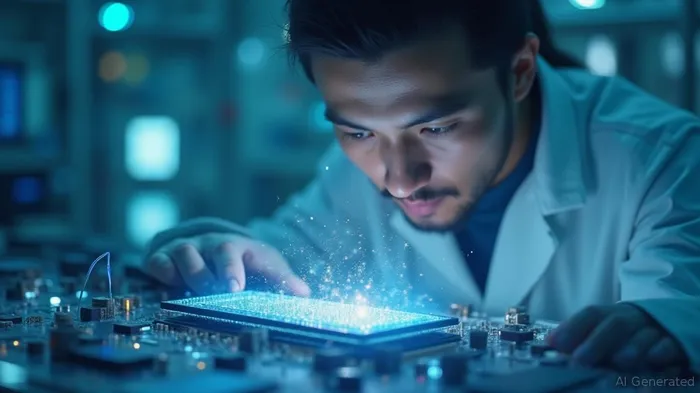
The Demand Surge: AI Content Tools Are Eating the World
Generative AI isn't just creating better chatbots—it's transforming how businesses produce everything from marketing content to movies. The global market for generative AI in content creation is projected to hit $80 billion by 2030, up from $15 billion in 2024. And the secret sauce? Advanced semiconductors. These AI models require massive computational power, and that means GPUsGPUS--, AI-specific chips, and cutting-edge packaging technologies like TSMC's CoWoS.
The numbers are staggering: gen AI chips alone now account for over 20% of global semiconductor sales, and their market is projected to hit $150 billion in 2025—up from $125 billion just last year. This isn't a fad; it's a seismic shift.
The Supply Chain Tightrope: Scarcity and Opportunity
But here's the catch: building these chips isn't easy. The world is in a semiconductor arms race, and the supply chain is stretched to its limits. Advanced nodes (think 3nm or 5nm chips) require extreme ultraviolet lithography machines—machines that only ASMLASML-- can build, and they're backlogged for years.
Look at NVIDIA (NVDA): its GPU sales jumped 60% in the last quarter as data centers raced to buy A100 and H100 chips. But the problem? Capacity constraints. TSMCTSM--, the world's top foundry, is expanding CoWoS wafer production by 100% this year—but it's still playing catch-up. This scarcity is pushing prices higher and margins fatter for those who control the supply.
The Winners: Scale, Innovation, and Geography
Not all chipmakers are created equal. The names to watch are those with moats—scale, proprietary tech, and geopolitical positioning.
NVIDIA (NVDA): The undisputed king of AI GPUs. Its H100 chip is the gold standard for training massive models. With a 50%+ gross margin and $30 billion in cash, it's buying startups (like chiplet designer Cerebras) to stay ahead.
TSMC (TSM): The “Saudi Aramco of semiconductors.” Its 3nm process is years ahead of Intel or Samsung, and its CoWoS packaging tech is irreplaceable for AI chips. The stock has held up despite macro fears—why? Because no one can replicate its ecosystem.
AMD (AMD): Under Lisa Su's leadership, AMD is eating Intel's lunch with its AI-optimized EPYC CPUs and GPU partnerships. Its $500 billion addressable market claim isn't hype—it's math.
ASML (ASML): The hidden gem. Without its EUV machines, there's no 3nm chips. Its backlog is years long, and competitors? None.
The Risks: Don't Get Buried in the Gold Rush
This isn't all sunshine. Geopolitical tensions—like the U.S.-China trade war—are forcing companies to build redundant factories (costly). Talent shortages? The industry needs 100,000+ new engineers annually—and we're not close. And let's not forget: if the AI hype overheats, some firms could be left holding the bag.
The Play: Buy the Semiconductor Stack
This is a sector rotation, not a fad. The demand isn't just from TikTok influencers—it's from Fortune 500 companies needing AI to stay competitive. My advice?
- Go long on the leaders: NVIDIANVDA-- and TSMC are the must-own stocks here.
- Add ASML as a “moat” play: It's the gatekeeper to advanced chips.
- Watch AMD for upside: Its CPU-GPU hybrid strategy is underappreciated.
Avoid the also-rans: Intel is playing catch-up, and Samsung's foundry business is a distant second.
Final Word: The Next Tech Supercycle
This isn't 2000. This is a real-world tech boom, driven by real demand for AI content creation tools. The semiconductor sector is the engine—and the companies that control the supply chain will be the titans of the next decade. Don't miss the boat here.
Action Alert! The time to load up on semiconductors is now. The gold rush is on—and the miners with the best picks will strike it rich.

Stay ahead of the market.
Get curated U.S. market news, insights and key dates delivered to your inbox.
AInvest
PRO
AInvest
PRO



Comments
No comments yet