
The Silent Tax: How UK Fiscal Drag Reshapes Investor Strategies and Market Valuations


 Aime Summary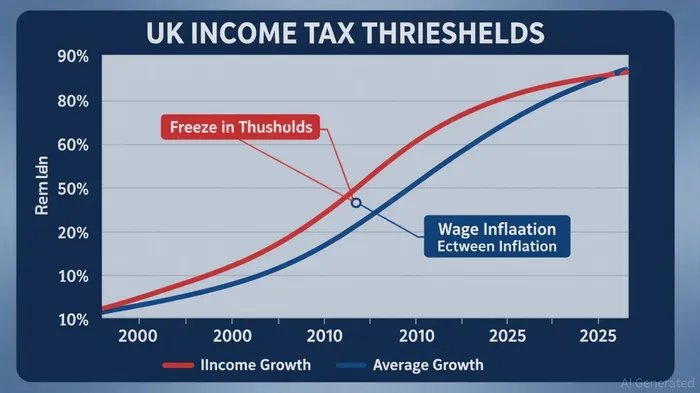
The UK's extended freeze on income tax thresholds—a policy initially announced in 2021 and extended to 2028—has quietly transformed the investment landscape. By locking tax thresholds in cash terms while wages rise, the government has created a fiscal drag effect that pushes millions into higher tax brackets. This stealthy tax hike, absent explicit rate increases, has profound implications for asset valuation models, sectoral dynamics, and long-term investor returns.
The Mechanics of Fiscal Drag
The Personal Allowance (PA) and higher rate threshold (HRT) have remained frozen at £12,570 and £50,270, respectively, since 2022. Meanwhile, average wages have surged, eroding the real value of these thresholds. By 2028, the Office for Budget Responsibility (OBR) projects that 7.2 million individuals will pay the 40% higher rate of income tax, up from 2.9 million in 2000. The additional rate threshold, now at £125,140, has further expanded the cohort of taxpayers in the 45% bracket.
This policy has generated £44.6 billion in additional revenue by 2028, equivalent to a 4p increase in the basic tax rate. However, the true cost lies in its indirect effects: reduced disposable income, altered consumption patterns, and a shift in investor behavior toward tax efficiency.
Investor Behavior and Tax-Efficient Strategies
As higher-rate taxpayers multiply, demand for tax-optimized vehicles has surged. Pension contributions, ISAs, and lifetime gifting strategies have become central to wealth preservation. For instance, the UK's ISA allowance (currently £20,000 annually) has seen record uptake, with investors prioritizing tax-free growth. Similarly, dividend stocks and tax-exempt bonds have gained traction as alternatives to taxable income streams.
The fiscal drag effect has also spurred demand for financial advisory services. High-net-worth individuals now allocate significant resources to estate planning and tax rebates, creating a boom in niche financial sectors. For example, firms specializing in inheritance tax mitigation have seen revenue grow by 20% annually since 2022.
Sectoral Shifts and Valuation Adjustments
The freeze has reshaped sectoral dynamics. Consumer-facing industries, reliant on discretionary spending, face headwinds as higher taxes reduce disposable income. Conversely, sectors offering tax-efficient products—such as financial services, real estate investment trusts (REITs), and healthcare—have gained relative strength.
Asset valuation models have also adapted. Traditional metrics like price-to-earnings (P/E) ratios now incorporate tax drag assumptions, as investors factor in the reduced after-tax returns for higher-rate taxpayers. For example, a company with a 10% pre-tax return might be valued at a 15% discount if 40% of its income is taxed at 40%. This recalibration has led to a re-rating of growth stocks, which are often taxed at higher rates, versus value stocks with more tax-advantaged income streams.
Long-Term Implications for Investors
The freeze's longevity—until 2028—means investors must adopt a long-term lens. Key considerations include:
1. Tax-Optimized Portfolios: Prioritize assets with favorable tax treatment, such as equities held in ISAs or pensions, and income-generating assets with low tax exposure (e.g., dividends, tax-exempt bonds).
2. Sector Rotation: Overweight sectors benefiting from fiscal drag, such as financial services, healthcare, and real estate, while underweighting discretionary consumer sectors.
3. Hedging Inflationary Pressures: Given the freeze's reliance on inflation to generate revenue, investors should hedge against inflation through TIPS, commodities, or inflation-linked bonds.
Conclusion: Navigating the New Normal
The UK's tax threshold freeze is a structural shift, not a temporary policy. For investors, this means rethinking traditional asset allocation and valuation frameworks. While the policy provides short-term fiscal relief for the government, its long-term impact on work incentives and economic growth remains a risk. Savvy investors will capitalize on the opportunities created by fiscal drag—leveraging tax-efficient strategies and sectoral imbalances—while hedging against its broader economic consequences.
In this evolving landscape, adaptability is key. The silent tax may not be visible on the surface, but its fingerprints are everywhere in the markets.

Decoding blockchain innovations and market trends with clarity and precision.
Latest Articles
Stay ahead of the market.
Get curated U.S. market news, insights and key dates delivered to your inbox.


AInvest
PRO
AInvest
PRO



Comments
No comments yet