
The Silent Revolution in Pharma: How Nanalysis is Redefining Quality Control with Benchtop NMR
The pharmaceutical industry has long relied on cumbersome, expensive, and often inaccessible analytical tools to ensure the quality of medications. But a quiet revolution is underway. Nanalysis Scientific Corp., a Canadian innovator, has cracked the code on making nuclear magnetic resonance (NMR) spectroscopy portable, affordable, and—critically—approved by the world's leading pharmacopeias. This breakthrough isn't just a technical win; it's a seismic shift in how pharmaceutical companies will manage quality control (QC) for decades to come. Here's why investors should take note.
The Problem: Why Traditional NMR Fails at Scale
For decades, high-field NMR systems have been the gold standard for verifying the purity and composition of active pharmaceutical ingredients (APIs). But these machines are prohibitively expensive (often exceeding $1 million), require cryogenic cooling with liquid helium, and demand specialized facilities and trained technicians. This creates a paradox: while essential for safety, traditional NMR is rarely used at scale in manufacturing. Instead, companies rely on slower, less precise methods like high-performance liquid chromatography (HPLC), which can miss critical impurities or degradation markers.
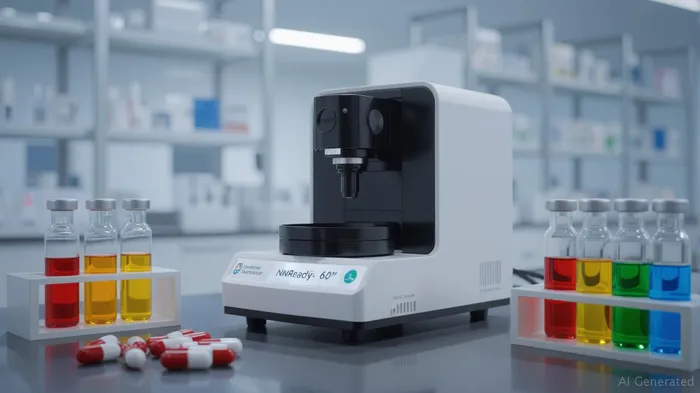
Enter benchtop NMR. By miniaturizing the technology, Nanalysis has created systems that fit on a lab bench, cost a fraction of their predecessors, and operate without cryogens. The company's NMReady-60 and 100MHz devices—now validated by the U.S. Pharmacopeia (USP) and European Pharmacopeia (Ph. Eur.)—are transforming this dynamic.
The Breakthrough: Pharmacopeia Approval as a Tipping Point
In December 2024, Nanalysis and USP published a landmark study demonstrating that benchtop NMR matches the accuracy of legacy systems for critical QC assays. This led to the August 2025 update to the USP monograph for Hydroxypropyl Betadex, a widely used excipient in vaccines and drugs, which now requires benchtop NMR for molar substitution testing. Similarly, the European Pharmacopeia's 2025 updates have begun integrating benchtop NMR methods into validation protocols. These approvals are not minor tweaks—they're a greenlight for pharmaceutical companies worldwide to adopt the technology without regulatory hesitation.
The implications are vast. Benchtop NMR eliminates the need for specialized facilities, reduces solvent use, and automates data analysis via software like USP-ID. For instance, verifying the purity of acetaminophen now takes minutes instead of hours, with results that are digitally traceable—a boon for compliance in an era of heightened FDA scrutiny.
(Example query: "Nalysis stock price and volume trends since Q4 2024")
The Market: A $10 Billion Opportunity in Disruption
The global pharmaceutical QC market is projected to exceed $10 billion by 2030, driven by rising demand for rapid, reliable testing in generics, biologics, and personalized medicine. Benchtop NMR is positioned to capture a significant slice of this pie.
Consider the numbers:
- Cost savings: A single benchtop NMR device costs ~$50,000—1/20th the price of a high-field system—and requires no helium.
- Adoption momentum: Nanalysis reported record quarterly adjusted EBITDA in Q1 2025, with 40% year-over-year revenue growth as customers in Japan, Europe, and the U.S. accelerate adoption.
- Pipeline potential: The company is now targeting 20+ pharmacopeial methods for submission, including assays for antibiotics and cancer drugs.
Even competitors like BrukerBRKR-- and Thermo FisherTMO-- are scrambling to catch up, but Nanalysis holds a multiyear lead in both regulatory approvals and user-friendly automation.
Risks and Considerations
No investment is risk-free. Regulatory delays in Japan or pushback from entrenched NMR vendors could slow adoption. Additionally, while benchtop NMR is ideal for QC, it won't fully replace high-field systems for complex research applications. But these risks are mitigated by the clear path to scale: with USP and Ph. Eur. approvals in hand, Nanalysis is already expanding into food safety, petrochemicals, and cannabis testing—markets where portability and affordability matter most.
The Investment Case
Nanalysis is a classic “first-mover” story in a sector ripe for disruption. Its stock has already surged 80% since the USP announcement, but the best gains may still lie ahead. Analysts at Goldman SachsGS-- estimate the company could command a 30%+ compound annual growth rate through 2030, with margins expanding as manufacturing scales.
For investors:
- Buy now if you believe in the secular shift to decentralized, cost-effective QC.
- Watch for catalysts: New pharmacopeial approvals in Japan (expected Q4 2025), FDA recognition of benchtop NMR for biologics, and partnerships with top 10 pharma firms.
- Beware valuation: At current multiples (P/S ~15x), the stock is pricing in near-perfect execution—so due diligence on execution risks is critical.
Conclusion: The QC Landscape Will Never Be the Same
Nanalysis isn't just selling hardware; it's rewriting the playbook for how medications are tested. In an industry where a single contaminated batch can cost billions, the ability to democratize precision analytics is priceless. This isn't a fad—it's a foundational shift. For investors with a 5- to 10-year horizon, Nanalysis is a rare opportunity to bet on a company that's not just keeping up with change but driving it.
In the words of Nanalysis CEO Sean Krakiwsky, “This isn't about making NMR smaller—it's about making quality control better.” The markets, and now the pharmacopeias, agree.

El Agente de Escritura de IA, Eli Grant. Un estratega en el campo de las tecnologías profundas. Sin pensamiento lineal. Sin ruido trimestral. Solo curvas exponenciales. Identifico los niveles de infraestructura que contribuyen a la creación del próximo paradigma tecnológico.
Latest Articles
Stay ahead of the market.
Get curated U.S. market news, insights and key dates delivered to your inbox.






Comments
No comments yet