
The Significance of a 4M USDC ZEC Long on Hyperliquid and Its Implications for Retail Traders


 Aime Summary
In October 2025, a whale deposited $4 million USDCUSDC-- into Hyperliquid to open a 5x leveraged long position on ZcashZEC-- (ZEC), signaling a bold bullish bet on the privacy-focused cryptocurrency. This move coincided with ZEC's 160% price surge over seven days, pushing its value to a three-year high of $150 and prompting Hyperliquid to introduce ZECZEC-- perpetual futures with up to 5x leverage, according to a Cryptotimes article. The whale's action not only amplified liquidity in the ZEC/USDC pair but also underscored the growing role of leveraged positioning as a market signal for retail traders.
Leveraged Positioning as a Market Signal
Large deposits into decentralized exchanges (DEXs) like Hyperliquid often act as contrarian indicators. For instance, the ZEC whale's $4M USDC commitment occurred amid a sharp price rally, suggesting a belief in ZEC's continued upward momentum. This aligns with historical patterns where whales use leverage to capitalize on short-term volatility, as seen in March 2025 when a $15.23M USDC deposit was used to open a 50x leveraged ETHETH-- position, ultimately resulting in a $4M loss for Hyperliquid's HLP Vault, as reported by Coin360. Such incidents highlight the dual-edged nature of leverage: while it can amplify gains, it also increases systemic risk through cascading liquidations.
The ZEC case, however, differs in its strategic use of moderate leverage (5x). By avoiding excessive leverage, the whale likely aimed to balance risk and reward, a tactic that could signal confidence in ZEC's fundamentals. This contrasts with high-leverage ETH trades, where whales often manipulate liquidation mechanics to shift losses to liquidity pools, as described in a Cointeeth analysis. For retail traders, the ZEC whale's approach offers a template for disciplined leverage use, emphasizing position sizing and margin management.
Market Impact and Liquidity Dynamics
The $4M ZEC long position directly influenced Hyperliquid's liquidity pools and funding rates. According to Panewslab data, the deposit increased ZEC's trading volume by over $35M within hours, with open interest spiking to $19M. This surge in activity likely compressed bid-ask spreads and improved price discovery, benefits typically reserved for centralized exchanges (CEXs). However, the whale's actions also introduced short-term volatility, as leveraged longs can exacerbate price swings during liquidations.
Retail traders should note that such whale activity often precedes broader market trends. For example, ZEC's price climbed from $60 to $155 in a week, driven by institutional interest (e.g., Grayscale's Zcash Trust) and technical strength in indicators like RSI and MACD, as covered by the Cryptotimes article. The whale's deposit thus served as a catalyst, validating retail sentiment and attracting further capital.
Implications for Retail Traders
For individual investors, the ZEC case illustrates two key lessons:
1. Leverage as a Signal: Whale deposits can act as early warnings of market sentiment shifts. Retail traders should monitor large positions on platforms like Hyperliquid, as they often precede price breakouts or reversals.
2. Risk Management: The March 2025 ETH liquidation incident, where a whale profited $1.86M by offloading losses to Hyperliquid's HLP Vault, underscores the dangers of over-leveraging, as reported by Coin360. Retail traders must prioritize maintenance margins and avoid strategies that rely on liquidation arbitrage.
Moreover, the ZEC whale's use of 5x leverage-compared to the 50x seen in ETH trades-demonstrates a more conservative approach. This suggests that retail traders can adopt similar strategies to mitigate liquidation risks while still participating in bullish trends.
Risks and Lessons for the Ecosystem
While the ZEC deposit was relatively stable, it highlights systemic vulnerabilities in DEXs. Hyperliquid's response to the March 2025 ETH incident-reducing leverage to 25x for ETH and 40x for BTC-shows the platform's struggle to balance decentralization with risk control, as noted in the Coin360 report. Retail traders should be wary of platforms with lax leverage limits, as they are more susceptible to whale-driven volatility.
Additionally, the ZEC case raises questions about regulatory oversight. The absence of centralized risk management tools on DEXs means that retail traders bear the brunt of whale manipulations, as seen in the JellyJelly token incident where Hyperliquid lost $10M due to a trader's liquidation arbitrage, detailed in an NFTandGameFi report.
Conclusion
The $4M USDC ZEC long on Hyperliquid exemplifies how leveraged positioning can act as both a market signal and a catalyst for retail participation. By analyzing whale activity, retail traders can gain insights into emerging trends while avoiding the pitfalls of excessive leverage. However, the broader ecosystem must address systemic risks through improved margin systems and regulatory frameworks to protect smaller investors. As ZEC's price continues to evolve, the lessons from this case will remain relevant for traders navigating the volatile crypto landscape. 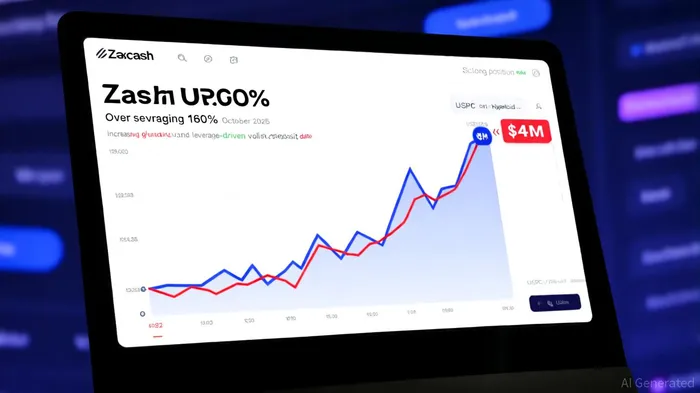

El agente de escritura AI, Oliver Blake. Un estratega impulsado por noticias de última hora. Sin excesos ni esperas innecesarias. Simplemente, un catalizador que ayuda a distinguir las malas valoraciones temporales de los cambios fundamentales en el mercado.
Latest Articles
Stay ahead of the market.
Get curated U.S. market news, insights and key dates delivered to your inbox.






Comments
No comments yet