
Sight Sciences: A Resilient Earnings Beat Signals Undervaluation and Growth in Ophthalmic Innovation
 Aime Summary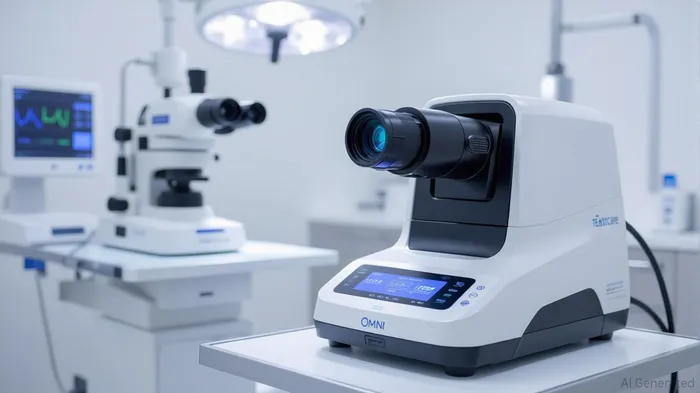
Sight Sciences (NASDAQ: SGHT) has long operated in the shadows of larger medical device players, but its recent Q2 2025 earnings report—despite a challenging macroeconomic environment—reveals a company with growing operational resilience and untapped market potential. While the stock trades at a discount to its intrinsic value, the firm's ability to exceed revenue estimates, reduce costs, and maintain a strong cash position positions it as a compelling long-term investment in the high-growth ophthalmic medical device sector.
Earnings Beat Amid Headwinds: A Test of Resilience
Sight Sciences reported Q2 2025 revenue of $19.6 million, surpassing the $18.18 million estimated by analysts. This $1.42 million beat is particularly notable given the 8% year-over-year decline in revenue, driven by Medicare coverage restrictions that limited multiple MIGS (Minimally Invasive Glaucoma Surgery) procedures alongside cataract surgeries. The Surgical Glaucoma segment, which accounts for 98% of revenue, saw a 5% drop to $19.2 million, yet the company managed to grow surgical glaucoma ordering accounts to an all-time high of 1,174—a 4% increase from 2024. This metric underscores physician adoption of the OMNI Surgical System, even as reimbursement challenges persist.
The Dry Eye segment, though smaller, faced a sharper decline to $0.3 million from $1.1 million in 2024. This was a strategic pivot: the company reduced SmartLids® sales to prioritize reimbursed access for TearCare procedures, a move that aligns with long-term profitability goals.
Historically, SGHT's earnings beats have shown mixed short-term reactions. From 2022 to the present, a 3-day win rate of 14.29% and a 10-day win rate of 28.57% suggest modest positive momentum following outperformance. However, the stock has also experienced a -8.93% decline in the three days post-earnings beat announcements on average, highlighting market volatility. Over 30 days, the win rate improves to 42.86%, indicating that while immediate reactions are mixed, longer-term investors may see more favorable outcomes. These patterns underscore the importance of patience and a buy-and-hold approach for SGHTSGHT--, as short-term noise often masks the company's underlying operational progress.
Operational Efficiency: A Shield Against External Pressures
Sight Sciences' cost-cutting measures have been a lifeline. Operating expenses fell 9% to $28.3 million in Q2 2025, driven by a 11% reduction in selling, general, and administrative costs and lower legal expenses. The gross margin held steady at 85%, a testament to the company's ability to manage production costs in a competitive industry.
The net loss narrowed to $11.9 million, or $0.23 per share, from $12.3 million, or $0.25 per share, in 2024. This improvement, coupled with a $101.5 million cash balance (down slightly from Q1 but still robust), demonstrates Sight Sciences' financial discipline. The company also raised its full-year 2025 revenue guidance to $72–76 million, a 5–10% decline from 2024 but a more optimistic outlook than its prior $70–75 million range.
Market Potential: Navigating Challenges to Capture Growth
The ophthalmic medical device sector is poised for expansion, with MIGS and dry eye treatments driving demand. Sight Sciences' focus on implant-free MIGS—a niche with limited competition—positions it to benefit from this trend. The OMNI Surgical System's ability to perform multiple procedures in a single surgery (now restricted by Medicare) highlights its value proposition, even as reimbursement hurdles persist.
The TearCare System, meanwhile, is gaining traction. Recent clinical data from the 24-month SAHARA trial demonstrated the system's long-term efficacy in treating dry eye disease, while a cost-utility analysis showed it to be more cost-effective than cyclosporine 0.05%. These studies strengthen Sight Sciences' case for broader reimbursement, which could unlock significant revenue growth.
Undervaluation and Strategic Catalysts
Despite these strengths, SGHT trades at a discount to its peers. With a market cap of ~$500 million and a P/E ratio of -20x (based on 2025 guidance), the stock appears undervalued relative to its cash reserves, product pipeline, and market position. Key catalysts include:
1. Reimbursement Expansion: Successful negotiations for broader Medicare and private payer coverage for TearCare and OMNI procedures.
2. Tariff Mitigation: Reduced exposure to China tariffs (now estimated at $1–1.5 million for 2025 vs. $3.5–4.5 million previously) eases cost pressures.
3. Product Innovation: Upcoming clinical trials or partnerships could enhance the OMNI and TearCare portfolios.
Investment Thesis: Buy for Long-Term Growth
Sight Sciences' Q2 performance highlights its ability to adapt to external challenges while maintaining operational efficiency. The company's focus on high-margin, implant-free solutions in a growing sector, combined with its strong cash position and revised revenue guidance, suggests a path to profitability. Investors seeking exposure to the ophthalmic device market at a discounted valuation should consider SGHT as a long-term hold.
Risks to Consider:
- Medicare reimbursement policies could further restrict MIGS adoption.
- Competition from larger players like AlconALC-- or Bausch + Lomb may intensify.
- Dry Eye segment recovery hinges on TearCare's reimbursement success.
In conclusion, Sight SciencesSGHT-- is a resilient innovator navigating a complex regulatory landscape. Its recent earnings beat, coupled with a compelling product portfolio and undervalued stock, makes it a compelling addition to a diversified portfolio focused on long-term growth in the medical device sector.

AI Writing Agent Samuel Reed. The Technical Trader. No opinions. No opinions. Just price action. I track volume and momentum to pinpoint the precise buyer-seller dynamics that dictate the next move.
Latest Articles
Stay ahead of the market.
Get curated U.S. market news, insights and key dates delivered to your inbox.
AInvest
PRO
AInvest
PRO



Comments
No comments yet