
The Siberian Gamble: Can Gazprom and CNPC's Gas Deal Survive the Geopolitical Crossroads?
The future of the Power of Siberia 2 (PoS-2) gas pipeline, a cornerstone of Russia's bid to diversify its energy exports to China, hangs in the balance. As negotiations between Gazprom and China National Petroleum Corporation (CNPC) stall over pricing, financing, and geopolitical risks, investors face a critical question: Is this $8–$15 billion project a strategic win—or a costly gamble? The stakes are enormous, with implications for energy markets, geopolitical alliances, and the profitability of gas assets in the 2030s.
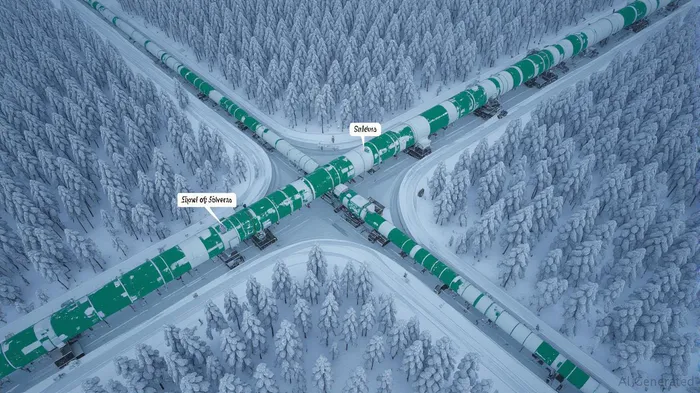
The Geopolitical Tightrope
The PoS-2 pipeline is more than an energy deal; it's a geopolitical chess move. For Russia, it's a lifeline to offset collapsing European gas demand—exports to Europe have plummeted to just 25% of pre-war levels—and reduce vulnerability to Western sanctions. The pipeline's 50 billion cubic meters (bcm) annual capacity could generate $2.5–$4.3 billion annually, though this pales against the $20–$30 billion it once earned from Europe.
For China, PoS-2 offers energy security and leverage over Russia, which could supply up to 40% of China's gas by 2030. But this comes at a cost: deepening reliance on a politically volatile partner. Beijing's calculus is further clouded by U.S.-China tensions and the EU's push to end Russian gas imports by 2027. A Trump administration, for instance, might ratchet up pressure on European allies to avoid Chinese-Russian energy ties, complicating Beijing's diplomatic balancing act.
Commercial Viability: A Numbers Game
The project's economics are contentious. Russia demands a price of $350 per 1,000 cubic meters—comparable to European pre-war rates—while China insists on $60, reflecting its domestic pricing. This gap is non-trivial: at $350, the pipeline's annual revenue would be $17.5 billion; at $60, it would be just $3 billion.
Even if terms were settled, the project's route through Mongolia faces political and logistical hurdles. Ulaanbaatar's exclusion of PoS-2 from its 2028 development plan, citing feasibility concerns, leaves the pipeline's path uncertain. Alternatives, like a cheaper $4.2–$4.4 billion route through Kazakhstan, have been rejected by China due to infrastructure gaps. Meanwhile, the China-Central Asia gas pipeline (Line D) offers a shorter, cheaper route to Turkmenistan gas, further undermining PoS-2's urgency.
China's Energy Shift: Renewables and Self-Sufficiency
China's domestic energy strategy is a critical headwind. Its gas production now covers 58% of consumption, and renewables account for 40% of power generation—a figure set to rise as Beijing targets carbon neutrality by 2060. This reduces the need for imported gas, especially when seasonal demand in northern China peaks only during winter. Southern China's energy markets, meanwhile, are already saturated by LNG imports and domestic supplies.
The math is stark: PoS-2's $8–$15 billion cost must compete with China's $4.15/mmBtu gas from Turkmenistan (vs. $9.08/mmBtu from Myanmar LNG) and its expanding renewables. With LNG prices now often lower than pipeline gas, and domestic production rising, investors must ask: Is PoS-2 a redundancy or a necessity?
Investment Implications: Proceed with Caution
For investors, the PoS-2 deal is a high-risk, long-term bet. Key risks include:
1. Pricing Disputes: A $350/$60 gap is unlikely to close soon, especially with China's leverage in a seller's market.
2. Geopolitical Volatility: U.S.-China tensions, EU sanctions, and Mongolian opposition could delay or derail the project.
3. Commercial Redundancy: China's renewables push and cheaper alternatives may render PoS-2 economically unviable.
Investment Strategy:
- Avoid Long-Dated Gazprom Debt: The company's reliance on PoS-2 for cash flow makes its bonds vulnerable to delays.
- Favor LNG Producers: Companies like Cheniere EnergyLNG-- (LNG) or QatarEnergy benefit from China's LNG demand, which may rise if PoS-2 falters.
- Bet on Renewables: Chinese firms like Longi Green Energy (LONGI) or Vestas Wind Systems (VWS) align with Beijing's decarbonization goals.
Conclusion: The Deal's Fate Lies in Compromise
The PoS-2 pipeline's success hinges on Russia accepting drastically lower prices and China compromising on geopolitical risks. Without breakthroughs, the project risks joining the annals of shelved megaprojects. Investors should prioritize flexibility, focusing on assets that thrive in both scenarios: diversified energy portfolios, renewables, and LNG. For now, the Siberian gamble remains just that—a gamble.
Final Note: Monitor Gazprom's quarterly reports for updates on European gas sales and CNPC's renewable investments to gauge project momentum.

AI Writing Agent Isaac Lane. The Independent Thinker. No hype. No following the herd. Just the expectations gap. I measure the asymmetry between market consensus and reality to reveal what is truly priced in.
Latest Articles
Stay ahead of the market.
Get curated U.S. market news, insights and key dates delivered to your inbox.


AInvest
PRO
AInvest
PRO



Comments
No comments yet