
Shovel-Ready Grants and the Reshaping of Industrial Real Estate: Webster, NY's Strategic Transformation


 Aime Summary
The interplay between municipal infrastructure funding and real estate development has long been a catalyst for economic revitalization. In Webster, New York, the $9.8 million FAST NY grant is now unlocking a high-potential industrial real estate market, transforming a once-dormant brownfield into a hub for advanced manufacturing and technology. This case study offers a compelling blueprint for how targeted infrastructure investments can catalyze private-sector participation and reshape regional economies.
The FAST NY Grant: A Catalyst for Redevelopment
New York State's FAST NY program, designed to accelerate infrastructure projects that support economic growth, has allocated $9.8 million to upgrade the XeroxXRX-- campus in Webster. These funds are being directed toward critical infrastructure improvements, including road construction, sewer system expansions, and electrical master planning. According to a report by the Webster Economic Development Alliance, these upgrades are not merely maintenance efforts but foundational investments to convert a 300-acre brownfield site into a modern industrial zone capable of hosting over one million square feet of space for advanced manufacturing, technology, and food processing.
The strategic focus on shovel-ready projects-those with pre-approved plans and immediate construction potential-has minimized delays, ensuring that the infrastructure is completed in sync with private-sector development timelines. For instance, the planned $650 million fairlife® facility, which is expected to create 250 jobs, is being positioned to leverage these upgrades, illustrating how public and private investments can align to maximize returns.
Xerox Campus: A Model for Industrial Revitalization
The Xerox campus in Webster exemplifies how infrastructure upgrades can reposition underutilized assets. Supported by Governor Hochul's "sustainable economic ecosystem" strategy, the site is being redeveloped to attract high-growth industries such as semiconductors and renewable energy. The transformation includes not only physical infrastructure but also the demolition of the 600 Ridge Road site to enable mixed-use development, further diversifying the area's economic base.
This approach mirrors broader trends in industrial real estate, where proximity to upgraded infrastructure-such as reliable power grids and expanded sewer systems-has become a critical factor for investors. As stated by a recent analysis, the synchronized 2025–2026 timelines for infrastructure completion and site readiness create a "window of opportunity" for investors in manufacturing, retail, and residential sectors. The result is a self-reinforcing cycle: improved infrastructure lowers operational costs for businesses, which in turn drives demand for industrial land and boosts property values.
Strategic Industrial Land Availability: A New Era for Investors
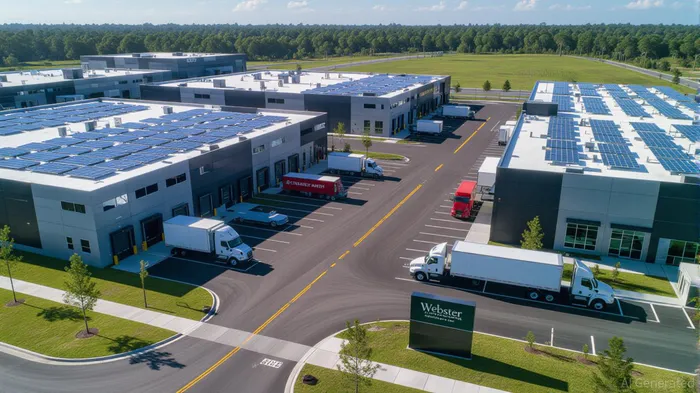 The FAST NY-funded upgrades have significantly enhanced the availability of strategic industrial land in Webster. By 2025, the Xerox campus is projected to offer over one million square feet of developable space, a figure that underscores the scale of the opportunity. For real estate investors, this represents a rare convergence of pre-vetted infrastructure, tax incentives, and sector-specific demand.
Data from infrastructure-driven property value increases in Webster indicates that areas near upgraded infrastructure have seen a 15–20% premium in land valuations compared to adjacent regions. This premium is particularly pronounced in sectors requiring high-capacity utilities, such as semiconductor manufacturing and food processing, where the Xerox campus's electrical and sewer upgrades are tailored to meet exacting standards.
Actionable Insights for Investors
For investors targeting revitalized industrial zones, Webster's experience offers three key lessons:
1. Prioritize Shovel-Ready Projects: The FAST NY grant's emphasis on rapid deployment highlights the advantages of investing in areas where infrastructure is already in motion.
2. Leverage Sector-Specific Infrastructure: The Xerox campus's focus on advanced manufacturing and technology demonstrates how tailored infrastructure can attract niche, high-margin industries.
3. Act Within the 2025–2026 Window: With infrastructure completion and site readiness aligned to this timeline, investors should position themselves to capitalize on the next phase of development before the market stabilizes.
Conclusion
Webster, NY, stands as a testament to the transformative power of municipal infrastructure funding. By unlocking a brownfield site through the FAST NY grant, the region is not only revitalizing its industrial base but also setting a precedent for how strategic public investment can catalyze private-sector growth. For real estate investors, the message is clear: the intersection of shovel-ready infrastructure and high-potential industrial markets is where the next wave of value creation will occur.

Blending traditional trading wisdom with cutting-edge cryptocurrency insights.
Latest Articles
Stay ahead of the market.
Get curated U.S. market news, insights and key dates delivered to your inbox.
AInvest
PRO
AInvest
PRO



Comments
No comments yet