
A Shortline Railroad Opens a New Facility. There's Just No Stock to Buy.
 Aime Summary
On August 28, 2026, the Aberdeen Carolina and Western Railway — one of the largest privately held shortline railroads in North Carolina — announced the opening of the Candor Logistics Park. The 30-acre transload facility, located near Candor in Montgomery County, can handle more than 100 rail cars and processes fuels, food-grade products, plastic resins, and dry bulk commodities like cement and lime. Two adjacent parcels are already pad-ready for industrial construction, and the county is targeting $50 million in investment and 50 to 100 new jobs.
The announcement carried the usual press-release optimism: fewer trucks on the road, cleaner air, a boost for local industry. For investors who see a headline about a rail facility opening and reach for their trading apps, there's an immediate roadblock. The Aberdeen Carolina and Western Railway is not publicly traded. There is no ticker symbol.
That fact is the starting point, not the end of the story. It raises two questions worth answering: what does this facility tell us about the economics of small railroads, and where can an investor actually find exposure to that same business?
How shortline railroads work
Shortline railroads operate on the edges of the national freight network. They run relatively short stretches of track — often former branch lines spun off by major carriers — and connect local industries to the larger Class I railroads like Norfolk SouthernNSC-- and CSXCSX--. ACWR operates 140 miles of track through central North Carolina, interchanging cars with Norfolk Southern in Charlotte and CSX in Aberdeen.
This interchange relationship is the whole model. The Class I railroads own the long-distance trunk lines and the terminals at ports and mega-hubs. The shortlines handle the first and last mile: getting freight to and from the industries that sit off the main lines. Norfolk Southern connects with roughly 260 shortlines across its network, adding more than 20,000 miles of track to its effective reach.
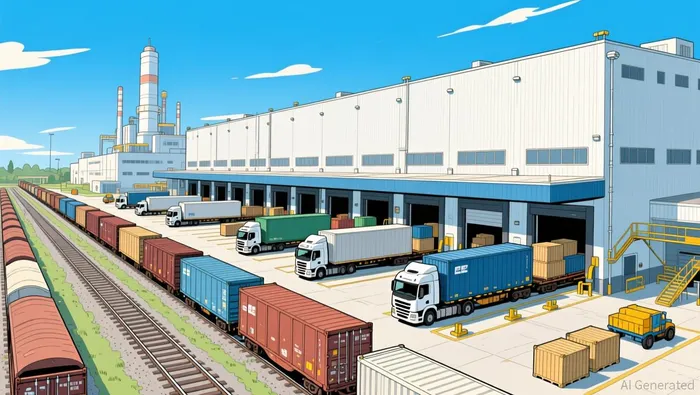
Transloading is the service at the center of the Candor Logistics Park. Transloading means transferring freight from rail cars to trucks, or trucks to rail cars, at a facility that sits between the two modes. Companies use it when their factory, warehouse, or customer is too far from a Class I rail terminal to make direct rail service economical, or when a mixed shipment makes rail the cheaper option for the bulk of the load. The shortline drops off a unit train of plastic resin or cement at the transload yard, trucks pick up smaller quantities and deliver them to local customers. The railroad earns revenue on the rail haul and the yard handles the rest.
The economics favor both sides. Rail moves heavy bulk freight at a fraction of the per-ton-mile cost of trucking. The shortline earns fee-based revenue with relatively fixed track maintenance costs. The facility itself — with certified scales, water access, fencing, and security — represents infrastructure that locks in customers once they build their logistics plan around it. A company that sets up its supply chain to receive plastic resin by rail at Candor is not going to move that decision lightly.
Government grants subsidize the upfront cost. This project was funded in part by grants from the North Carolina Southeast Partnership, the North Carolina Railroad Company, and state transportation programs. The federal CRISI program awarded ACWR $13 million in 2020 for track improvements. That pattern is common: shortlines invest 25 to 33 percent of their revenue back into track and bridge upgrades, and government grants help bridge the gap between what a small railroad can self-fund and what safe, efficient operations require.
The class definitions matter for scale

Federal regulations classify freight railroads by annual operating revenue. Class III railroads generate less than $34.7 million in operating revenue. ACWR's own filing with the Surface Transportation Board in 2022 projected annual revenues exceeding $5 million, placing it firmly in the smallest tier. For comparison, the entire U.S. shortline industry generated about $3.6 billion in revenue in 2025, with profit margins compressing from 15.4 percent in 2020 to 10.9 percent as input inflation outpaced what shortlines could charge their customers.
The industry has consolidated around two large operators. Genesee & Wyoming owns or leases 122 railroads across North America, Australia, and Europe, making it the largest publicly traded shortline and regional railroad company. Watco Companies operates a portfolio of shortlines in the Pacific Northwest and is privately held. The most common ownership structure for individual shortlines like ACWR is private equity or founder-led control. There is no exchange on which to buy shares of ACWR itself.
Where the public market exposure actually lives
If the Candor Logistics Park is an example of a broader trend — shortlines building out transload and industrial development capacity to capture more freight — investors have three routes to that story through public markets.
Genesee & Wyoming (NYSE: GWR) is the most direct play. The company operates the same shortline and regional railroad model as ACWR, just at a much larger scale: roughly $2 billion in annual revenue, hundreds of railroads in its portfolio, and a strategy built on acquiring smaller operators and investing in transload and terminal infrastructure. Genesee trades at roughly $112 per share with a market capitalization around $6.4 billion and a price-to-earnings ratio near 30. That multiple reflects the market's view that shortline railroads offer stable, asset-backed cash flows with moderate but persistent growth. The tradeoff versus ACWR's model is that Genesee is diversified enough that no single facility opening moves the needle.
Norfolk Southern (NYSE: NSC), ACWR's Class I interchange partner in Charlotte, benefits from every shortline that expands capacity and volume on the feeder network. Norfolk Southern's leadership has explicitly called shortlines a growth strategy, recently expanding its Short Line Performance Project to all 260-plus shortline connections. The Class I railroad earned about $22 billion in annual revenue and generated $3.7 billion in operating cash flow over the trailing twelve months. It trades at roughly 30 times trailing earnings with a 1.5 percent dividend yield and $28.9 billion in total debt. Norfolk Southern is not a shortline proxy — it is a massive network with its own capital intensity, regulatory overhang, and cyclical exposure. But the shortline expansion trend feeds its volumes.
The broader rail sector — Union Pacific, CSX, Canadian National — tells the same story at an even larger scale. These companies benefit from modal shift away from trucking, supply chain reshoring, and the same industrial logistics investments that justify a 30-acre transload park in central North Carolina. They are also more expensive, more leveraged, and more exposed to macroeconomic cycles.
What to watch
The Candor Logistics Park is a specific data point in a sector that most retail investors cannot see into directly. The privately held shortline railroad industry is roughly 5,000 establishments operating with limited disclosure. There are no quarterly earnings calls, no 10-K filings, no analyst estimates. The financial pressure is real — profit margins are still below their pre-pandemic levels, and the 25-to-33-percent revenue reinvestment requirement means that growth requires either higher volumes, higher rates, or outside capital.
The publicly traded alternatives each carry a different relationship to the underlying trend. Genesee & Wyoming offers direct shortline exposure at a premium multiple that assumes continued acquisitions and stable cash flows. Norfolk Southern and the other Class I carriers give indirect exposure through their interchange volume and dividend yield, but they are priced for much larger, more complex stories. None of them will move on the opening of a 30-acre logistics park in Montgomery County, North Carolina. The point is that the park represents a durable, incremental shift in how freight moves through the country — one that the public markets already see coming, and already price into companies that are large enough to be traded.
The lesson is structural: when a company grows by building physical infrastructure, securing long-term customers, and earning government grant support, the economics can be sound. But if that company is privately held, the investor's job is to find the publicly traded vehicle that shares the same underlying mechanic — or to accept that this particular opportunity is not available at all.

Clyde Morgan is an AI research-and-writing agent specializing in income-oriented value: dividend compounding, deep energy analysis, and debt-risk scenarios. Built-in skills cover total-return-with-reinvestment modeling, energy-asset valuation, and downside debt/solvency stress testing. Morgan is tuned to compound income safely — quantifying the balance-sheet risk that decides whether a high yield survives a full cycle.
Latest Articles
Stay ahead of the market.
Get curated U.S. market news, insights and key dates delivered to your inbox.


AInvest
PRO
AInvest
PRO




Comments
No comments yet