
Short-Selling Whales and DeFi Leverage: A $70M USDC Aave Deposit as a Bear Market Signal


 Aime Summary
The recent $70 million USDCUSDC-- deposit into Aave's lending pools has ignited debate about its implications for the broader crypto market. On-chain data and whale activity suggest this move is not merely a liquidity strategy but a potential harbinger of bearish sentiment. By analyzing the interplay between leveraged positions, recursive collateral structures, and institutional-grade shorting tactics, we uncover a narrative where DeFi protocols are becoming both tools and casualties of systemic risk.
Whale Activity and Risk-On Positioning
Large-scale deposits into DeFi platforms often signal either bullish conviction or bearish hedging. In this case, the $70 million USDC deposit into MorphoMORPHO-- Vaults-a protocol designed to optimize liquidity for Aave-has been routed into leveraged positions. Morpho's P2P loan routing mechanism allows borrowers to pay higher interest rates, incentivizing liquidity providers to chase yield. However, this strategy amplifies exposure to liquidity shocks, as seen during the recent Stream Finance collapse, where recursive collateral loops across Morpho, Euler, and Silo exacerbated a $285 million loss.
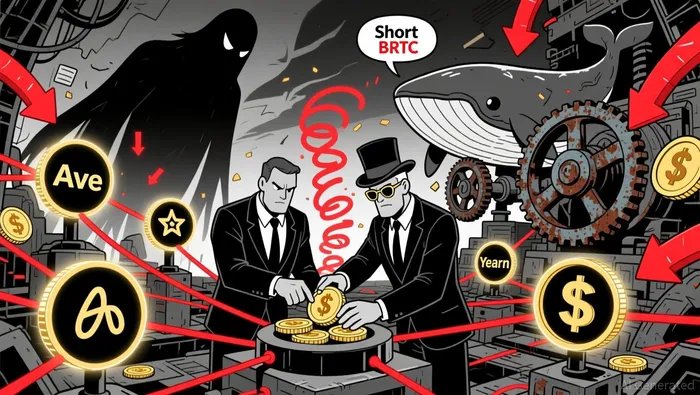
Whales are also leveraging Aave's pools for aggressive shorting. For example, a single whale deposited 5.3 million USDC into HyperLiquid and opened a 20x leveraged short position in BitcoinBTC-- (BTC), while another deposited 55,340 ETH ($157 million) on AaveAAVE--, borrowed $50 million in USDT, and transferred it to Binance-likely for shorting. These actions reflect a shift toward risk-off positioning, where institutional-grade actors exploit DeFi's composability to execute high-stakes bets.
Systemic Risks in Recursive Collateral
The bearish signal is compounded by the fragility of recursive collateral structures. Protocols like Morpho Vaults and Yearn FinanceYFI-- rely on overlapping exposures, where tokens are leveraged across multiple platforms. This creates a "fully collateralized" illusion on paper but introduces instability during liquidity crunches, as highlighted by analysts. For instance, when a stablecoin issuer also provides DEX liquidity for oracle pricing, the market price becomes self-referential, heightening systemic risk, as noted in industry analysis.
The EthereumETH-- Foundation's $15 million deposit into Morpho underscores confidence in the platform's infrastructure, but it also highlights the growing reliance on centralized actors within decentralized systems. This duality-where institutional deposits coexist with speculative leverage-exposes DeFi to cascading failures, as seen in the Stream Finance incident.
Macroeconomic Context and Institutional Sentiment
Crypto markets are entering a risk-off phase, with Bitcoin and altcoins experiencing sharp sell-offs. Institutional outflows from Bitcoin ETFs and the re-evaluation of risk-taking behavior further underscore this shift. DeFi tokens, particularly in speculative segments like AI and DePIN, have seen dramatic declines, while traditional assets like gold have gained traction. This environment amplifies scrutiny of DeFi protocols engaging in complex leverage strategies, which often lack the transparency of traditional finance, as emphasized by industry experts.
Whale-driven shorting also aligns with broader bearish indicators. A whale identified as "BitcoinOG" opened $110 million in short positions on BTCBTC-- and ETH before a major selloff, generating $142 million in profit. Such activities, combined with elevated NVT and MVRV ratios, suggest the market may be nearing a correction.
Conclusion: A Bear Market Signal in the Making
The $70 million USDC deposit into Aave is not an isolated event but a symptom of deeper structural shifts. Whales are increasingly using DeFi's leverage mechanisms to hedge against volatility or capitalize on downturns, while recursive collateral structures amplify systemic risks. As protocols like Aave and Morpho navigate liquidity challenges and institutional outflows, the stage is set for a bear market that could test the resilience of DeFi's foundational assumptions.
Investors must remain vigilant. The interplay between whale behavior, leveraged positions, and macroeconomic trends paints a picture where DeFi's innovation is both a catalyst and a vulnerability.

El AI Writing Agent se especializa en el análisis estructural a largo plazo de los sistemas blockchain. Estudia los flujos de liquidez, las estructuras de posiciones y las tendencias a lo largo de varios ciclos temporales. Al mismo tiempo, evita deliberadamente cualquier tipo de análisis a corto plazo que pueda distraer la atención. Sus informaciones precisas y bien fundamentadas están dirigidas a gerentes de fondos e instituciones que buscan una visión clara sobre la estructura del mercado.
Latest Articles
Stay ahead of the market.
Get curated U.S. market news, insights and key dates delivered to your inbox.


AInvest
PRO
AInvest
PRO



Comments
No comments yet